
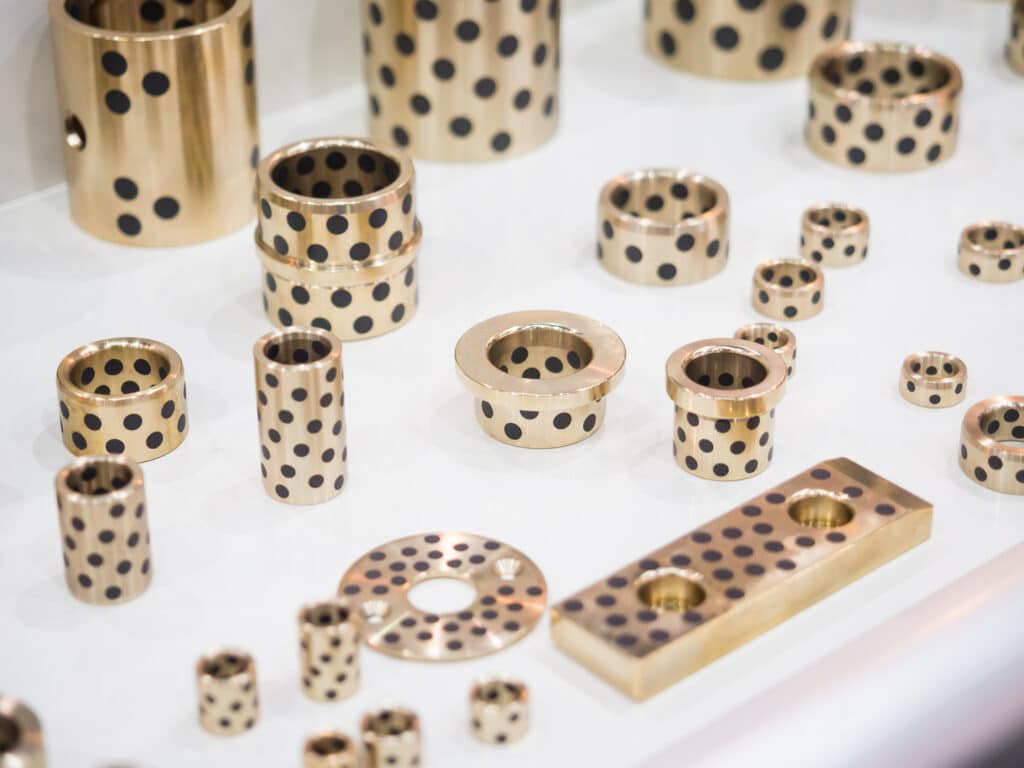
Hochwertige, selbstschmierende Bronze-Graphit-Buchsen sind Gleitlager, die Lasten aufnehmen und die Reibung reduzieren. ohne äußeres Öl oder Fett Die in einen Bronzegusskörper eingebetteten massiven Graphitstopfen übertragen bei Bewegung einen sich selbst erneuernden Schmierfilm auf die Welle. Dadurch eignen sie sich ideal für Lager mit eingeschränkter Wartungszugänglichkeit, bei denen Verunreinigungen vermieden werden müssen oder bei oszillierenden und langsamen Bewegungen ein herkömmlicher Ölfilm nicht ausreichend schmiert. Von Spritzgusswerkzeugen und Stanzwerkzeugen bis hin zu Wasserturbinenführungen und Drehpunkten von Baumaschinen – Graphitstopfen-Bronzebuchsen bieten zuverlässige und wartungsarme Leistung. Dieser Leitfaden behandelt die Metallurgie, die Geometrie der Graphitstopfen, die Last-Drehzahl-Grenzwerte und die Beschaffungskriterien – mit allen Spezifikationen, die Sie für eine präzise Angebotsanfrage benötigen.
TL;DR – Wichtigste Erkenntnisse
- Selbstschmierende Bronze-Graphit-Buchsen kombinieren eine gegossene Bronzematrix (typischerweise C86300, C93200 oder CuAl10Fe) mit eingebetteten Vollgraphitstopfen, die 15–40 % der Lagerfläche.
- Sie sind aktiv ohne äußere Schmierung über einen breiten Temperaturbereich (typischerweise −40 °C bis +300 °C, (höher bei Sonderqualitäten), bei denen Ölfilmlager versagen.
- Die maximale statische Last erreicht 100–250 MPa abhängig von der Bronzesorte; der PV-Grenzwert (Druck × Geschwindigkeit) definiert den sicheren Betriebsbereich.
- Das Graphitstopfenmuster (Durchmesser, Abstand, Prozentsatz) ist auf die Bewegungsart abgestimmt — größere Graphitfläche für oszillierende/langsame Drehzahlen, niedriger für rotierenden Betrieb.
- Die Rückverfolgbarkeit der Materialien wurde mittels OES, dimensionaler CMM-Prüfung und dokumentiertem Cpk überprüft, um OEM-Lieferanten von Herstellern von Standardbuchsen zu trennen.
Was ist eine selbstschmierende Bronze-Graphit-Buchse?
Eine selbstschmierende Bronze-Graphit-Buchse ist ein Gleitlager, das aus einem gegossenen Bronzekörper besteht, in den Vollgraphitstopfen Die Lagerbuchsen sind regelmäßig eingepresst. Beim Drehen oder Gleiten der Welle an der Buchse bildet sich eine dünne Graphitschicht, die einen Trockenschmierfilm erzeugt, der sich durch die eingebetteten Graphitpartikel kontinuierlich erneuert. Im Gegensatz zu ölgetränkter Sinterbronze (die auf ein begrenztes Ölreservoir angewiesen ist) reicht der Graphitvorrat für die gesamte Lebensdauer des Lagers.
Das ingenieurtechnische Prinzip ist Festfilmschmierung. Die geschichtete Kristallstruktur von Graphit lässt sich leicht entlang ihrer Basalebenen abscheren, wodurch reibungsarmes Material auf die Gegenfläche übertragen wird. Dies funktioniert im Vakuum, unter Wasser, bei hohen Temperaturen und unter oszillierender Bewegung – Bedingungen, unter denen herkömmliche flüssige Schmierstoffe versagen.
| Lagertyp | Schmierstoffquelle | Wartung | Bester Zustand |
|---|---|---|---|
| Bronzegraphit (verstopft) | Eingebetteter fester Graphit | Keine (Lebenszeit) | Oszillierend, langsam, hohe Temperatur, verschmutzt |
| Ölimprägnierte Sinterbronze | Endliches Ölreservoir in Poren | Regelmäßiges Nachölen | Kontinuierliche Rotation, mäßige Geschwindigkeit |
| Massive Bronze (gefettet) | Äußeres Fett | Häufiges Nachfetten | Schwere Last mit Wartungszugang |
| Polymerbeschichtet (PTFE) | PTFE-Transferfolie | Keiner | Leichte Beladung, trocken, niedrige Temperatur |
| Wälzlager | Äußeres Öl/Fett | Periodisch | Hohe Geschwindigkeit, geringe Reibung |
KeyFix stellt über seine Firma Bronze-Graphit-Buchsen und andere Präzisionsbauteile her. CNC-Bearbeitungsfähigkeit, Einhaltung enger Toleranzen bei Bohrung und Außendurchmesser für die Presspassung.
Welche Bronzelegierungen werden für Graphitbuchsen verwendet?
Die Bronzematrix trägt die mechanische Belastung; der Graphit dient der Schmierung. Die Legierungswahl zielt auf ein ausgewogenes Verhältnis von Belastbarkeit, Korrosionsbeständigkeit und Kosten ab.
| Bronzelegierung | Bezeichnung | Zugfestigkeit (MPa) | Maximale Belastung (MPa) | Beste Anwendung |
|---|---|---|---|---|
| Hochbleihaltige Zinnbronze | C93200 (SAE 660) | 240 | 100–140 | Universell einsetzbar, mittlere Belastung |
| Manganbronze | C86300 (SAE 430B) | 820 | 200–250 | Hohe Belastung, hohe Festigkeit |
| Aluminiumbronze | CuAl10Fe3 (C95400) | 585 | 180–220 | Korrosion + hohe Belastung, maritime |
| Zinnbronze | C90500 (SAE 62) | 310 | 120–160 | Mittlere Belastung, guter Verschleiß |
| Bronzeguss (CuSn) | CuSn12 | 280 | 110–150 | Allgemeine Industrie |
Manganbronze (C86300) und Aluminiumbronze (CuAl10Fe3) sind die Hochleistungs-Arbeitstiere Ihre hohe Zugfestigkeit ermöglicht es der Buchse, statische Lasten von bis zu 200–250 MPa aufzunehmen und eignet sich daher für Werkzeugsätze, Pressen und schwere Baumaschinen. Für korrosionsgefährdete oder maritime Anwendungen kombiniert Aluminiumbronze hohe Belastbarkeit mit Seewasserbeständigkeit.
💡 Anmerkung des Ingenieurs: Passen Sie die Bronzestufe an die Lastart, Nicht nur die Stärke der Belastung ist entscheidend. Bei stoßbelasteten Anwendungen (Stanzwerkzeuge, Schmiedemaschinen) widersteht Manganbronze (C86300) den Stößen, die weichere Zinnbronze ermüden lassen würden. Bei dauerhaft hohen Belastungen mit Korrosion ist Aluminiumbronze trotz höherer Kosten die technisch bessere Wahl.
Wie beeinflusst die Geometrie des Graphitstopfens die Leistung?
Das Graphitstopfenmuster – Durchmesser, Abstand und prozentualer Oberflächenanteil – ist der entscheidende Einstellparameter. Mehr Graphitfläche bedeutet bessere Schmierung, aber weniger tragende Bronze; weniger Graphit bedeutet höhere Belastbarkeit, aber einen dünneren Schmierfilm.
| Bewegungsart | Empfohlener Graphitbereich | Steckerbelegung | Begründung |
|---|---|---|---|
| Oszillierend / schwingend | 25–40 % | Dichte, große Stopfen | Niedrige Drehzahl führt zu unzureichendem Ölfilm; mehr Festschmierstoff erforderlich. |
| Langsam rotierende | 20–30 % | Mittlere Stecker | Mäßige Nachfrage nach Filmerneuerungen |
| Hochgeschwindigkeitsrotation | 15–25 % | Wenige, kleine Stecker | Geschwindigkeit erzeugt Film; Ladekapazität priorisiert |
| Hin- und hergehende / lineare | 25–35 % | Axiale Stopfenreihen | Lineare Bewegungen benötigen eine kontinuierliche Schmierung entlang des Bewegungsablaufs. |
| Schub-/Axialbelastung | 30–40 % | Radiales Steckerarray | Für den Gesichtskontakt ist eine großflächige Gleitmittelabdeckung erforderlich. |
| Intermittierend / Start-Stopp | 30–40 % | Dichte Stopfen | Häufige Grenzschmierung beginnt |
Der Graphitanteil bestimmt direkt den Reibungskoeffizienten: Typische selbstschmierende Bronze-Graphit-Buchsen erreichen einen dynamischer Reibungskoeffizient von 0,05–0,15 abhängig von Graphitfläche, Belastung und Geschwindigkeit. Ein höherer Graphitanteil verringert die Reibung, reduziert aber die PV-Grenze (Druck-Geschwindigkeits-Grenze).
KeyFix bearbeitet den Bronzekörper und setzt Graphitstopfen nach dem vorgegebenen Muster ein, wobei die Maßgenauigkeit durch seine Inspektionsstandards Programm und Bestätigung der Bronzechemie durch AMETEK OES am eingehenden Material.
Welche Last- und Geschwindigkeitsgrenzen gelten?
Der Betriebsbereich einer selbstschmierenden Buchse wird durch drei Grenzwerte definiert: maximalen statischen Druck, maximale Gleitgeschwindigkeit und den kombinierten PV-Faktor (Druck × Geschwindigkeit). Wird der PV-Grenzwert überschritten, entsteht Wärme schneller, als die Buchse sie abführen kann, was zum Versagen des Graphitfilms führt.
| Parameter | Typischer Bereich | Anmerkungen |
|---|---|---|
| Maximaler statischer Druck (P) | 100–250 MPa | Bronze-Qualitätsabhängig |
| Maximaler dynamischer Druck | 40–100 MPa | Für kontinuierliche Bewegung |
| Maximale Gleitgeschwindigkeit (V) | 0,5–2,5 m/s | Höher bei geringer Auslastung |
| PV-Grenzwert (trocken) | 1,8–3,6 MPa·m/s | Kombinierter Arbeitsbereich |
| Betriebstemperatur | −40 bis +300 °C | Sondersorten bis +600 °C |
| Reibungskoeffizient | 0,05–0,15 | Graphitflächenabhängig |
Die PV-Grenze ist die wichtigste Auslegungsvorgabe. Eine Durchführungsleitung unter hoher Last (hoher P-Wert) muss langsam laufen (niedrige Spannung); eine unter hoher Last (hohe Spannung) muss unter geringer Last laufen (niedriger P-Wert). Die Berechnung des tatsächlichen PV-Werts im Vergleich zur Nenngrenze verhindert den häufigsten Ausfallmechanismus – den thermischen Durchschlag der Graphitschicht.
⚠️ Häufige Fehlerquelle: Die alleinige Auslegung einer selbstschmierenden Buchse auf Basis der Last, ohne Berücksichtigung der Gleitgeschwindigkeit, führt häufig zu einer Überschreitung der zulässigen Tragfähigkeit (PV-Grenze). Eine für eine statische Last von 200 MPa ausgelegte Buchse kann bei hoher Wellendrehzahl bereits bei 60 MPa versagen, da das Produkt aus Tragfähigkeit und Gleitgeschwindigkeit (PV) die thermische Grenze überschreitet. Berechnen Sie daher immer die Tragfähigkeit (PV), nicht nur die Gleitgeschwindigkeit (P).
Welche Formen und Konfigurationen sind verfügbar?
Selbstschmierende Bronze-Graphit-Buchsen werden in verschiedenen Standardgeometrien hergestellt, um unterschiedlichen Montage- und Belastungsrichtungen gerecht zu werden.
| Bilden | Lastrichtung | Typische Anwendung |
|---|---|---|
| Zylindrische Hülse | Radial | Wellenlager, Drehzapfen, Gestänge |
| Flanschhülse | Radial + leichte axiale | Vertikale Schächte, positionierte Lager |
| Druckscheibe | Axial | Drehtische, Rotationstische, axiale Belastungen |
| Verschleißplatte / Gleitplatte | Linear/gleitend | Werkzeugsätze, Maschinenführungen, Führungen |
| Kugellager | Fehlausrichtung | Gelenke, Aufhängung |
| Kundenspezifisch gefertigt | Pro Antrag | Maßgefertigte Geometrie, spezielle Bronze |
KeyFix produziert all diese Formulare für die Bereiche Maschinenbau, Automobilindustrie und Baumaschinen. Portfolio an CNC-Teilen Und Maschinenkomponentenprogramme demonstrieren Sie die Bandbreite der nach Spezifikation gelieferten Präzisionsbronzebauteile.
Wie werden Bronze-Graphit-Buchsen hergestellt?
Die Herstellung umfasst Bronzeguss oder Stangenmaterial, Präzisionsbearbeitung und den Einbau von Graphitstopfen.
| Prozessschritt | Zweck | KeyFix-Funktion |
|---|---|---|
| Bronzebestandsprüfung | Legierungszusammensetzung bestätigen | AMETEK OES zu eingehendem Material |
| CNC-Drehen / -Bohren | Formbohrung, Außendurchmesser, Länge bis zur Toleranz | STS C-Serie + Schweizer Drehmaschinen, ±0,005 mm |
| Graphit-Stopfenbohrung | Bohren Sie die Dübellöcher im Muster | CNC-positionierte Lochreihe |
| Graphitstopfen-Presspassung | Vollgraphitstopfen einsetzen | Kontrollierter Pressvorgang |
| Endbearbeitung | Endgültige Bohrung/Außendurchmesser gemäß Zeichnung | CMM-geprüft auf ±0,001 mm |
| Inspektion | Dreidimensional + visuell | 100 % optische + CMM |
Präzise Bohrungs- und Außendurchmessertoleranzen sind für selbstschmierende Buchsen entscheidend, da diese durch Einpressen in ein Gehäuse montiert werden und auf einer Welle mit definiertem Spiel laufen. KeyFix hält diese Toleranzen durchgängig ein. Präzisionsbearbeitung Leistungsfähigkeit, wobei die Bronzechemie durch die Rohstoff Kontrollprozess.
Benötigen Sie ein Angebot für selbstschmierende Bronze-Graphit-Buchsen? Senden Sie Ihre Zeichnung oder Spezifikation an die KeyFix-Ingenieure – Sie erhalten innerhalb von 48 Stunden eine DFM-Prüfung und ein Angebot. Hier ein Angebot anfordern oder senden Sie eine E-Mail an sales@keyfixpro.com.
Was sollte in einer Buchsenzeichnung angegeben werden?
| Zeichnungsaufruf | Was anzugeben ist | Warum es wichtig ist |
|---|---|---|
| Bronzelegierung | z. B. C86300, CuAl10Fe3 | Antriebsbelastbarkeit, Korrosion |
| Bohrungsdurchmesser + Toleranz | Innendurchmesser mit Passungsklasse | Bestimmt das Wellenspiel |
| Außendurchmesser + Toleranz | Außendurchmesser mit Presspassungszugabe | Gewährleistet den Erhalt von Wohnraum |
| Graphitbereich / -muster | Prozentuale + Steckerbelegung | Reguliert Reibung und PV-Grenze |
| Länge | Gesamtlänge mit ± | Lagerbereich |
| Betriebsdruck, Spannung, Temperatur | Last, Drehzahl, Temperaturbereich | Prüft auf Übereinstimmung mit dem PV-Grenzwert |
| Bilden | Hülse, Flansch, Druckplatte | Definiert Geometrie |
Wie qualifiziert man einen Hersteller von Bronzebuchsen?
| Prüfpunkt | Mindestanforderung | KeyFix-Status |
|---|---|---|
| Qualitätssystem | ISO 9001-Mindeststandard | IATF 16949 + ISO 9001 + ISO 14001 |
| Bronzebearbeitung | CNC-Drehen/Bohren für Bronze | STS C-Serie + Schweizer Drehmaschinen |
| Materialprüfung | OES auf eingehende Bronze | AMETEK OES auf 100 % von Wärmemengen |
| Dimensionskontrolle | Koordinatenmessgerät mit dokumentierter Genauigkeit | CMM bei ±0,001 mm |
| Graphitstopfenverfahren | Gezieltes Schnittmuster + Presspassung | CNC-positioniert, validiert |
| SPC-Implementierung | Cpk ≥ 1,33 auf Bohrung/Außendurchmesser | Cpk ≥ 1,67, Echtzeit-SPC |
| Rückverfolgbarkeit | Pro Charge bis zur Materialwärme | Digitale Rückverfolgbarkeit pro Charge |
Der vertikal integrierte Campus von KeyFix vereint Präzisionsbearbeitung, Kaltumformung, Und Stempeln unter einem einheitlichen IATF 16949-Qualitätssystem – seinem Projektportfolio Und Unternehmenshintergrund Eine Fehlerquote von 0 PPM in über 100 Programmen in mehr als 20 Ländern dokumentieren.
Welche Logistik- und Versandbedingungen gelten?
KeyFix produziert in Huizhou, Guangdong, in der Nähe der Exporthäfen Südchinas.
| Begriff | Detail |
|---|---|
| Produktionsstandort | Huizhou, Provinz Guangdong |
| Standardversandbedingungen | FCA Dongguan |
| Seefrachtbegriff | FOB Hafen Shenzhen Yantian |
| Prototypen-Vorlaufzeit | 7–14 Werktage (Luftfracht-Express) |
| Produktionsvorlaufzeit | 4–6 Wochen nach Musterfreigabe |
Die kurze Inlandstrecke von Huizhou nach Dongguan und zum Hafen Shenzhen Yantian verkürzt die Transitzeit und senkt die Frachtkosten für internationale Käufer.
Häufig gestellte Fragen
Wie lange ist die Lebensdauer von selbstschmierenden Bronze-Graphit-Buchsen?
Da die Graphitversorgung die eingebetteten Stopfen über die gesamte Wandstärke hinweg durchdringt, hält die Schmierung über die gesamte Lebensdauer des Lagers an – es gibt kein Ölreservoir, das sich leeren könnte. Die Lebensdauer hängt von Last, Drehzahl und PV-Faktor ab; innerhalb der Nenn-PV-Grenze erreichen diese Buchsen regelmäßig zehntausende Betriebsstunden wartungsfrei.
Worin besteht der Unterschied zwischen mit Graphit gefüllten und mit Öl imprägnierten Bronzebuchsen?
Graphitverstärkte Bronze nutzt massive Graphitstopfen für eine trockene, dauerhafte Schmierung, die auch bei hohen Temperaturen, im Vakuum, unter Wasser und bei oszillierenden Bewegungen funktioniert. Ölimprägnierte Sinterbronze hingegen basiert auf einem begrenzten Ölreservoir in ihrer porösen Struktur und eignet sich für die kontinuierliche Rotation bei moderaten Drehzahlen, erfordert jedoch Bedingungen, die das Öl im Inneren halten.
Welchem Temperaturbereich können diese Buchsen standhalten?
Standardmäßige selbstschmierende Bronze-Graphit-Buchsen arbeiten in einem Temperaturbereich von etwa −40 °C bis +300 °C. Spezielle Graphitformulierungen und Bronzesorten erweitern die obere Grenze auf +600 °C – weit über den Bereich hinaus, in dem herkömmliche Öl- und Fettschmierstoffe versagen.
Welche Bronzelegierungen verarbeitet KeyFix für die Herstellung von Buchsen?
KeyFix-Maschinen C93200, C86300, C90500, CuAl10Fe3 (Aluminiumbronze) und CuSn12, deren chemische Zusammensetzung von AMETEK OES geprüft wurde. Die Legierungsauswahl wird auf die Belastungsart, die Korrosionsumgebung und die PV-Anforderungen der jeweiligen Anwendung abgestimmt.
Über welche Zertifizierungen verfügt KeyFix?
KeyFix ist nach IATF 16949, ISO 9001 und ISO 14001 zertifiziert. Materialzertifikate, dimensionale CMM-Berichte und PPAP-Level-3-Dokumentation gehören zum Standard für OEM-Programme.
Welche Versandbedingungen gelten für internationale Bestellungen?
Standardversand ist FCA Dongguan, mit Seefracht als FOB Hafen Shenzhen Yantian Aus dem Produktionswerk in Huizhou. Die Auslieferung erfolgt 4–6 Wochen nach Musterfreigabe.
Benötigt Ihr nächstes Projekt hochwertige, selbstschmierende Buchsen aus Bronze-Graphit – ob Hülse, Flansch, Anlaufscheibe oder Sonderanfertigung? Dann senden Sie Ihre Zeichnung an das Ingenieurteam von KeyFix. Wir prüfen Ihre Konstruktionszeichnung kostenlos und erstellen Ihnen innerhalb von 48 Stunden ein Angebot. Entdecken Sie die vollständige Produktpalette. Produktportfolio oder Kontaktieren Sie KeyFix an sales@keyfixpro.com.
Autor: KeyFix-Entwicklungsteam Veröffentlicht: 31. Mai 2026 Letzte Aktualisierung: 31. Mai 2026