
Los casquillos de grafito de bronce autolubricantes de alta calidad son cojinetes lisos que soportan la carga y reducen la fricción. sin aceite ni grasa externos Los tapones de grafito sólido incrustados en un cuerpo de bronce fundido transfieren una película lubricante autorrenovable al eje durante su movimiento. Esto los convierte en el cojinete ideal en aplicaciones donde el acceso para mantenimiento es limitado, se debe evitar la contaminación o donde el movimiento oscilante y a baja velocidad podría agotar la película de aceite convencional. Desde matrices de moldeo por inyección y herramientas de estampado hasta guías de turbinas hidráulicas y pivotes de maquinaria de construcción, los bujes de bronce con tapones de grafito ofrecen un rendimiento predecible y de bajo mantenimiento. Esta guía abarca la metalurgia, la geometría de los tapones de grafito, los límites de carga y velocidad, y los criterios de suministro, con el nivel de detalle necesario para redactar una solicitud de cotización precisa.
TL;DR — Conclusiones clave
- Los casquillos de grafito de bronce autolubricantes combinan una matriz de bronce fundido (típicamente C86300, C93200 o CuAl10Fe) con tapones de grafito sólido incrustados que cubren 15–40 % de la superficie de apoyo.
- Ellos operan sin lubricación externa en un amplio rango de temperaturas (típicamente De -40 °C a +300 °C, más alto para grados especiales), donde fallan los cojinetes de película de aceite.
- Alcance de carga estática máxima 100–250 MPa Dependiendo del grado de bronce, el límite PV (presión × velocidad) define el rango de operación seguro.
- El patrón de tapones de grafito (diámetro, espaciado, porcentaje) está ajustado al tipo de movimiento. Mayor área de grafito para oscilación/baja velocidad, más bajo para servicio rotativo.
- La trazabilidad verificada del material mediante OES, la inspección dimensional con CMM y la documentación del Cpk permiten diferenciar a los proveedores de calidad OEM de los talleres de bujes genéricos.
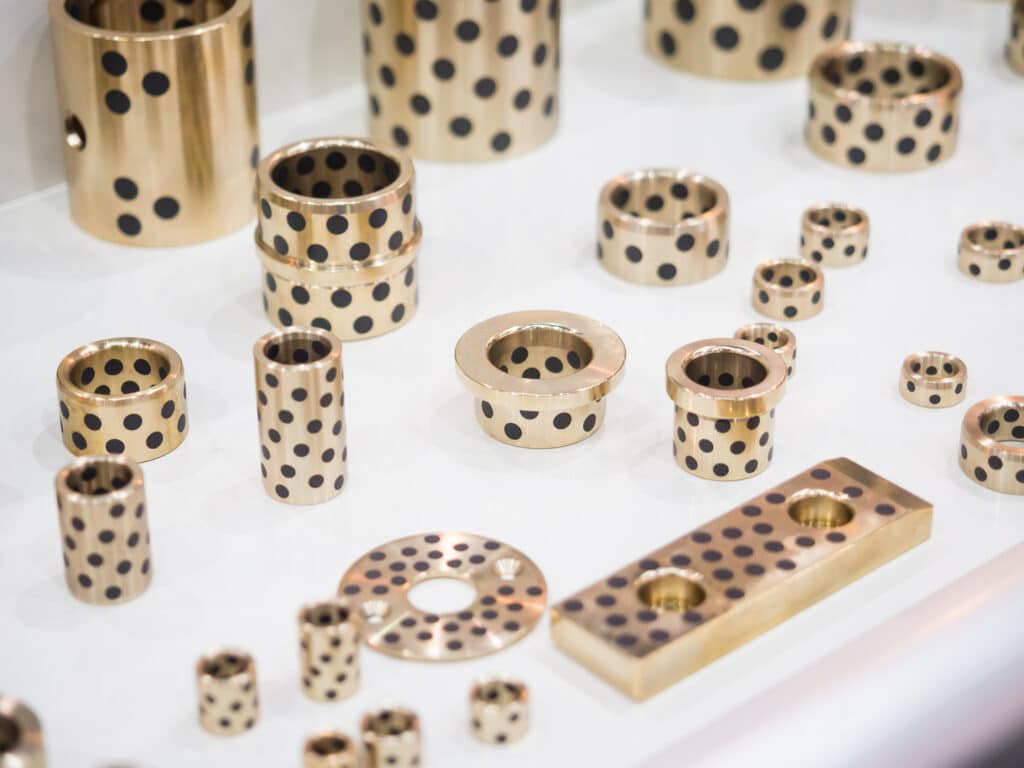
¿Qué es un casquillo de grafito de bronce autolubricante?
Un casquillo de grafito de bronce autolubricante es un cojinete liso hecho de un cuerpo de bronce fundido en el que tapones de grafito sólido Se ajustan a presión siguiendo un patrón regular. A medida que el eje gira o se desliza contra el casquillo, recoge una fina capa de grafito, formando una película lubricante seca que se renueva continuamente gracias a los tapones integrados. A diferencia del bronce sinterizado impregnado en aceite (que depende de un depósito de aceite limitado), el suministro de grafito dura toda la vida útil del cojinete.
El principio de ingeniería es lubricación de película sólida. La estructura cristalina en capas del grafito se corta fácilmente a lo largo de sus planos basales, transfiriendo material de baja fricción a la superficie de contacto. Esto funciona en el vacío, bajo el agua, a altas temperaturas y bajo movimiento oscilatorio, condiciones que impiden el uso de lubricantes líquidos convencionales.
| Tipo de rodamiento | Fuente de lubricación | Mantenimiento | En las mejores condiciones |
|---|---|---|---|
| Grafito de bronce (tapado) | Grafito sólido incrustado | Ninguno (de por vida) | Oscilante, de baja velocidad, de alta temperatura, contaminado |
| Bronce sinterizado impregnado en aceite | Yacimiento de petróleo finito en los poros | Reengrase periódico | Rotación continua, velocidad moderada |
| Bronce macizo (engrasado) | Grasa externa | Reengrasado frecuente | Carga pesada con acceso para mantenimiento |
| Revestido de polímero (PTFE) | Película de transferencia de PTFE | Ninguno | Carga ligera, seca, baja temperatura |
| Rodamiento de elementos rodantes | Aceite/grasa externa | Periódico | Alta velocidad, baja fricción |
KeyFix fabrica bujes de grafito de bronce y otros componentes de precisión a través de su Capacidad de mecanizado CNC, manteniendo tolerancias ajustadas en el diámetro interior y exterior para una instalación a presión.
¿Qué aleaciones de bronce se utilizan para los casquillos de grafito?
La matriz de bronce soporta la carga mecánica; el grafito se encarga de la lubricación. La selección de la aleación busca un equilibrio entre la capacidad de carga, la resistencia a la corrosión y el costo.
| Aleación de bronce | Designación | Tracción (MPa) | Carga máxima (MPa) | Mejor aplicación |
|---|---|---|---|---|
| Bronce de estaño con alto contenido de plomo | C93200 (SAE 660) | 240 | 100–140 | Uso general, carga moderada |
| Bronce de manganeso | C86300 (SAE 430B) | 820 | 200–250 | Carga pesada, alta resistencia |
| Bronce de aluminio | CuAl10Fe3 (C95400) | 585 | 180–220 | Corrosión + alta carga, marina |
| Bronce de estaño | C90500 (SAE 62) | 310 | 120–160 | Carga moderada, buen desgaste |
| Bronce fundido (CuSn) | CuSn12 | 280 | 110–150 | Industria general |
El bronce de manganeso (C86300) y el bronce de aluminio (CuAl10Fe3) son los caballos de batalla de alta carga Su elevada resistencia a la tracción permite que el casquillo soporte cargas estáticas de hasta 200–250 MPa, lo que lo hace idóneo para matrices, prensas y maquinaria pesada de construcción. Para aplicaciones en ambientes corrosivos o marinos, el bronce de aluminio combina una alta capacidad de carga con resistencia al agua de mar.
💡 Nota del ingeniero: Haga coincidir el grado bronce con el tipo de carga, No se trata solo de magnitud. Para aplicaciones sometidas a cargas de impacto (matrices de estampado, equipos de forja), el bronce al manganeso (C86300) resiste el impacto que fatigaría el bronce de estaño, más blando. Para cargas elevadas y constantes con corrosión, el bronce de aluminio es la mejor opción de ingeniería, a pesar de su mayor costo.
¿Cómo afecta la geometría de los tapones de grafito al rendimiento?
El patrón de los tapones de grafito —diámetro, espaciado y porcentaje de superficie— es el parámetro de ajuste clave. Una mayor superficie de grafito implica mayor lubricación, pero menor resistencia del bronce; una menor superficie de grafito implica mayor capacidad de carga, pero una película lubricante más delgada.
| Tipo de movimiento | Área de grafito recomendada | Patrón de enchufe | Razón fundamental |
|---|---|---|---|
| Oscilante / oscilante | 25–40 % | Tapones densos y grandes | La baja velocidad reduce la película de aceite; necesita un lubricante más sólido. |
| Rotación a baja velocidad | 20–30 % | Tapones medianos | Demanda moderada de renovación de películas |
| Rotación de alta velocidad | 15–25 % | Tapones pequeños y escasos | La velocidad genera película; se prioriza la capacidad de carga. |
| Alternativo/lineal | 25–35 % | filas de tapones axiales | El movimiento lineal requiere lubricación continua a lo largo del recorrido. |
| Carga axial/empuje | 30–40 % | Conjunto de enchufes radiales | El contacto facial requiere una amplia cobertura de lubricante. |
| Intermitente / arranque-parada | 30–40 % | Tapones densos | Inicios frecuentes de lubricación límite |
El porcentaje de cobertura de grafito rige directamente el coeficiente de fricción: los típicos bujes de grafito de bronce autolubricantes logran un coeficiente de fricción dinámica de 0,05–0,15 Dependiendo del área de grafito, la carga y la velocidad. Un mayor porcentaje de grafito reduce la fricción, pero disminuye el límite PV (presión-velocidad).
KeyFix mecaniza el cuerpo de bronce e instala tapones de grafito según el patrón especificado, verificando la precisión dimensional a través de su normas de inspección programa y confirmación de la composición química del bronce mediante AMETEK OES en el material entrante.
¿Cuáles son los límites de carga y velocidad?
El rango de operación de un buje autolubricante está definido por tres límites: presión estática máxima, velocidad de deslizamiento máxima y el factor PV combinado (presión × velocidad). Superar el límite PV genera calor más rápido de lo que el buje puede disiparlo, lo que provoca la ruptura de la película de grafito.
| Parámetro | Rango típico | Notas |
|---|---|---|
| Presión estática máxima (P) | 100–250 MPa | Dependencia del grado bronce |
| Presión dinámica máxima | 40–100 MPa | Para movimiento continuo |
| Velocidad máxima de deslizamiento (V) | 0,5–2,5 m/s | Mayor para servicio de baja carga |
| Límite de PV (seco) | 1,8–3,6 MPa·m/s | Envolvente operativa combinada |
| Temperatura de funcionamiento | −40 a +300 °C | Grados especiales hasta +600 °C |
| Coeficiente de fricción | 0,05–0,15 | Dependencia del área de grafito |
El límite de PV es la restricción de diseño más importante. Un buje que soporta una carga elevada (alta P) debe funcionar lentamente (baja V); uno que funciona rápidamente (alta V) debe soportar una carga ligera (baja P). Calcular el valor real de PV en función del límite nominal evita el modo de fallo más común: la ruptura térmica de la película de grafito.
⚠️ Error común: Especificar un buje autolubricante basándose únicamente en la carga, sin comprobar la velocidad de deslizamiento, suele llevar el diseño más allá de su límite PV. Un buje con una carga estática nominal de 200 MPa puede fallar a tan solo 60 MPa si la velocidad del eje es alta, debido a que el producto PV excede el límite térmico. Siempre calcule PV, no solo P.
¿Qué formularios y configuraciones están disponibles?
Los casquillos de grafito de bronce autolubricantes se fabrican en varias geometrías estándar para adaptarse a diferentes direcciones de montaje y carga.
| Forma | Dirección de la carga | Aplicación típica |
|---|---|---|
| Manguito cilíndrico | Radial | Cojinetes de eje, pasadores de pivote, articulaciones |
| Manguito con brida | Radial + axial ligero | Ejes verticales, cojinetes ubicados |
| Arandela de empuje | Axial | Plataformas giratorias, mesas rotatorias, cargas axiales |
| Placa de desgaste / placa deslizante | Lineal/deslizante | Juegos de matrices, guías de máquina, guías |
| Rodamiento esférico | Desalineación | Articulaciones, suspensión |
| mecanizado a medida | Por solicitud | Geometría a medida, bronce especial |
KeyFix produce todos estos formularios en los sectores de maquinaria, automoción y equipos pesados; Catálogo de piezas CNC y programas de componentes de maquinaria Demostrar la gama de componentes de bronce de precisión entregados según las especificaciones.
¿Cómo se fabrican los casquillos de grafito de bronce?
El proceso de producción combina la fundición de bronce o el uso de barras de material, el mecanizado de precisión y la instalación de tapones de grafito.
| Paso del proceso | Objetivo | Capacidad de reparación de llaves |
|---|---|---|
| Verificación de existencias de bronce | Confirmar la composición química de la aleación. | AMETEK OES sobre el material entrante |
| Torneado/mandrinado CNC | Forma del orificio, diámetro exterior, longitud a tolerancia | Tornos STS serie C + tipo suizo, ±0,005 mm |
| Perforación con tapón de grafito | Perfore agujeros para tapones siguiendo el patrón | Matriz de orificios posicionados mediante CNC |
| Tapón de grafito de ajuste a presión | Instale tapones de grafito macizo. | Proceso de prensado controlado |
| Acabado del mecanizado | Diámetro exterior final para imprimir | Verificado mediante CMM con una precisión de ±0,001 mm. |
| Inspección | Dimensional + visual | 100 % óptico + CMM |
Las tolerancias de precisión del diámetro interior y exterior son fundamentales para los casquillos autolubricantes, ya que se instalan mediante ajuste a presión en una carcasa y funcionan sobre un eje con una holgura controlada. KeyFix mantiene estas tolerancias a través de su mecanizado de precisión capacidad, con química de bronce verificada a través de la materia prima proceso de control.
¿Necesita un presupuesto para casquillos de grafito de bronce autolubricantes? Envíe su plano o especificación a los ingenieros de KeyFix; recibirá una revisión DFM y un presupuesto en un plazo de 48 horas. Obtén un presupuesto aquí o envíe un correo electrónico a sales@keyfixpro.com.
¿Qué información se debe especificar en el plano de un buje?
| Convocatoria para sorteo | Qué especificar | Por qué es importante |
|---|---|---|
| Aleación de bronce | p. ej., C86300, CuAl10Fe3 | Capacidad de carga de accionamiento, corrosión |
| Diámetro del orificio + tolerancia | Diámetro interior con clase de ajuste | Determina la holgura del eje |
| Diámetro exterior + tolerancia | Diámetro exterior con tolerancia de ajuste a presión | Garantiza la retención de viviendas |
| Área/patrón de grafito | Porcentaje + disposición de los enchufes | Ajusta la fricción y el límite PV |
| Longitud | Longitud total con ± | Área de apoyo de los conjuntos |
| P, V, temperatura de funcionamiento | Carga, velocidad, rango de temperatura | Valida contra el límite de PV |
| Forma | Manguito, bridado, empuje, placa | Define la geometría |
¿Cómo se selecciona a un fabricante de bujes de bronce?
| Punto de auditoría | Requisito mínimo | Estado de la corrección de claves |
|---|---|---|
| Sistema de calidad | ISO 9001 mínimo | IATF 16949 + ISO 9001 + ISO 14001 |
| Mecanizado de bronce | Torneado/mandrinado CNC para bronce | Serie C de STS + Tornos suizos |
| Verificación de materiales | OES sobre el bronce entrante | AMETEK OES en 100 % de calores |
| Control dimensional | Máquina de medición por coordenadas (CMM) con precisión documentada | CMM con una precisión de ±0,001 mm |
| Proceso de tapones de grafito | Patrón controlado + ajuste a presión | Posicionado por CNC, validado |
| Implementación de SPC | Cpk ≥ 1,33 en diámetro interior/exterior | Cpk ≥ 1,67, SPC en tiempo real |
| Trazabilidad | Por lote a calor del material | Trazabilidad digital por lote |
El campus integrado verticalmente de KeyFix combina mecanizado de precisión, forjado en frío, y estampado bajo un único sistema de calidad IATF 16949 — su cartera de proyectos y Antecedentes de la empresa Documentar un historial de defectos de 0 PPM en más de 100 programas en más de 20 países.
¿Cuáles son los términos de logística y envío?
KeyFix fabrica sus productos en Huizhou, Guangdong, cerca de los puertos de exportación del sur de China.
| Término | Detalle |
|---|---|
| Ubicación de fabricación | Huizhou, provincia de Guangdong |
| Términos de envío estándar | FCA Dongguan |
| término de flete marítimo | FOB Puerto de Shenzhen Yantian |
| Plazo de entrega del prototipo | 7-14 días hábiles (envío aéreo exprés) |
| Plazo de entrega de producción | De 4 a 6 semanas después de la aprobación de la muestra. |
El corto trayecto terrestre desde Huizhou hasta Dongguan y el puerto de Shenzhen Yantian reduce el tiempo de tránsito y el coste del flete para los compradores internacionales.
Preguntas frecuentes
¿Cuánto duran los casquillos de grafito de bronce autolubricantes?
Gracias a que el grafito se distribuye por todo el espesor de la pared a través de los tapones integrados, la lubricación dura toda la vida útil del rodamiento; no hay depósito de aceite que se agote. La vida útil depende de la carga, la velocidad y el factor PV; dentro del límite PV nominal, estos casquillos ofrecen habitualmente decenas de miles de horas de funcionamiento sin necesidad de mantenimiento.
¿Cuál es la diferencia entre los casquillos de bronce con tapones de grafito y los impregnados de aceite?
El bronce con tapones de grafito utiliza tapones de grafito sólido para una lubricación seca y duradera que funciona a altas temperaturas, en vacío, bajo el agua y en movimientos oscilantes. El bronce sinterizado impregnado en aceite se basa en un depósito de aceite limitado en su estructura porosa, adecuado para la rotación continua a velocidad moderada, pero que requiere condiciones que retengan el aceite.
¿Qué rango de temperaturas pueden soportar estos casquillos?
Los casquillos de grafito de bronce autolubricantes estándar funcionan aproximadamente entre -40 °C y +300 °C. Las formulaciones especiales de grafito y los grados de bronce extienden el límite superior hasta +600 °C, muy por encima del rango en el que se degradan los lubricantes convencionales de aceite y grasa.
¿Qué aleaciones de bronce mecaniza KeyFix para los casquillos?
Las máquinas KeyFix utilizan aleaciones C93200, C86300, C90500, CuAl10Fe3 (bronce de aluminio) y CuSn12, con composición química verificada por AMETEK OES. La selección de la aleación se adapta al tipo de carga, el entorno corrosivo y los requisitos de PV de la aplicación.
¿Qué certificaciones posee KeyFix?
KeyFix cuenta con las certificaciones IATF 16949, ISO 9001 e ISO 14001. Los certificados de materiales, los informes dimensionales de CMM y la documentación PPAP Nivel 3 son estándar para los programas OEM.
¿Qué condiciones de envío se aplican a los pedidos internacionales?
El envío estándar es FCA Dongguan, con flete marítimo como FOB Puerto de Shenzhen Yantian Desde la planta de producción de Huizhou. Los envíos se realizan entre 4 y 6 semanas después de la aprobación de la muestra.
Si su próximo proyecto requiere bujes de grafito de bronce autolubricantes de alta calidad (manguitos, bridados, arandelas de empuje o geometría personalizada), envíe su dibujo al equipo de ingeniería de KeyFix para obtener una revisión DFM gratuita y un presupuesto en 48 horas. Explore la gama completa cartera de productos o Contacta con KeyFix en sales@keyfixpro.com.
Autor: Equipo de ingeniería de KeyFix Publicado: 31 de mayo de 2026 Última actualización: 31 de mayo de 2026