
Las piezas mecanizadas por CNC de aluminio de 5 ejes y las piezas torneadas por CNC abarcan los dos procesos complementarios que sustentan la mayoría de los componentes de aluminio de precisión: el fresado de geometrías 3D complejas en una sola operación y el torneado de piezas con simetría rotacional a alta velocidad. Para los compradores que buscan carcasas, soportes, ejes, colectores o monturas ópticas de aluminio, la elección entre el mecanizado de 5 ejes y el torneado CNC (o una combinación de ambos) determina la tolerancia, el acabado superficial, el plazo de entrega y el coste unitario. Esta guía explica la lógica de ingeniería, el comportamiento del material, la filosofía de tolerancia y los criterios de abastecimiento, con el nivel de detalle necesario para redactar una solicitud de cotización precisa.
TL;DR — Conclusiones clave
- El mecanizado de 5 ejes sujeta la pieza de trabajo en una configuración mientras se aproxima desde cinco direcciones, eliminando los errores de reposicionamiento que se acumulan en múltiples configuraciones de 3 ejes.
- El torneado CNC es el campeón de la productividad para piezas redondas (ejes, bujes, pasadores), alcanzando ±0,005 mm en diámetros con tornos tipo suizo.
- El aluminio 6061-T6 y el 7075-T6 dominan el trabajo de aluminio CNC; el 6061 equilibra el costo y la maquinabilidad, el 7075 ofrece resistencia de grado aeroespacial a un costo mayor.
- Las piezas de aluminio de 5 ejes logran ±0,01 mm en superficies contorneadas complejas; las piezas de aluminio torneadas alcanzan ±0,005 mm en diámetros críticos.
- La trazabilidad verificada de los materiales mediante OES, la inspección CMM y la documentación de Cpk permiten diferenciar a los proveedores de grado OEM de los talleres de producción de materias primas.
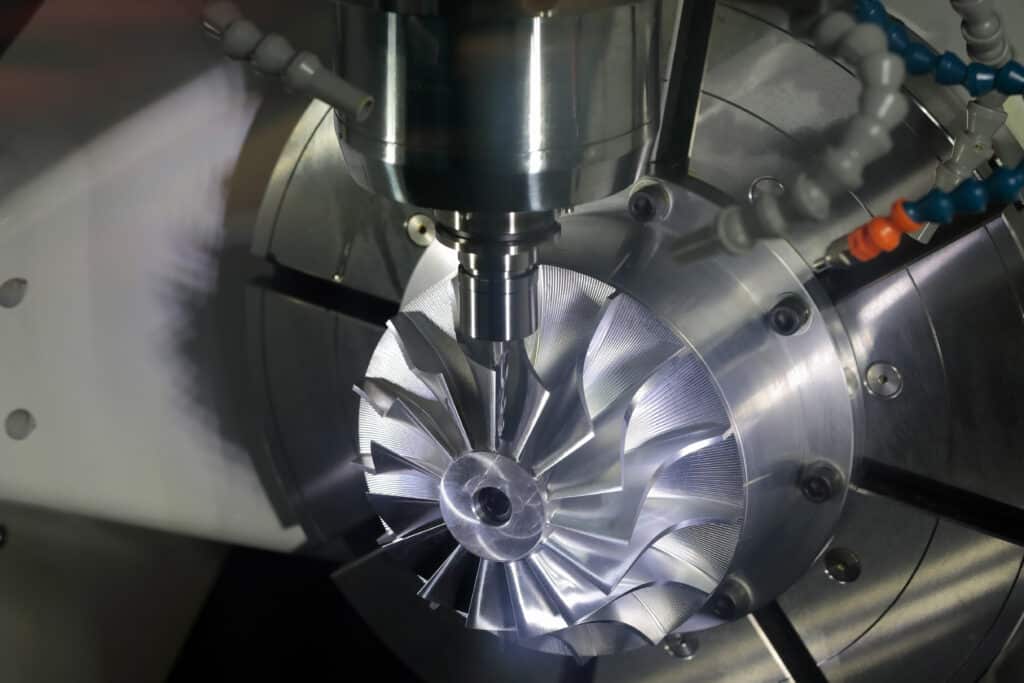
¿Cuál es la diferencia entre el mecanizado de 5 ejes y el torneado CNC?
Los dos procesos resuelven problemas geométricos diferentes. Mecanizado de 5 ejes Mueve una herramienta de corte alrededor de una pieza de trabajo estacionaria o giratoria a lo largo de cinco ejes: tres lineales (X, Y, Z) más dos rotatorios (normalmente A y C). Esto permite que la herramienta alcance socavados, salientes angulares y superficies contorneadas. sin volver a instalar. Torneado CNC Hace girar la pieza de trabajo contra una herramienta de corte fija, lo que resulta ideal para cualquier pieza con simetría rotacional.
| Atributo | Mecanizado de 5 ejes | Torneado CNC |
|---|---|---|
| Mejor geometría | Contornos 3D complejos, socavados, características angulares | Piezas redondas: ejes, casquillos, pasadores, accesorios |
| Número de configuraciones | Una (fijación individual) | Uno a dos |
| Tolerancia (aluminio) | ±0,01 mm en los contornos | ±0,005 mm en diámetros |
| Acabado superficial (Ra) | 0,4–1,6 μm | 0,4–1,6 μm |
| Punto óptimo de volumen | 1–2.000 piezas | 50–1.000.000+ piezas |
| Tiempo de ciclo | Más largo (interpolación multieje) | Corto (alta velocidad del husillo) |
| Índice de costos típico | 2.0× | 0,6–1,0× |
Muchos componentes reales necesitan ambos. Un eje de aluminio torneado con una superficie plana fresada y un orificio transversal comienza en un torno y termina en una fresadora, o se procesa en un centro de torneado-fresado que combina ambos en una sola máquina. Capacidad de mecanizado CNC Cubre ambos extremos de este espectro, operando centros de mecanizado de 5 ejes de la serie C de STS junto con equipos de torneado de tipo suizo bajo un mismo techo.
💡 Nota del ingeniero: Si su pieza es redonda con algunas características fuera del eje, especifique una Torno fresador-torneador (con herramientas motorizadas) En lugar de realizar operaciones de torneado y fresado por separado, el torneado-fresado las integra en una sola configuración, eliminando el error de reajuste que reduce la tolerancia de posición entre las piezas torneadas y fresadas.
¿Por qué elegir aluminio para piezas mecanizadas por CNC?
El aluminio es el metal más mecanizado en la fabricación de precisión por cuatro razones: maquinabilidad, peso, conductividad y resistencia a la corrosión.
Maquinabilidad — El aluminio se corta más rápido que el acero, el acero inoxidable o el titanio, con un índice de maquinabilidad de alrededor de 70–90 % de latón de fácil mecanizado. Mayores velocidades de corte implican ciclos de producción más cortos y menores costes por pieza.
Peso - En 2,70 g/cm³, el aluminio es aproximadamente un tercio de la densidad del acero, lo que lo convierte en la opción por defecto para componentes aeroespaciales, automotrices y robóticos donde el peso es un factor crítico.
Conductividad térmica y eléctrica — La alta conductividad del aluminio lo hace adecuado para disipadores de calor, carcasas electrónicas y cubiertas de radiofrecuencia.
Resistencia a la corrosión — El aluminio forma una capa de óxido autoprotectora; el anodizado la mejora aún más para su uso en exteriores y en entornos marinos.
| Aleación de aluminio | Límite elástico (MPa) | Maquinabilidad | Corrosión | Mejor aplicación |
|---|---|---|---|---|
| 6061-T6 | 276 | Excelente | Bueno (el anodizado mejora) | Soportes, carcasas y placas de uso general |
| 7075-T6 | 503 | Bien | Moderado (se requiere anodizado) | Piezas estructurales aeroespaciales sometidas a altas tensiones. |
| 2024-T3 | 345 | Bien | Moderado | Accesorios para aeronaves, piezas críticas para la fatiga |
| 5052-H32 | 193 | Bueno (gomoso) | Excelente (marino) | Cajas de chapa, herrajes marinos |
| 6063-T5 | 145 | Excelente | Bien | Perfiles extruidos, arquitectónicos |
Para la mayoría de las piezas mecanizadas por CNC de aluminio de 5 ejes y piezas torneadas por CNC, 6061-T6 es el valor predeterminado del volumen — Equilibra el costo, la maquinabilidad y el rendimiento mecánico. El 7075-T6 está reservado para aplicaciones donde la relación resistencia-peso es primordial y el mayor costo del material está justificado.
¿Qué tolerancias puede alcanzar el mecanizado de aluminio de 5 ejes?
La capacidad de tolerancia influye en el costo más que cualquier otra especificación. El principio es el siguiente: Especifique la tolerancia que requiere su función, no la tolerancia máxima que la máquina puede soportar.
| Clase de tolerancia | Valor (mm) | Multiplicador de costos | Método de inspección | Aplicación de aluminio |
|---|---|---|---|---|
| General (ISO 2768-m) | ±0,10–0,20 | 1.0× | Calibrar | Corchetes no críticos |
| Fino (ISO 2768-f) | ±0,05–0,10 | 1.3× | Micrómetro, medidor de altura | Interfaces de montaje |
| Precisión | ±0,02–0,05 | 1.8× | Indicador de cuadrante, CMM | Ajuste de cojinetes, alineación |
| Alta precisión | ±0,01–0,02 | 2,5× | CMM | Monturas ópticas, caras de sellado |
| Ultra precisión | ±0,005–0,01 | 4.0× | Máquina de medición por coordenadas (CMM), con control de temperatura. | Herramientas para semiconductores |
Un dibujo de aluminio bien especificado identifica algunas características críticas con tolerancias estrictas y permite tolerancias generales en otros lugares, reduciendo el tiempo de inspección en 40–60 % sin comprometer la función. KeyFix verifica las características críticas contra la medición de CMM en ±0,001 mm precisión, con documentación completa de inspección del primer artículo a través de su normas de control de calidad e inspección programa.
⚠️ Error común: Aplicar una tolerancia uniforme de ±0,01 mm a todas las dimensiones de una pieza de aluminio —incluidas las características no funcionales— puede duplicar el coste de inspección y triplicar el índice de desperdicio. Reserve las tolerancias de ultraprecisión para las 3 a 8 características que realmente las requieren.
¿Qué acabados y tratamientos superficiales se aplican a las piezas de aluminio mecanizadas por CNC?
Las piezas de aluminio mecanizadas por CNC suelen requerir un tratamiento superficial para protegerlas de la corrosión, mejorar su resistencia al desgaste, sus propiedades eléctricas o su apariencia. La capa de óxido natural protege el aluminio en bruto, pero los acabados especiales prolongan significativamente su vida útil.
| Tratamiento | Espesor (μm) | Propiedad clave | Apariencia | Mejor uso |
|---|---|---|---|---|
| Anodizado tipo II | 5–25 | Corrosión + color | Transparente o teñido | Para interiores y exteriores, decorativo |
| Anodizado duro tipo III | 25–75 | Resistencia al desgaste (más de 400 HV) | De gris a negro | De alta resistencia al desgaste, industrial |
| Conversión de cromato (Alodine) | 0,5–4 | Conductividad eléctrica + corrosión | Oro o transparente | Conexión a tierra, carcasas de RF |
| Granallado con perlas | Textura de la superficie | Mate uniforme | Gris satinado | preparación cosmética |
| Recubrimiento en polvo | 60–120 | Corrosión + color | Cualquier color RAL | Recintos exteriores |
| Cepillado + Anodizado transparente | 8–15 | Estética premium | Metálico cepillado | Productos de consumo |
KeyFix coordina el anodizado, la conversión de cromato y el recubrimiento en polvo a través de socios de acabado calificados, mientras que opera internamente líneas de zinc-níquel y DACROMET para componentes de acero, detallado en su materia prima y tratamiento de superficies página.
¿Cómo se fabrican las piezas de aluminio de 5 ejes y las piezas torneadas por CNC?
La ruta de producción depende de la geometría, el volumen y la tolerancia. La siguiente tabla relaciona el proceso con el tipo de pieza.
| Proceso | Mejor para | Volumen | Tolerancia | Capacidad de reparación de llaves |
|---|---|---|---|---|
| Fresado simultáneo de 5 ejes | Impulsores, carcasas contorneadas, socavados | 1–2.000 | ±0,01 mm | Centros de 5 ejes de la serie C de STS |
| Fresado posicional 3+2 | Agujeros angulares, piezas prismáticas multifacéticas | 1–5.000 | ±0,02 mm | 5 ejes en modo posicional |
| Torneado CNC (2 ejes) | Ejes, casquillos, piezas redondas simples | 50–100.000 | ±0,02 mm | Tornos tipo suizo y de mandril |
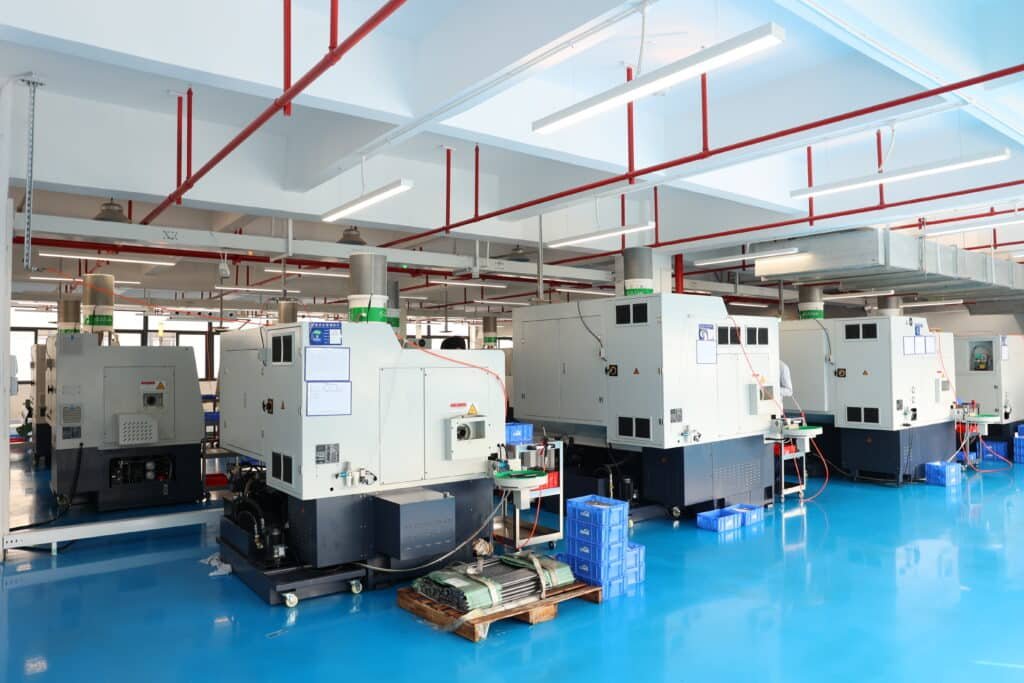
| Torneado tipo suizo | Piezas pequeñas y delgadas de precisión (≤32 mm) | 500–1.000.000+ | ±0,005 mm | Tornos suizos controlados por SYNTEC |
| Torneado-fresado (herramientas motorizadas) | Piezas redondas con características fuera del eje | 50–50.000 | ±0,01 mm | Celdas combinadas de torneado y fresado |
KeyFix utiliza centros de mecanizado de 5 ejes de la serie C de STS con Velocidad del husillo de 4000 rpm, precisión de ±0,005 mm y recorrido del eje Z de 250 mm., manejando componentes complejos de Φ35–Φ71 a través de un sistema CNC SYNTEC. Este perfil de equipo, explicado en detalle en el tecnología de mecanizado Descripción general: abarca desde prototipos de carcasas de aluminio de 5 ejes hasta series de producción torneadas de gran volumen.
¿Necesita un presupuesto para piezas de aluminio mecanizadas en 5 ejes o piezas torneadas por CNC? Envíe su archivo STEP o plano a los ingenieros de KeyFix; recibirá una revisión DFM y un presupuesto en un plazo de 48 horas. Obtén un presupuesto aquí o envíe un correo electrónico a sales@keyfixpro.com.
¿Qué información se debe especificar en un plano CNC de aluminio?
Un dibujo completo evita las idas y venidas que retrasan los presupuestos y aumentan las tasas de rechazo.
| Convocatoria para sorteo | Qué especificar | Por qué es importante |
|---|---|---|
| Aleación y temple | p. ej., 6061-T6, 7075-T6 | Impulsa la resistencia, la maquinabilidad y el costo. |
| Tolerancias críticas | Características específicas (por ejemplo, diámetro de ±0,01 mm) | Los controles se ajustan y funcionan correctamente. |
| Acabado superficial (Ra) | Por superficie (por ejemplo, cara de sellado Ra 0,8 μm) | Costo de acabado de los motores |
| Tratamiento de superficies | Tipo, grosor, áreas de enmascaramiento | Define la corrosión + apariencia |
| Llamadas de subprocesos | Roscas estándar ISO/UNC | Evita el recargo por herramientas especiales. |
| condición de borde | Desbarbado, chaflán, especificación de radio | Afecta a la seguridad en la manipulación y al montaje. |
| Certificación de materiales | Certificado de fábrica, RoHS/REACH si es necesario | Requerido para industrias reguladas |
KeyFix mecaniza piezas de aluminio para los sectores automotriz, aeroespacial, electrónico y de maquinaria. Programas de componentes y sujetadores para automóviles y componentes ligeros para competición Demostrar la variedad de trabajos en aluminio realizados según las especificaciones del fabricante original.
¿Cómo se califica a un fabricante de máquinas CNC de aluminio de 5 ejes?
Para obtener piezas de aluminio de precisión es necesario verificar tanto los equipos como los sistemas de calidad.
| Punto de auditoría | Requisito mínimo | Estado de la corrección de claves |
|---|---|---|
| Sistema de calidad | ISO 9001 mínimo | IATF 16949 + ISO 9001 + ISO 14001 |
| Equipo de 5 ejes | Centros multieje modernos | Control SYNTEC de 5 ejes de la serie C de STS |
| Verificación de materiales | OES en aluminio entrante | AMETEK OES en 100 % de calores |
| Control dimensional | Máquina de medición por coordenadas (CMM) con precisión documentada | Máquina de medición por coordenadas (CMM) con precisión de ±0,001 mm y control de temperatura. |
| Pruebas de acabado superficial | Perfilómetro | medidores de rugosidad digitales |
| Implementación de SPC | Cpk ≥ 1,33 en dimensiones críticas | Cpk ≥ 1,67, SPC en tiempo real |
| El primer artículo informa | Diseño dimensional completo | Capacidad AS9102 / PPAP Nivel 3 |
| Trazabilidad | Por lote a calor del material | Trazabilidad digital por lote |
El campus integrado verticalmente de KeyFix combina Mecanizado CNC de 5 ejes, forjado en frío, y estampado de precisión Bajo un único sistema de calidad IATF 16949, se mantiene un registro documentado de 0 defectos por millón de partes (PPM) en más de 100 programas en más de 20 países.
¿Cuáles son los términos de logística y envío?
| Término | Detalle |
|---|---|
| Ubicación de fabricación | Huizhou, provincia de Guangdong |
| Términos de envío estándar | FCA Dongguan |
| término de flete marítimo | FOB Puerto de Shenzhen Yantian |
| Plazo de entrega del prototipo | 7-14 días hábiles (envío aéreo exprés) |
| Plazo de entrega de producción | De 4 a 6 semanas después de la aprobación del PPAP |
La proximidad de la base de producción de Huizhou a Dongguan y al puerto de Shenzhen Yantian agiliza la logística de exportación: las piezas de aluminio terminadas se trasladan desde el mecanizado hasta el puerto en un corto trayecto por tierra, lo que reduce el tiempo de tránsito y el coste del flete para los compradores internacionales.
Preguntas frecuentes
¿Cuál es la cantidad mínima de pedido para piezas de aluminio mecanizadas por CNC de 5 ejes?
Las cantidades de prototipos comienzan en 10 piezas para piezas de aluminio mecanizadas por CNC, con plazos de entrega de 7 a 14 días por vía aérea. Los volúmenes de producción se escalan eficientemente desde 100 piezas con precios escalonados para cantidades de 1000, 10 000 y más de 100 000 unidades. La producción de torneado tipo suizo es más rentable a partir de 10 000 piezas.
¿Qué certificaciones posee KeyFix en mecanizado CNC?
KeyFix tiene IATF 16949, ISO 9001, y ISO 14001 Certificaciones. Los informes completos de inspección del primer artículo, los certificados de materiales y la documentación PPAP Nivel 3 son estándar para los programas OEM. El sistema de calidad completo se detalla en el normas de inspección documentación.
¿Puede KeyFix mecanizar piezas de aluminio tanto fresadas en 5 ejes como torneadas por CNC?
Sí. KeyFix utiliza centros de mecanizado STS serie C de 5 ejes para piezas con contornos complejos y tornos tipo suizo para componentes torneados de precisión, además de celdas de torneado-fresado para piezas redondas con características fuera del eje. Esta combinación permite cubrir todo el espectro geométrico con un solo proveedor.
¿Qué aleaciones de aluminio mecaniza KeyFix?
KeyFix Las máquinas procesan aleaciones de aluminio 6061-T6, 7075-T6, 2024-T3, 5052-H32 y 6063-T5, con material de entrada verificado por AMETEK OES. Se atienden solicitudes de aleaciones personalizadas con certificación del fabricante.
¿Qué plazos de entrega y condiciones de envío se aplican?
El tiempo de entrega del prototipo es de 7 a 14 días hábiles; los lotes de producción se envían de 4 a 6 semanas después de la aprobación PPAP. El envío estándar es FCA Dongguan, con flete marítimo como FOB Puerto de Shenzhen Yantian desde la base de producción de Huizhou.
¿Cómo garantiza KeyFix la precisión dimensional en piezas de aluminio de 5 ejes?
Mediante inspección CMM en ±0,001 mm Precisión en una sala de metrología con temperatura controlada, combinada con monitorización SPC en tiempo real con el objetivo de alcanzar un Cpk ≥ 1,67 en las dimensiones críticas. Cada nuevo número de pieza recibe un informe documentado de la primera inspección.
Si su próximo proyecto requiere piezas mecanizadas por CNC de aluminio de 5 ejes o piezas torneadas por CNC (carcasas, soportes, ejes, colectores o componentes de precisión), envíe su dibujo o archivo STEP al equipo de ingeniería de KeyFix para obtener una revisión DFM gratuita y un presupuesto en 48 horas. Explore la gama completa de productos. cartera de productos o Contacta con KeyFix en sales@keyfixpro.com.
Autor: Equipo de ingeniería de KeyFix Publicado: 31 de mayo de 2026 Última actualización: 31 de mayo de 2026