Introduction: Where Grams Become Seconds
Automotive racing screws occupy a unique engineering niche where every fastener must justify its mass on the vehicle. In professional motorsport, telemetry data consistently shows that a 1 kg reduction in rotating and unsprung mass correlates with 0.03–0.05 seconds per lap on a typical 2 km circuit. Across a full race distance, systematically replacing steel hardware with purpose-engineered lightweight automotive racing screws can separate podium finishes from mid-pack results.
Yet weight reduction alone does not define a competent racing fastener. Each motorsport discipline subjects hardware to radically different thermal loading, vibrational frequency, and peak mechanical stress. This guide maps the specific demands of six major racing categories to quantified fastener specifications, enabling race engineers to select automotive racing screws that deliver measurable gains without engineering risk.
Thermal-Mechanical Load Profiles Across Racing Disciplines
The starting point for any automotive racing screw specification is the operating environment. The table below profiles six mainstream competition formats by their dominant stress vectors, providing the engineering context that governs material, coating, and thread-design decisions downstream.
| Racing Discipline | Peak Sustained Temperature | Dominant Vibration Band | Maximum Lateral G-Load | Primary Corrosive Agent | Typical Race Duration |
|---|---|---|---|---|---|
| Formula / Open-Wheel | 650 °C (exhaust zone) | 150–400 Hz (engine harmonics) | 4.5–6.0 G | Brake dust, coolant mist | 60–90 min |
| GT / Sports Car Endurance | 750 °C (turbo exhaust) | 80–250 Hz (mixed powertrain) | 3.0–4.5 G | Fuel vapor, humidity, brake fluid | 6–24 hr |
| Rally / Gravel Stage | 400 °C (braking zones) | 20–120 Hz (terrain-induced) | 2.5–4.0 G (transient impacts) | Stone chips, mud, water immersion | 15–25 min per stage |
| Drift / Tandem | 350 °C (rear tire zone) | 60–180 Hz (sustained wheel spin) | 1.5–2.5 G (lateral slide) | Tire smoke particulate, rubber deposit | 60–90 sec per run |
| Drag Racing | 900 °C+ (header primary tubes) | 500–1,200 Hz (high-RPM burst) | 0.5 G lateral / 5.0 G longitudinal | Nitromethane residue, exhaust condensate | 4–10 sec per pass |
| Time Attack / Hill Climb | 550 °C (brake rotors) | 100–350 Hz (mixed) | 3.0–5.0 G | UV exposure, altitude humidity cycling | 2–10 min per run |
These profiles reveal why a one-size-fits-all approach to automotive racing screws invariably produces either over-engineering waste or under-engineering failure.
Material Selection Matrix for Racing Fasteners
With the load profile established, material selection follows directly. Each alloy family offers a distinct combination of strength-to-density ratio, thermal ceiling, and fatigue behavior that maps to specific racing applications.
| Material | Density (g/cm³) | Tensile Strength (MPa) | Max Service Temp (°C) | Weight Savings vs. Steel | Optimal Racing Application |
|---|---|---|---|---|---|
| Ti-6Al-4V (Grade 5) | 4.43 | 950–1,100 | 350 (continuous) / 600 (intermittent) | 43 % | Engine bay, suspension, exhaust flanges |
| Ti-6Al-2Sn-4Zr-2Mo (Grade 19) | 4.54 | 900–1,000 | 540 (continuous) | 42 % | Turbo housing studs, extended-endurance exhaust |
| 7075-T6 Aluminum | 2.81 | 530–570 | 120 (continuous) | 64 % | Body panels, aero devices, interior hardware |
| 6061-T6 Aluminum | 2.70 | 290–310 | 150 (continuous) | 66 % | Non-structural brackets, cosmetic dress-up |
| Inconel 718 | 8.19 | 1,030–1,280 | 700 (continuous) | −4 % (heavier) | Turbo manifold studs, header collectors |
| A286 (Iron-Nickel Superalloy) | 7.92 | 860–1,000 | 650 (continuous) | −1 % | Exhaust header flange bolts, turbo outlet |
| 4340 Alloy Steel (Q&T) | 7.85 | 1,100–1,500 | 400 (temper limit) | Baseline (0 %) | Roll cage, safety harness mounts, drivetrain |
| 17-4PH Stainless (H900) | 7.78 | 1,170–1,310 | 300 (continuous) | +1 % | Brake caliper bolts, corrosion-critical locations |
Two material-selection principles warrant emphasis. First, titanium Grade 5 (Ti-6Al-4V) is not a universal solution — its continuous service limit of 350 °C means direct exhaust-manifold applications require Grade 19 titanium or Inconel 718. Second, aluminum racing screws deliver the largest weight savings (64–66 %) but must be restricted to low-load, low-temperature zones; sustained temperatures above 120 °C risk creep-induced clamp-load loss.
Thread Engineering for High-Vibration Environments
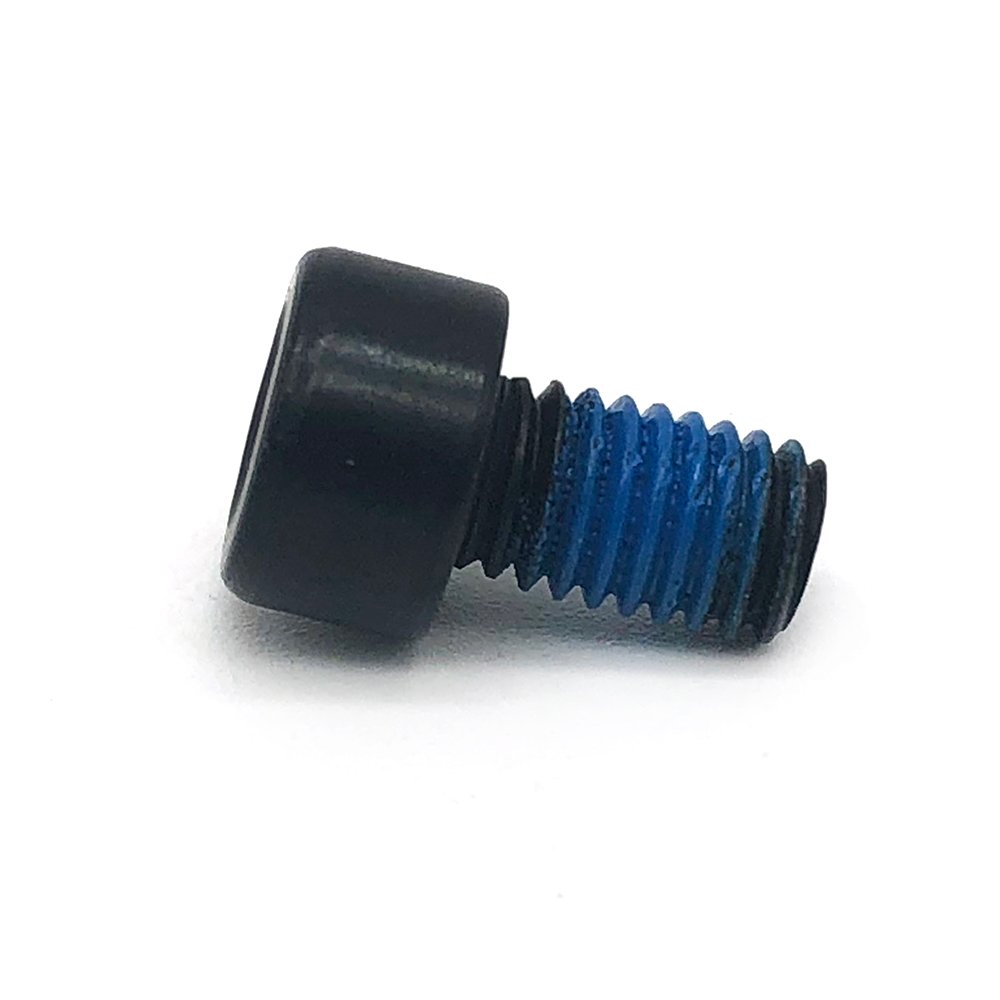
Racing environments generate vibrational inputs far exceeding road-vehicle norms. Without deliberate anti-loosening design, any threaded joint subjected to transverse vibration will progressively lose preload — a phenomenon quantified by the Junker test (DIN 65151). Automotive racing screws must incorporate anti-loosening strategies matched to each discipline’s vibration severity.
| Anti-Loosening Strategy | Mechanism | Effective Vibration Range | Re-Usability | Weight Penalty | Typical Racing Use |
|---|---|---|---|---|---|
| Nylon Insert Lock Nut (Nyloc) | Friction from deformed polymer insert | Low to moderate (≤ 200 Hz) | 3–5 re-uses | Minimal | Aero device mounting, interior panels |
| All-Metal Prevailing Torque Nut | Distorted thread zone creates interference | Moderate to high (≤ 500 Hz) | 10+ re-uses | Minimal | Suspension pickup points, roll cage joints |
| Safety Wire (Lock Wire) | Positive mechanical restraint via twisted wire | Extreme (unlimited) | Single-use wire | 2–5 g per pair | Engine internals, brake calipers, critical bolts |
| Serrated Flange Head | Teeth bite into bearing surface under clamp load | Low to moderate (≤ 150 Hz) | Re-usable | None | Bodywork, fender bolts, quick-release panels |
| Thread-Locking Adhesive (Medium) | Anaerobic adhesive bonds thread surfaces | Moderate (≤ 300 Hz) | Single-use; heat removable | None | Transmission housing, differential cover |
| Nordlock Wedge Washer | Opposed cams convert loosening rotation into bolt tension | High (≤ 800 Hz) | 25+ re-uses | 3–8 g per set | Wheel studs, hub flanges, critical suspension |
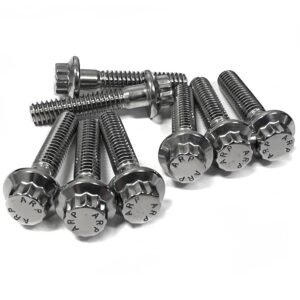
For formula-class and GT-endurance automotive racing screws in safety-critical locations, most sanctioning bodies (FIA, IMSA, SFI) mandate safety wire as the primary positive locking method. KEYFIX manufactures drilled-head titanium and alloy-steel racing screws with wire-hole positioning held to ±0.1 mm — ensuring clean wire routing that passes technical inspection.
Racing Application Map: Components by Vehicle Zone
Translating material and thread-locking knowledge into a practical bill-of-materials requires mapping fastener specifications to specific vehicle zones. The matrix below assigns recommended automotive racing screw configurations to the most commonly upgraded attachment points.
| Vehicle Zone | Component Attachment | Recommended Material | Thread Size Range | Coating / Finish | Locking Method |
|---|---|---|---|---|---|
| Engine Bay — Valve Cover | Valve cover to cylinder head | Ti-6Al-4V | M6 × 1.0 | Uncoated (Ti natural oxide) | Thread-locking adhesive |
| Engine Bay — Exhaust Manifold | Header flange to head | Inconel 718 or A286 | M8 × 1.25 / M10 × 1.25 | Nickel anti-seize applied at assembly | Safety wire (drilled head) |
| Engine Bay — Turbo Compressor | Compressor housing to bearing housing | Ti Grade 19 or Inconel | M8 × 1.25 | Dry-film lubricant (MoS₂) | All-metal prevailing torque nut |
| Chassis — Suspension Upper Arm | Pickup bracket to chassis rail | 4340 Q&T (class 12.9) | M10 × 1.5 / M12 × 1.75 | Zinc-nickel (720+ hr NSS) | Nordlock wedge washer |
| Chassis — Roll Cage | Tube joint gusset plates | 4340 Q&T (class 12.9) | M8 × 1.25 / M10 × 1.5 | Black oxide + oil | Safety wire (mandatory per FIA) |
| Braking — Caliper Mount | Caliper to upright/knuckle | 17-4PH H900 or Ti-6Al-4V | M12 × 1.5 / M14 × 1.5 | Passivated (stainless) or Ti natural | Safety wire (drilled head) |
| Exterior — Aero Device | Wing endplate, splitter support | 7075-T6 Aluminum | M5 × 0.8 / M6 × 1.0 | Type III hard anodize (color options) | Nyloc nut or serrated flange |
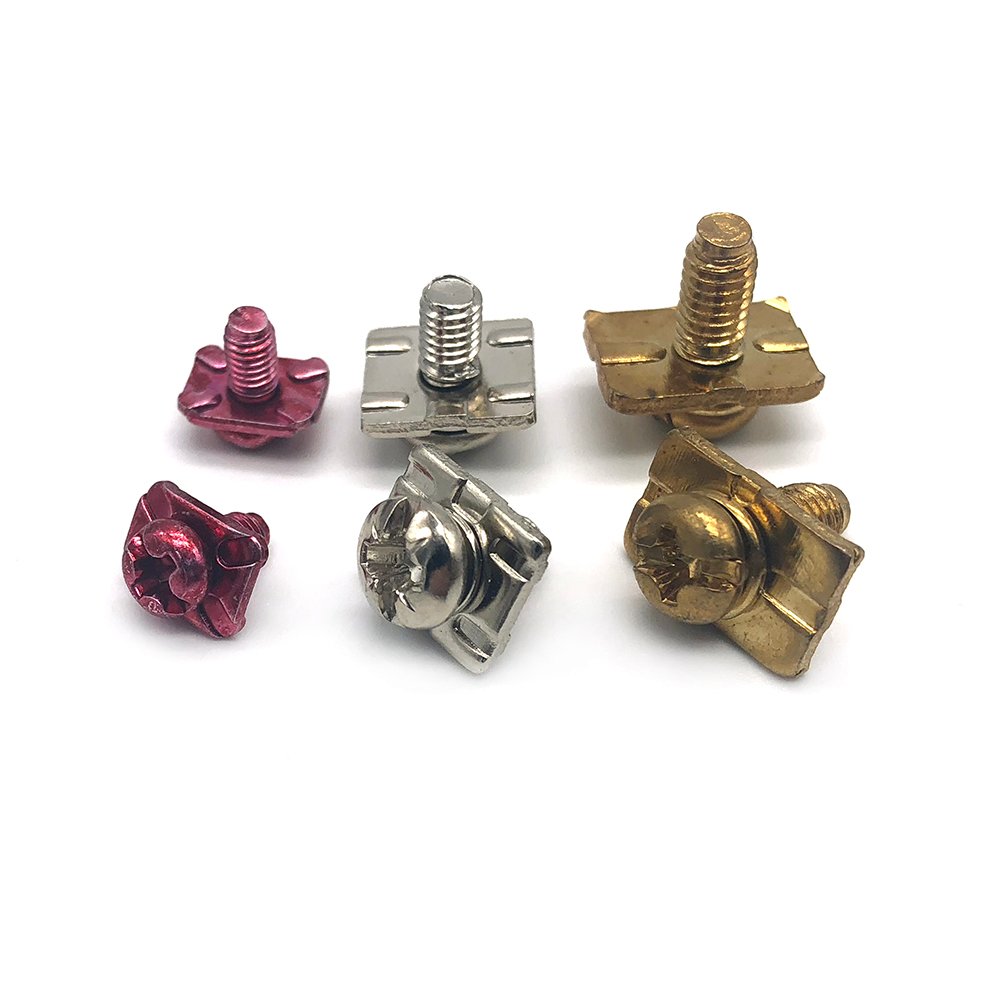
| Exterior — Bodywork | Fender, bumper, wide-body kit | 6061-T6 Aluminum | M5 × 0.8 / M6 × 1.0 | Anodize (black, red, blue, gold) | Serrated flange or Dzus quarter-turn |
| Interior — Seat / Harness | Race seat bracket to floor | 4340 Q&T (class 10.9+) | M8 × 1.25 / 3/8″-24 UNF | Zinc flake or cadmium (per SFI) | All-metal lock nut (per FIA 8855) |
| Drivetrain — Flywheel | Flywheel to crankshaft | ARP 2000 or Ti-6Al-4V | M10 × 1.0 / M11 × 1.0 | Moly lubricant applied at assembly | Torque + angle method |
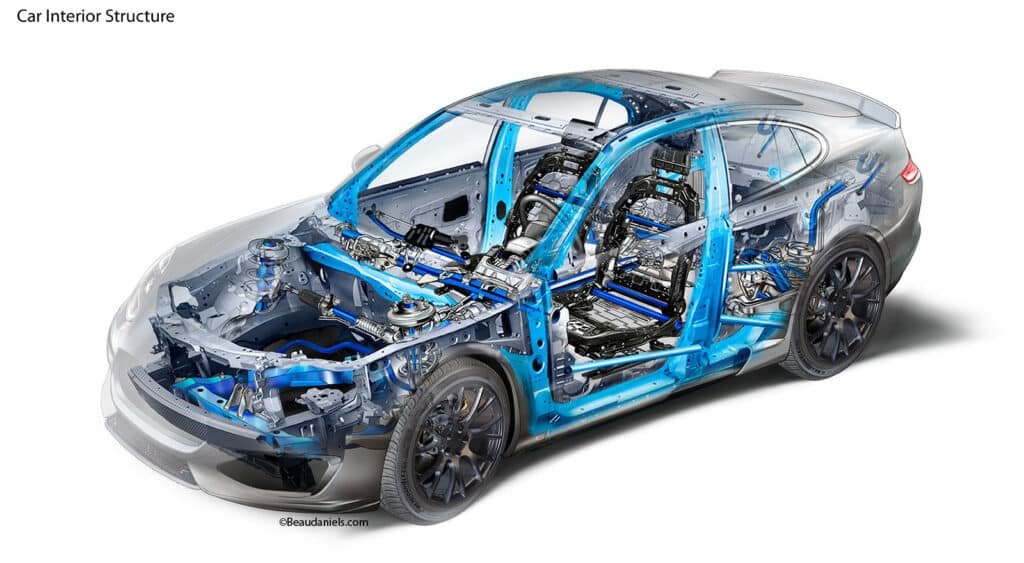
This map intentionally distinguishes safety-critical from performance-critical zones. Exterior bodywork tolerates aluminum automotive racing screws for maximum weight savings, while any fastener in the driver-to-chassis load path (seat mounts, harness anchors, roll cage) must use high-strength steel per homologation requirements.
Surface Treatment Options for Motorsport Conditions
Racing exposes fasteners to chemical and thermal environments that destroy conventional zinc plating within a single event weekend.
| Surface Treatment | Applicable Base Material | Temperature Ceiling (°C) | Corrosion Resistance | Aesthetic Options | Motorsport Suitability |
|---|---|---|---|---|---|
| Type III Hard Anodize | 6061/7075 Aluminum | 180 | Moderate (40–100 hr NSS) | Black, natural, red, blue, gold | Aero hardware, body fasteners, dress-up |
| PVD Titanium Nitride (TiN) | Ti-6Al-4V, Stainless | 500 | Excellent | Gold, rainbow, black | Visible engine bay screws, show-car builds |
| Zinc-Nickel Alloy (12–15% Ni) | Carbon & alloy steel | 250 | Outstanding (720–1,000+ hr NSS) | Silver, black | Suspension, chassis, brake brackets |
| Cadmium Plate | Alloy steel | 230 | Excellent (salt + fuel resistant) | Silver-gold | Mandatory per SFI for some harness hardware |
| Black Oxide + Oil | Carbon & alloy steel | 300 | Low (48–96 hr NSS) | Satin black | Non-corrosion-critical interior bolts |
| Nickel Anti-Seize Compound | All materials (applied at assembly) | 980 | N/A (lubricant, not barrier) | N/A | Exhaust studs, turbo bolts, spark plugs |
KEYFIX supplies zinc-nickel coatings specified to the neutral salt spray hours the drawing requires (per ASTM B117). For aluminum automotive racing screws, Type III hard anodizing with sealed oxide layers provides both abrasion resistance (≥ 400 HV) and the color-matched aesthetics that privateer builders demand for show-quality engine bays.
Dimensional Precision and Fatigue-Life Advantages
Racing joints operate closer to their yield limits than road-vehicle joints, making dimensional consistency critical. A 0.03 mm thread pitch diameter deviation across a set of cylinder-head studs creates 8–12 % clamp-load scatter, compromising head-gasket sealing uniformity.
| Precision Parameter | Typical Aftermarket Tolerance | KEYFIX Racing-Grade Tolerance |
|---|---|---|
| Thread Pitch Diameter | ±0.04 mm | ±0.02 mm |
| Overall Length (Under Head) | ±0.25 mm | ±0.10 mm |
| Head Bearing Surface Flatness | 0.08 mm TIR | 0.03 mm TIR |
| Shank Diameter Concentricity | 0.06 mm TIR | 0.02 mm TIR |
| Safety Wire Hole Position (Angular) | ±3° | ±1° |
| Surface Finish (Thread Root) | Ra ≤ 1.6 μm | Ra ≤ 0.8 μm |
The surface-finish line is particularly consequential for fatigue performance. Thread-root roughness acts as a stress concentrator — reducing Ra from 1.6 μm to 0.8 μm can extend fatigue life by 20–35 % under alternating-stress conditions typical of engine and suspension fasteners. KEYFIX achieves these finishes through cold-formed (rolled) threads rather than cut threads, a process that simultaneously work-hardens the root radius and introduces beneficial compressive residual stress — both of which resist fatigue-crack initiation.
Manufacturing Approach at KEYFIX
KEYFIX’s vertically integrated campus combines all technologies required to deliver automotive racing screws from raw alloy through finished, inspected hardware.
Alloy Verification — SPECTRO optical emission spectrometry confirms every incoming lot against mill certificates. Titanium Grade 5 billets are verified for Al (5.5–6.75 %) and V (3.5–4.5 %) content.
Cold Forging — Multi-station progressive headers form near-net-shape blanks preserving continuous grain flow, elevating shear resistance 40–60 % versus machined-from-bar equivalents, with typically 95 %+ material utilization.
CNC Precision Turning — 5-axis mill-turn centers hold ±0.005 mm positional repeatability for hexalobular recesses, drilled safety-wire holes, and reduced-shank profiles.
Thread Rolling — Planetary and flat-die rollers generate cold-worked threads at sub-Ra 0.8 μm root finish, delivering fatigue endurance roughly ten times superior to cut threads.
Quality Assurance — IATF 16949-certified protocols: 2D video measuring at 0.001 mm optical resolution, automated optical sorting, and traceability linking each finished automotive racing screw to its raw-material heat number.
Frequently Asked Questions
Are titanium automotive racing screws legal in all sanctioning bodies?
Most major sanctioning bodies (FIA, IMSA, SFI, SCCA) permit titanium in non-safety-critical locations. However, safety-related points (roll cage, harness mounts, fuel cell straps) may mandate specific steel grades per homologation appendices. Always verify material allowances against your series’ technical regulations.
How much weight can a full titanium conversion save?
A comprehensive engine-bay and suspension titanium conversion on a GT-class car typically replaces 2.5–4.0 kg of steel fasteners with 1.4–2.3 kg of titanium, yielding 1.1–1.7 kg net reduction concentrated in performance-sensitive zones where its effect on center-of-gravity is disproportionately large.
Does KEYFIX supply both prototype and series-production racing hardware?
Yes. CNC-machined prototypes have no MOQ. Cold-forged production runs typically begin at 10,000 pieces per variant with progressive cost reductions at higher tiers. KEYFIX supports programs from single-team bespoke kits to multi-season racing supply.
What anti-loosening method suits exhaust manifold studs on turbocharged race engines?
Above 600 °C, nylon-insert lock nuts fail — the polymer degrades past 120 °C. Use all-metal prevailing torque nuts rated to 650 °C+ or safety wire through drilled-head studs, with nickel anti-seize compound applied at assembly to prevent galling.
KEYFIX — established in 2005, IATF 16949 / ISO 9001 / ISO 14001 certified — specializes in precision-engineered automotive racing screws and custom performance fasteners for motorsport clients worldwide. With 20+ years of manufacturing experience, titanium Gr5 and alloy-steel machining on 32 CNC machines, and SPECTRO (Germany) OES material verification, KEYFIX delivers the accuracy, material integrity, and fatigue performance that competitive racing demands. Visit www.keyfixpro.com or contact sales@keyfixpro.com.