
Introduction: Creating Threads Where No Back-Side Access Exists

Automotive rivet nuts china manufacturers address one of vehicle assembly’s most persistent challenges: how to establish a strong, reusable threaded connection in a thin panel or closed-section profile when the back side is physically inaccessible. Hollow door sections, sealed roof rails, tubular instrument-panel beams, and enclosed EV battery trays all present this blind-side condition — and rivet nuts are the engineered solution.
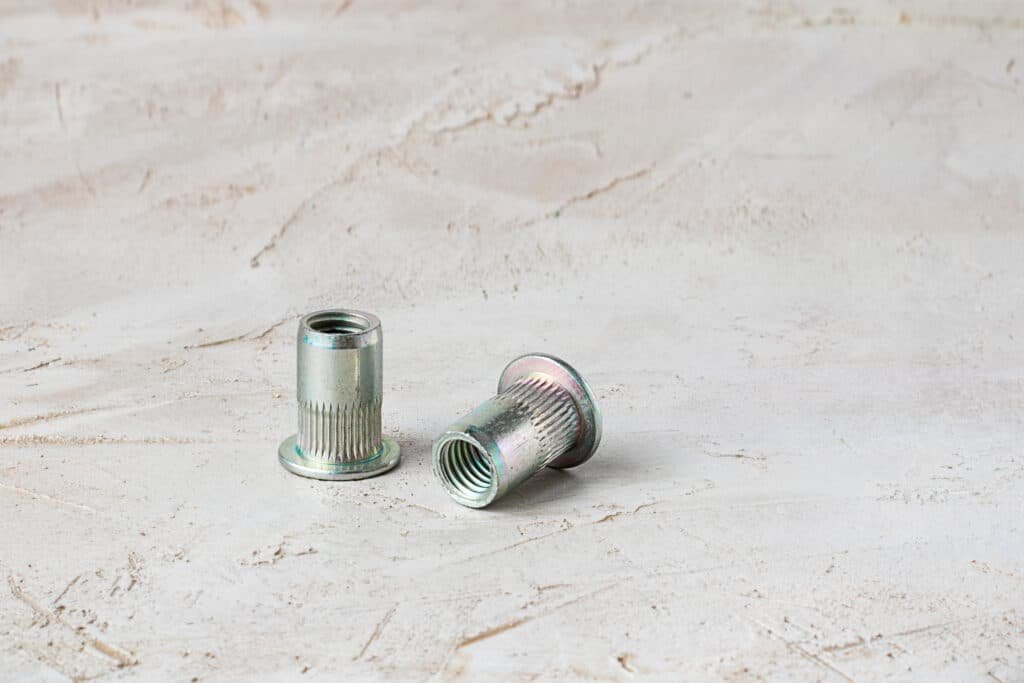
A rivet nut (also termed blind rivet nut, rivnut, or nutsert) is a one-piece tubular fastener with internal threads and a deformable body. Inserted through a pre-drilled hole from the accessible side, it is compressed axially by a setting tool until the un-threaded portion buckles outward behind the panel, forming a permanent mechanical interlock. The resulting installed insert provides a captive threaded receptacle capable of accepting standard bolts or machine screws — transforming a thin sheet into a load-bearing threaded joint.
This guide examines the engineering parameters that govern rivet nut performance in automotive service: grip range calculation, body style selection, pull-out and torque-out strength validation, and the manufacturing precision that distinguishes OEM-grade automotive rivet nuts china production from generic hardware.
Rivet Nut Body Styles and Anti-Rotation Performance
The external body profile of a rivet nut determines two critical behaviors: resistance to rotation under screw torque (anti-spin), and the magnitude of bulge formation during setting.
| Body Style | External Profile | Anti-Rotation Rating | Bulge Diameter (Relative) | Primary Automotive Application |
|---|---|---|---|---|
| Round / Smooth | Plain cylindrical | None — relies on friction only | Smallest | Light-duty interior brackets, wire-harness clips |
| Knurled Round | Longitudinal or diamond knurl | Moderate | Small-Medium | Door latch reinforcement, mirror mount |
| Hexagonal Body | Full-length hex profile | Excellent | Medium | Structural brackets, suspension reinforcement |
| Half-Hex | Hex on shank, round on collapse zone | Very Good | Medium | Chassis cross-member, EV battery tray |
| Ribbed / Splined | Longitudinal ribs on shank | Good | Small-Medium | Exterior trim brackets, fender reinforcement |
| Closed-End (Sealed) | Round or hex with sealed bottom | Varies by profile | Standard | Fluid-tight enclosures, battery housing |
For automotive structural joints where bolt torque exceeds 10 Nm, round smooth rivet nuts are inadequate — the setting bulge alone cannot resist the torque reaction, causing the insert to spin within the panel hole. Hexagonal and half-hex body styles embed their flat faces into the parent material during setting, creating a positive anti-rotation interlock that resists torque-out values 3–5 times higher than smooth equivalents. This is why hex-body variants dominate automotive rivet nuts china production for OEM structural applications.
Grip Range: The Most Mis-Specified Parameter
Grip range defines the material thickness window within which a rivet nut sets correctly. Specifying outside this window is the single most common cause of rivet nut field failures in automotive applications.
| Grip Range Condition | Setting Behavior | Joint Consequence |
|---|---|---|
| Panel thickness within grip range | Bulge forms correctly; head seats flush | Full rated pull-out and torque-out strength achieved |
| Panel thinner than minimum grip | Over-compression; bulge distorts excessively | Reduced pull-out; thread misalignment; potential spin |
| Panel thicker than maximum grip | Under-compression; incomplete bulge | Head not seated; loose insert; rattle under vibration |
| Panel at lower boundary of grip | Tight but acceptable; slight over-set | 90–100 % of rated strength; monitor for thread distortion |
| Panel at upper boundary of grip | Minimal bulge; marginal interlock | 70–85 % of rated strength; validate by pull-out test |
Each rivet nut size and body style has a specific grip range — typically spanning 0.5 to 3.0 mm per grip designation. Automotive body structures use multiple panel gauges (0.7 mm inner door skin, 1.2 mm B-pillar reinforcement, 2.5 mm subframe bracket), so a single rivet nut part number rarely covers all positions. OEM programs typically require 3–5 grip designations per thread size to match the vehicle’s panel-thickness map.
KeyFixPro manufactures automotive rivet nuts across the full M3–M12 thread range with grip designations calibrated in 0.5 mm increments, enabling precise matching to each panel position on the vehicle. Grip-range accuracy is verified by setting-force monitoring during production validation: every grip designation undergoes destructive pull-out testing on calibrated test panels to confirm rated strength within the published thickness window.
Material Selection and Strength Hierarchy
The rivet nut body material must be softer than the setting tool mandrel (to deform during installation) yet hard enough to resist thread stripping under bolt torque. This constraint creates a defined material hierarchy.
| Material | Tensile Strength (MPa) | Setting Force (M6, Typical) | Max Bolt Class Compatible | Corrosion Strategy | Best Automotive Application |
|---|---|---|---|---|---|
| Aluminum 5050 / 5052 | 170 – 230 | 8 – 12 kN | 4.8 | Anodize or chromate | Interior brackets, lightweight non-structural |
| Low-Carbon Steel (1010 / 1018) | 300 – 420 | 12 – 18 kN | 8.8 | Zinc or zinc-nickel plating | General body structure, door reinforcement |
| Medium-Carbon Steel (1035) | 450 – 580 | 15 – 22 kN | 10.9 | Zinc-nickel or DACROMET | Chassis, suspension reinforcement |
| Stainless Steel (304 / 316) | 520 – 620 | 16 – 24 kN | A2-70 / A4-70 | Inherent; passivation optional | Exhaust-adjacent, coastal fleet, EV underbody |
| High-Strength Steel (HRT grades) | 600 – 800 | 20 – 28 kN | 10.9 – 12.9 | Zinc-nickel mandatory | Structural joints replacing weld nuts |
The bolt-class compatibility column is critical and frequently overlooked. Installing a class 10.9 bolt into an aluminum rivet nut will strip the threads long before the bolt reaches its proof load — wasting the bolt’s capacity and creating a joint weaker than intended. The rule: the rivet nut body material must support thread strip-out loads exceeding the proof load of the mating bolt.
Pull-Out and Torque-Out Strength Benchmarks
Two destructive tests define rivet nut joint strength: pull-out (axial extraction from the panel) and torque-out (rotational extraction under applied torque).
| Thread Size | Body Material | Panel: 1.5 mm Mild Steel | Panel: 2.0 mm Mild Steel | Max Torque-Out (Hex Body) |
|---|---|---|---|---|
| M4 | Steel 1010 | Pull-out: 2.8 kN | Pull-out: 3.5 kN | 6 Nm |
| M5 | Steel 1010 | Pull-out: 4.2 kN | Pull-out: 5.5 kN | 10 Nm |
| M6 | Steel 1010 | Pull-out: 5.8 kN | Pull-out: 7.5 kN | 16 Nm |
| M6 | Steel 1035 (HRT) | Pull-out: 7.0 kN | Pull-out: 9.0 kN | 22 Nm |
| M8 | Steel 1010 | Pull-out: 8.5 kN | Pull-out: 11.0 kN | 25 Nm |
| M8 | Steel 1035 (HRT) | Pull-out: 10.5 kN | Pull-out: 13.5 kN | 35 Nm |
| M10 | Steel 1035 (HRT) | Pull-out: 13.0 kN | Pull-out: 17.0 kN | 50 Nm |
These values increase with panel thickness because a thicker panel provides more bearing surface against which the bulge reacts. This is precisely why grip range accuracy matters: a rivet nut set at the upper boundary of its grip (minimal bulge) will deliver 15–30 % lower pull-out than the same part set at optimal mid-grip thickness.
KeyFixPro validates every grip designation through destructive pull-out and torque-out testing per IFI-148 protocol on calibrated mild-steel test panels, with results documented in the PPAP dimensional layout report for each part number.
Surface Treatment for Automotive Corrosion Environments
| Coating | Thickness (μm) | Salt Spray (hrs) | H₂ Embrittlement Risk | Suitability for Automotive Rivet Nuts |
|---|---|---|---|---|
| Trivalent Zinc | 8 – 12 | 200 – 400 | Low (low-carbon steel) | Interior, mild exterior |
| Zinc-Nickel (12–15 % Ni) | 8 – 15 | 720 – 1,000+ | Moderate (requires bake for HRT) | Underbody, wheel well, structural |
| DACROMET / Geomet | 6 – 10 | 500 – 1,000 | None (no electrolytic process) | Chassis, EV battery tray, structural |
| Passivation (Stainless) | Chemical conversion | Inherent | None | Exhaust zone, coastal fleet |
| Aluminum Anodize (Type II) | 8 – 25 | 336+ (per MIL-A-8625) | None | Aluminum body panels, weight-critical |
DACROMET and zinc flake coatings are preferred for structural automotive rivet nuts china applications because they achieve high salt-spray endurance without the electrolytic hydrogen exposure that zinc-nickel electroplating introduces. For high-strength (HRT) rivet nuts where hydrogen embrittlement risk is elevated, DACROMET eliminates the need for post-plating hydrogen-relief baking — simplifying the process chain and removing a potential failure mode.
KeyFixPro’s in-house DACROMET and zinc-nickel coating lines validate every lot to 1,000+ hours neutral salt spray per ASTM B117.
Dimensional Tolerances for Reliable Automated Setting
Automated rivet nut setting tools feed, orient, and set fasteners at cycle times of 2–4 seconds per insert. Dimensional inconsistency causes feed jams, mis-sets, and line stoppages.
| Critical Dimension | Specification | KeyFixPro Capability | Consequence of Non-Conformance |
|---|---|---|---|
| Body OD | ±0.05 mm | ±0.02 mm | Over-size → won’t enter hole; under-size → loose fit, spin |
| Flange OD | ±0.10 mm | ±0.05 mm | Over-size → interference with adjacent features |
| Body Length | ±0.15 mm | ±0.08 mm | Affects grip range accuracy directly |
| Thread Class | 6H (ISO 965-1) | 6H verified GO/NO-GO | Off-spec → bolt won’t engage or thread strips |
| Flange Flatness | ≤ 0.08 mm TIR | ≤ 0.04 mm TIR | Uneven seat → panel dimple; reduced pull-out |
| Concentricity (Thread to Body) | ≤ 0.10 mm TIR | ≤ 0.05 mm TIR | Eccentric bolt loading → reduced fatigue life |
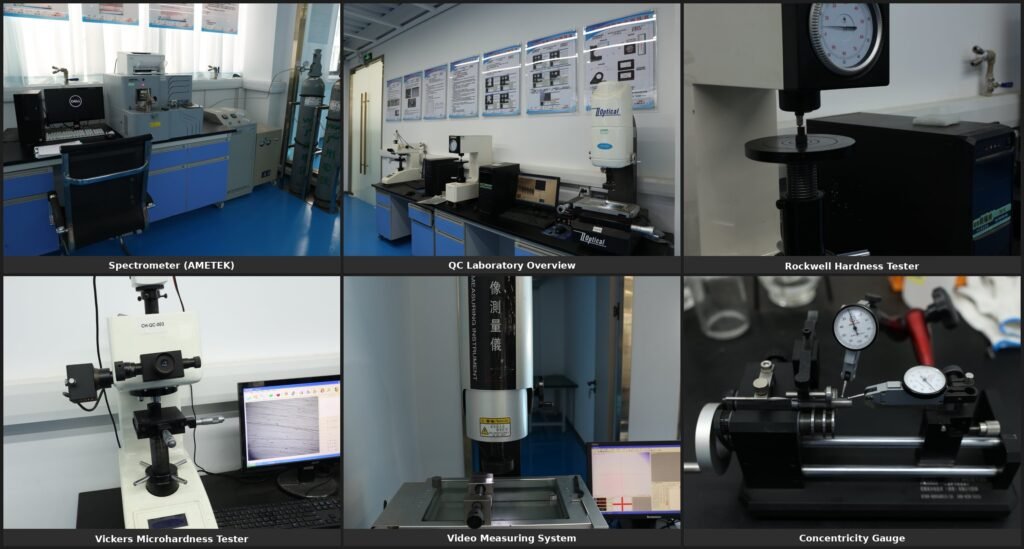
KeyFixPro achieves these tolerances through multi-station cold heading for body formation, CNC secondary machining for thread and flange finishing, and 100 % optical sorting under IATF 16949 quality protocols with CMM verification at ±0.001 mm resolution.
Qualifying an Automotive Rivet Nuts China Supplier
| Audit Criterion | Minimum Requirement | KeyFixPro Status |
|---|---|---|
| IATF 16949 Scope | Covers cold-headed rivet nuts | Certified — full scope |
| Cold Heading Capability | Multi-station progressive forming of tubular blanks | Confirmed — multi-station headers |
| Thread Tapping / Rolling | Internal thread to 6H class | CNC tapping + GO/NO-GO on every lot |
| Grip Range Validation | Destructive pull-out per grip on calibrated panels | Pull-out + torque-out per IFI-148 |
| Coating Process Control | In-house or qualified sub-tier with salt spray records | In-house zinc-nickel + DACROMET |
| Dimensional SPC (Cpk) | ≥ 1.33 on body OD, length, thread | Cpk ≥ 1.67 maintained |
| PPAP Level 3+ | Full dimensional layout + capability + material certs | Level 3–5 with digital traceability |
| 0 PPM Track Record | Documented across multiple programs | 0 PPM across 100+ automotive programs |
Vehicle-Zone Application Map
| Vehicle Zone | Typical Application | Thread Size | Body Style | Material | Coating |
|---|---|---|---|---|---|
| Door Inner (Hollow Section) | Latch reinforcement, hinge mount | M6, M8 | Hex body | Steel 1010 | Zinc-nickel |
| Instrument Panel Beam | Steering column bracket, airbag mount | M8, M10 | Half-hex | Steel 1035 HRT | DACROMET |
| Roof Rail (Closed Profile) | Roof rack base, curtain airbag bracket | M6 | Hex body | Steel 1010 | Zinc-nickel |
| EV Battery Tray | Module mounting, cooling plate bracket | M6, M8 | Closed-end hex | Stainless 304 | Passivated |
| Seat Cross-Member | Seat track anchor (thin floor pan) | M8, M10 | Half-hex | Steel 1035 HRT | DACROMET |
| Tailgate / Liftgate | Gas strut bracket, latch mount | M6 | Knurled round | Steel 1010 | Trivalent zinc |
| Underbody Shield | Splash guard bracket | M5, M6 | Ribbed round | Steel 1010 | DACROMET |
Frequently Asked Questions
What is the difference between a rivet nut and a weld nut?
A rivet nut is installed mechanically from one side through a pre-drilled hole — no heat, electricity, or back-side access required. A weld nut is permanently fused to the panel via resistance welding, requiring two-sided electrode access and introducing heat-affected zones. Rivet nuts are preferred for closed sections, heat-sensitive substrates, and positions requiring post-assembly installation.
Can rivet nuts replace weld nuts in structural automotive joints?
Yes, when high-strength (HRT) body materials and hex-body anti-rotation profiles are specified. HRT steel rivet nuts in M8 and M10 achieve pull-out forces of 10–17 kN in 1.5–2.0 mm mild steel — sufficient for many structural bracket, seat-mount, and suspension-reinforcement applications previously served by projection weld nuts.
How does KeyFixPro ensure grip range accuracy?
Each grip designation undergoes destructive pull-out testing on calibrated test panels at production validation. Body length tolerance is held to ±0.08 mm (tighter than the ±0.15 mm industry norm), and setting-force curves from automated installation tools are correlated to the published grip window during PPAP approval.
What minimum order applies for custom automotive rivet nuts?
Cold-headed prototypes start at 1,000 pieces. Production runs begin at 50,000 pieces per variant, with cost reductions at 100K, 500K, and 1M+ tiers. Contact sales@keyfixpro.com for program-specific quotations.
KeyFixPro — established in 2000, IATF 16949 / ISO 9001 / ISO 14001 certified — manufactures precision automotive rivet nuts for OEM and Tier 1 programs across 20+ countries. With 25+ years of cold-heading heritage, 50+ patents, in-house coating lines, ±0.001 mm inspection capability, and grip-range-validated quality on every designation, KeyFixPro delivers the blind-side threaded joints that modern vehicle architectures demand. Visit www.keyfixpro.com or contact sales@keyfixpro.com.