
Sourcing precision-machined parts from overseas demands more than a competitive price tag. Engineers and procurement managers evaluating custom CNC machining China suppliers need verifiable technical data, traceable material credentials, and process-level transparency. This guide breaks down the critical parameters, material options, and quality benchmarks that distinguish a dependable Chinese CNC partner from a commodity workshop — and explains how KeyFixPro’s manufacturing infrastructure addresses each requirement.
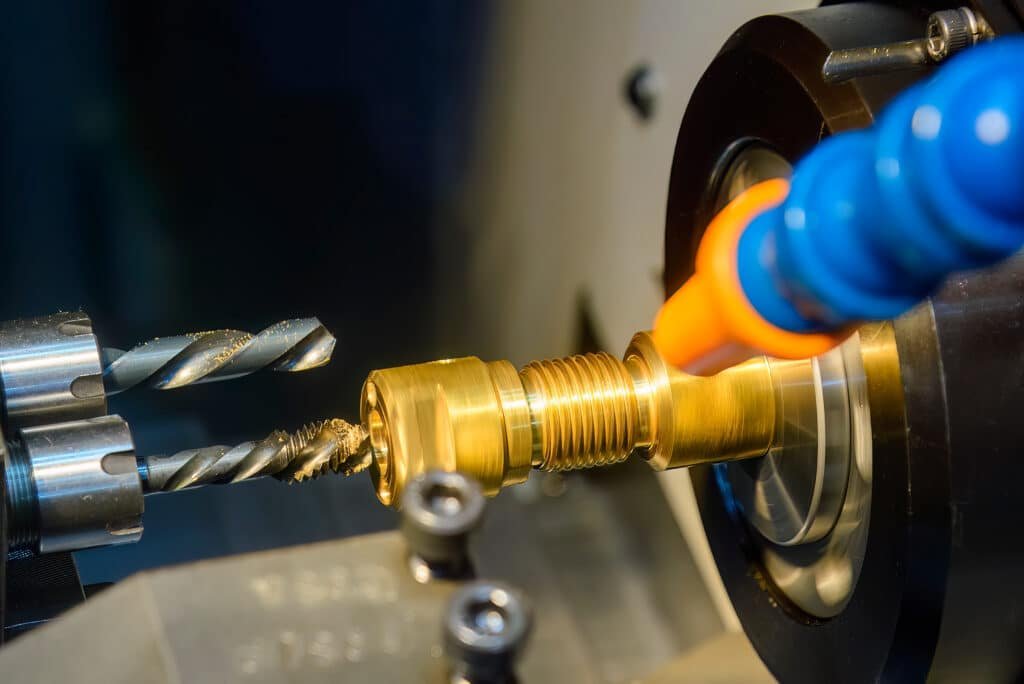
Why China Remains a Strategic Hub for Custom CNC Fabrication
China’s position in global subtractive manufacturing is underpinned by a mature supply chain ecosystem rather than labor cost alone. The country’s key industrial corridors host concentrated clusters of raw material mills, heat treatment facilities, and surface coating lines — often within a compact logistics radius. KeyFixPro leverages this geographic density to shorten lead times and simplify multi-process workflows, a measurable advantage when a single custom fastener may require forging, CNC turning, thread rolling, and DACROMET finishing in sequence.
| Strategic Factor | Impact on Custom CNC Procurement |
|---|---|
| Integrated raw material supply chain | Direct mill access reduces material lead time to 3–5 business days |
| Multi-process facility proximity | Forging → machining → coating completed under unified quality control |
| Scalable workforce with specialized training | Supports prototype-to-series production without retooling delays |
| IATF 16949 adoption across tier-one suppliers | Automotive-grade quality systems as baseline, not premium add-on |
| Competitive total landed cost | 30–50% lower than equivalent EU/NA manufacturing for equivalent tolerances |
Rather than viewing Chinese CNC suppliers as interchangeable, procurement teams should evaluate each facility against specific technical benchmarks discussed in the sections that follow.
Machine Tool Specifications: What to Verify Before Placing an Order
The backbone of any CNC operation is its installed equipment. Vague claims about “advanced machinery” tell buyers nothing useful. What matters is spindle speed, axis count, working envelope, and the control system architecture governing interpolation accuracy.
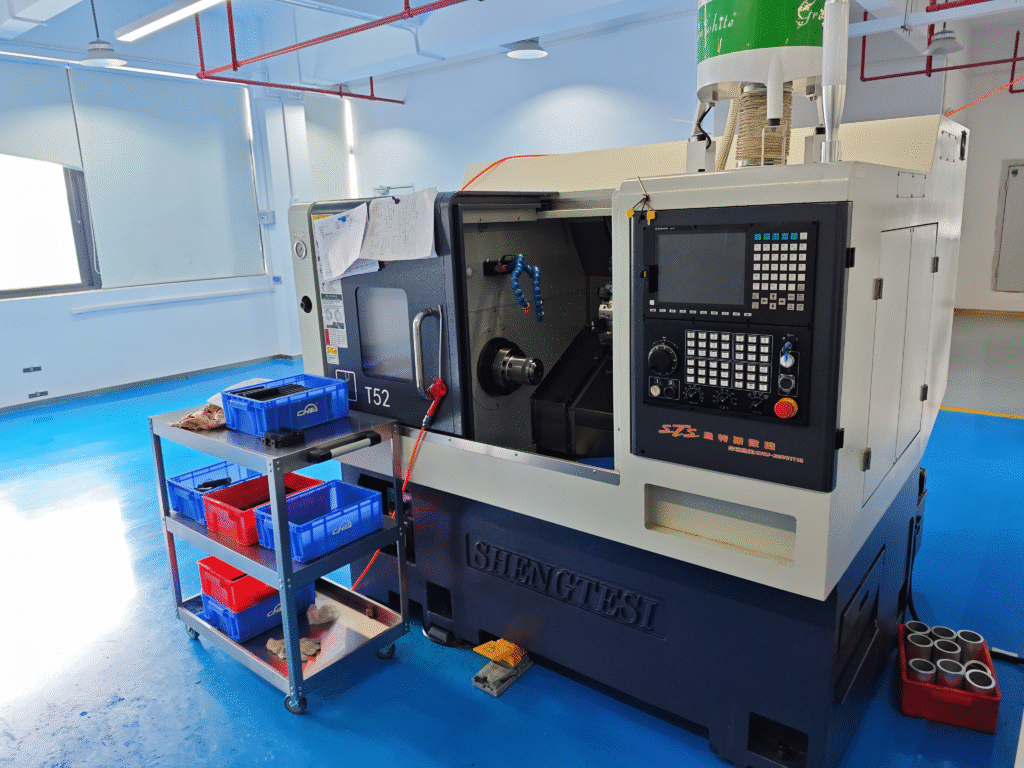
KeyFixPro’s machining floor runs on STS C-series 5-axis centers paired with SYNTEC numerical controllers. Below is a direct comparison of these specifications against industry standard thresholds for precision fastener production:
| Technical Parameter | KeyFixPro Capability | Industry Standard Threshold |
|---|---|---|
| Axis configuration | 5-axis simultaneous | 3-axis minimum for complex geometry |
| Spindle speed | 4,000 RPM | 3,000–6,000 RPM typical range |
| Positioning accuracy | ±0.005 mm | ±0.01 mm acceptable for most fasteners |
| CMM verification accuracy | ±0.001 mm | ±0.003 mm for general inspection |
| Z-axis travel | 250 mm | Application-dependent |
| Workpiece diameter range | Φ35 – Φ71 mm | Varies by machine class |
| Control system | SYNTEC CNC | Fanuc / Siemens / SYNTEC considered industry-standard |
| Surface finish capability | Ra 0.4 μm and finer | Ra 0.8 μm typical for machined fasteners |
The 5-axis configuration is particularly relevant for custom CNC machining projects involving undercut threads, asymmetric head geometries, or compound-angle features found in powertrain and aerospace fastening assemblies. A 3-axis setup would require multiple fixturings — each one introducing cumulative positional error.
Material Selection and Verification Protocol
Material integrity is non-negotiable in safety-critical fastener applications. A reputable custom CNC machining China source must demonstrate two capabilities: breadth of stock and analytical traceability.
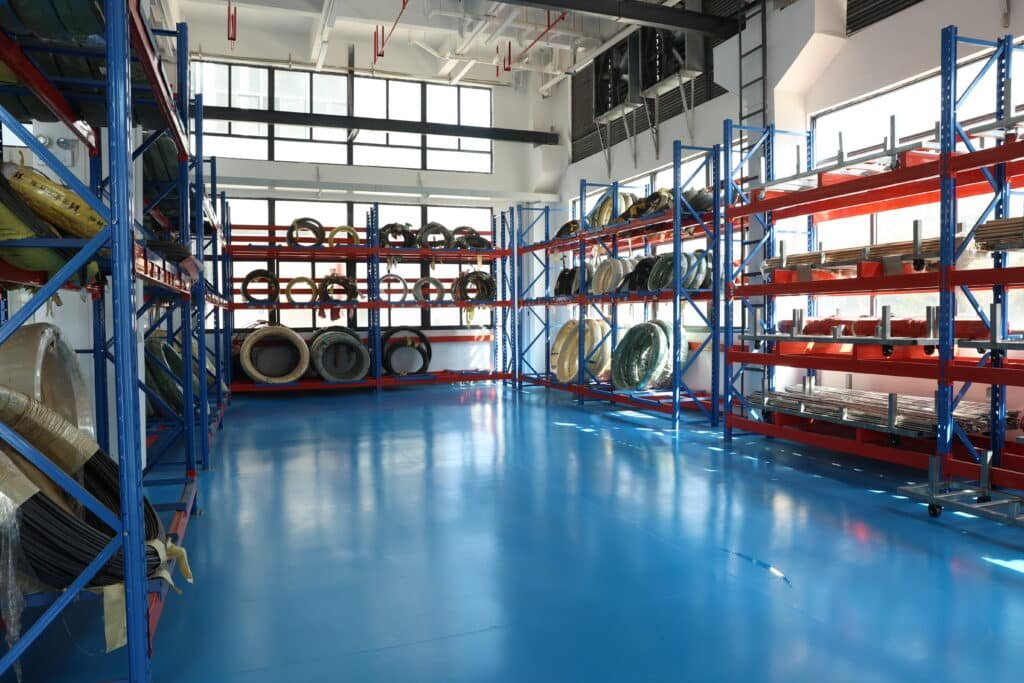
KeyFixPro maintains inventory across the following material families, with every incoming batch subjected to AMETEK optical emission spectrometry before it enters the production queue:
| Material Category | Common Grades Available | Typical Application Domain |
|---|---|---|
| Aluminum alloys | 6061-T6, 7075-T6, 2024-T3 | Lightweight structural brackets, EV motor housings |
| Austenitic stainless steel | 304, 316, 316L | Marine hardware, medical instrument fixation |
| Precipitation-hardened stainless | 17-4 PH (H900–H1150) | High-fatigue valve body fasteners |
| Titanium | Grade 2 (CP), Grade 5 (Ti-6Al-4V) | Aerospace structural joints, implant-grade components |
| Copper and brass | C11000, C36000, H62 | Electrical grounding connectors, thermal management |
| Nickel superalloy | Inconel 625, Inconel 718 | Exhaust manifold studs, high-temperature turbine fixings |
| Engineering polymers | PEEK, POM (Delrin), PTFE, Ultem | Insulating bushings, chemical-resistant spacers |
| Alloy steel / tool steel | 4140, 8.8 / 10.9 / 12.9 class | High-load structural bolts, transmission shaft pins |
The AMETEK spectrometer cross-references elemental composition against EN, ASTM, and JIS specifications in real time. This eliminates the risk of grade substitution — a documented concern when sourcing raw bar stock across extended supply chains.
Tolerance Stacking Analysis: How Multi-Process Manufacturing Affects Dimensional Control
One distinction of KeyFixPro’s integrated production model is the ability to manage tolerance accumulation across sequential processes within a single facility. When a component undergoes cold forging followed by CNC finish-machining, each stage introduces its own dimensional variance. Controlling that stack-up requires coordinated process planning.
| Manufacturing Stage | Typical Tolerance Band | Cumulative Stack-Up Risk |
|---|---|---|
| Cold forging (near-net shape) | ±0.10 – ±0.15 mm | Baseline geometry established |
| CNC rough turning | ±0.03 – ±0.05 mm | Removes forging flash; corrects runout |
| CNC finish machining (5-axis) | ±0.005 – ±0.01 mm | Final dimensions, thread profiles, surface finish |
| Thread rolling / tapping | ±0.013 mm (Class 6g/6H) | Pitch diameter held to gauge limits |
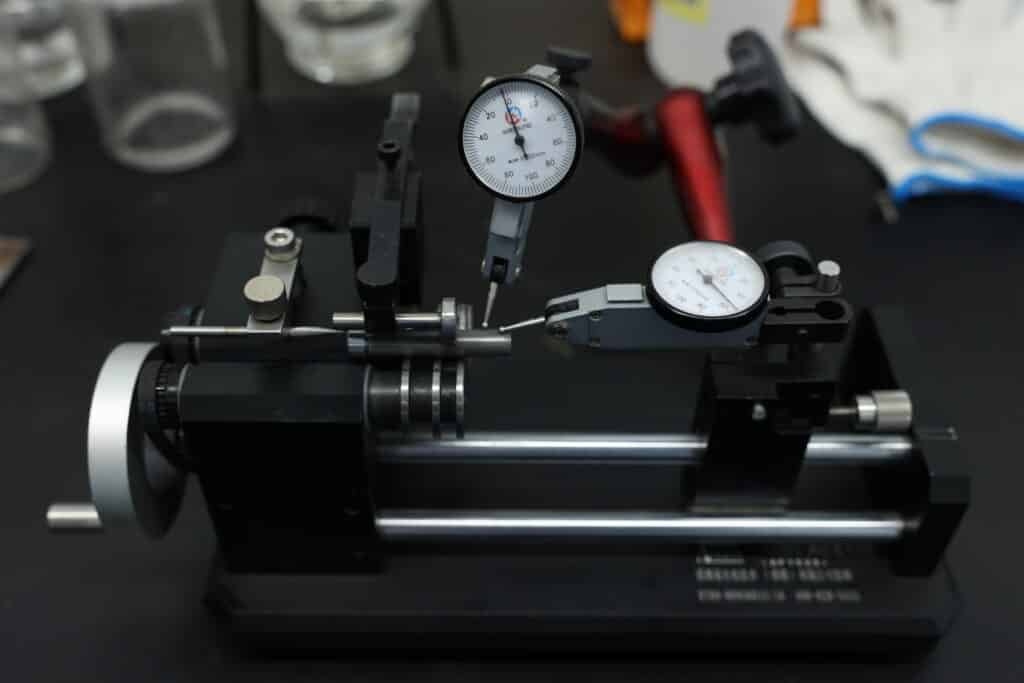
| Post-machining CMM verification | ±0.001 mm measurement uncertainty | Confirms assembled tolerance compliance |
By housing forging presses, CNC lathes, and coordinate measuring machines under one roof, KeyFixPro eliminates inter-facility transport that typically introduces handling damage and environmental variable shifts (temperature, humidity) between process steps.
Quality Assurance Architecture: Beyond ISO Certification
Certificates hanging on a wall do not prevent defective parts from reaching an assembly line. The operational value lies in how quality systems translate into measurable inspection protocols.
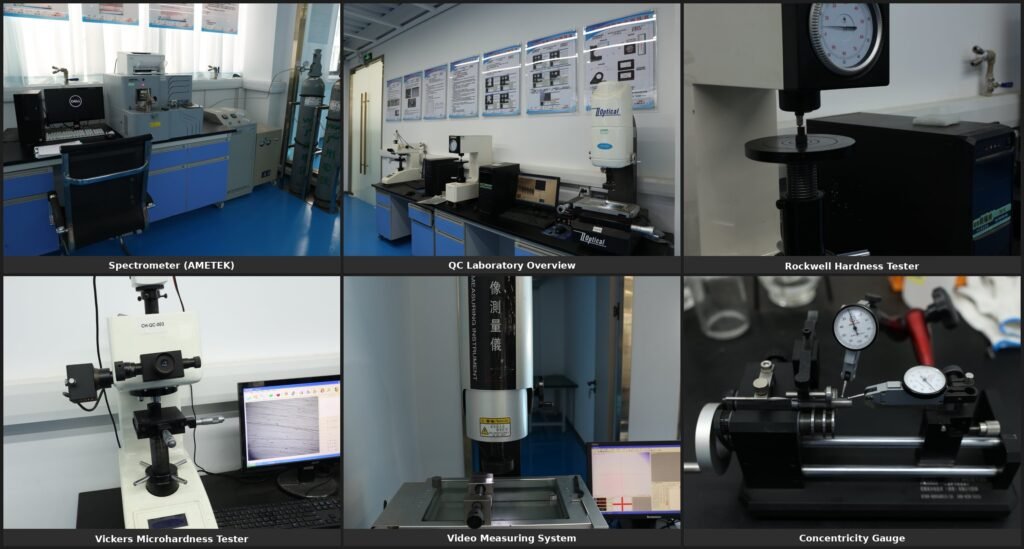
KeyFixPro holds IATF 16949, ISO 9001, and ISO 14001 certifications. More importantly, the facility deploys a four-tier inspection architecture designed to catch deviations at each production gate:
| Inspection Stage | Equipment / Method | Measurement Scope |
|---|---|---|
| Incoming material verification | AMETEK optical emission spectrometer | Elemental composition vs. grade specification |
| First article inspection (FAI) | CMM + 3D scanning | Full GD&T conformance on initial production piece |
| In-process statistical monitoring | Go/no-go gauging + profilometry | Critical dimensions, Ra surface roughness at intervals |
| Final outgoing audit | Automated optical sorting (100% parts) | Dimensional check, surface defect detection, thread integrity |
The automated optical sorting line deserves emphasis. Unlike statistical sampling (AQL-based), this system inspects every individual component exiting the production cell. For automotive OEM programs governed by 0 PPM targets, 100-percent screening is not optional — it is the minimum acceptable outgoing quality gate.
Surface Engineering Options for Corrosion and Wear Resistance
Raw machined parts rarely ship without protective treatment. The choice of surface coating affects service life, torque-tension behavior, coefficient of friction, and RoHS compliance. KeyFixPro’s in-house and partner-network treatments include:
| Coating Type | Salt Spray Resistance | Friction Coefficient (μ) | RoHS Status | Recommended Application |
|---|---|---|---|---|
| Zinc-nickel electroplate | 720–1,000+ hours | 0.12–0.18 | Compliant | Underbody automotive, chassis bolting |
| DACROMET (zinc-aluminum flake) | 1,000+ hours | 0.10–0.16 | Compliant | Engine bay, exhaust-adjacent hardware |
| Hot-dip galvanize | 500–800 hours | 0.15–0.25 | Compliant | Structural steel, wind tower flanges |
| Black oxide | 48–96 hours | 0.15–0.20 | Compliant | Decorative / low-corrosion indoor use |
| Anodize (Type II / Type III) | 336–1,000 hours | 0.25–0.40 | Compliant | Aluminum aerospace brackets, EV connectors |
| Electroless nickel plate | 500–1,000 hours | 0.12–0.16 | Compliant | Precision valve fittings, sensor housings |
These coating options allow engineers to specify corrosion protection matched to the operating environment — from salt-laden coastal wind farms to controlled cleanroom medical device assemblies.
Application-Specific Customization Scenarios
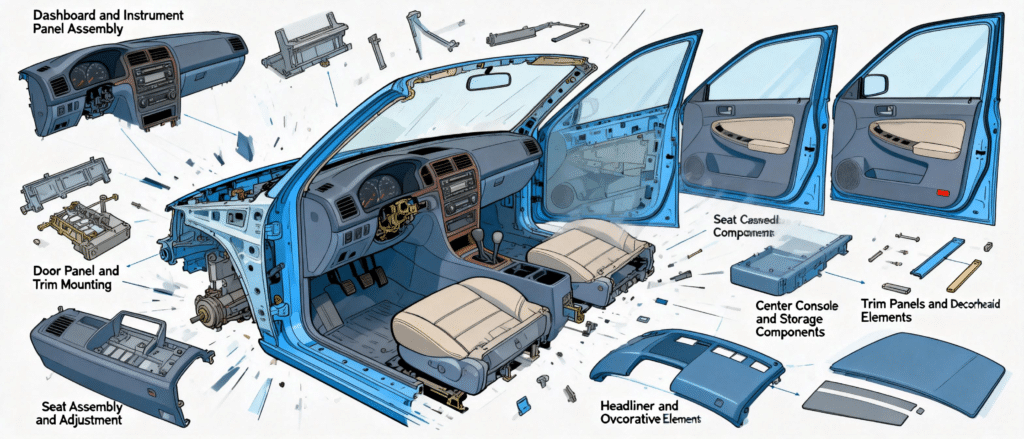
Custom CNC machining China suppliers are evaluated not by catalog products, but by their track record solving unique engineering problems. Below are representative project categories that KeyFixPro’s engineering team of 20-plus fastener specialists has addressed across more than 100 completed programs worldwide:
| Application Sector | Typical Custom Component | Key Technical Requirement |
|---|---|---|
| Automotive powertrain | Shoulder bolts with compound undercut | ±0.005 mm concentricity, 10.9 tensile class |
| Wind energy | Anchor studs with DACROMET finish | M24–M36 range, 1,000-hour salt spray, full traceability |
| Medical instruments | Titanium Grade 5 locking pins | Ra 0.4 μm finish, biocompatibility documentation |
| Racing / EV motors | Lightweight aluminum hub fasteners | Weight reduction vs. 7075-T6 fatigue life optimization |
| Industrial machinery | Hex standoffs with press-fit features | Interference fit tolerance ±0.008 mm, batch consistency |
| Electronics enclosures | Brass threaded inserts | Knurl geometry for plastic over-mold retention force |
Each scenario involves collaborative DFM (design for manufacturability) review, where KeyFixPro’s engineers propose geometry modifications to reduce machining cycles and improve structural performance without compromising the original design intent.
How to Evaluate a Custom CNC Machining Supplier in China: A Decision Checklist
Before committing to a purchase order, procurement professionals should score potential suppliers against these weighted criteria:
| Evaluation Criterion | What to Request from Supplier | Red Flag If Missing |
|---|---|---|
| Equipment list with specifications | Make, model, axis count, accuracy rating for each CNC center | Vague “state-of-the-art” language without model numbers |
| Material traceability system | Spectrometer test reports linked to heat/lot numbers | No incoming material inspection documented |
| Quality certifications (current) | IATF 16949 scope certificate with IATF number and expiry date | ISO 9001 only, without automotive-specific scope |
| Inspection capability | CMM brand/model, 3D scanner resolution, optical sorter throughput | Reliance on manual caliper checks for critical dimensions |
| Reference projects | Named industry sectors, volume ranges, coating specifications delivered | Refusal to share anonymized case data |
| Engineering support | DFM feedback turnaround, assigned engineer contact | Sales-only communication, no technical dialogue |
| Minimum order flexibility | Stated policy on prototype quantities and mixed-batch runs | Rigid MOQ thresholds that exclude R&D sampling |
KeyFixPro maintains a zero-MOQ policy, accepting single-piece prototypes through mid-volume production runs. This flexibility is particularly valuable during product development stages when dimensional validation precedes series commitment.
Start Your Custom CNC Machining Project
Initiating a project with KeyFixPro follows a structured technical workflow: upload CAD data (STEP, IGES, or SolidWorks native formats), receive DFM analysis and material recommendation within 48 hours, approve a quoted process plan, and track production through digital inspection milestones. Every shipped lot includes a documentation package encompassing material certificates, dimensional reports, 3D scan deviation maps, and surface roughness measurements.
For engineers and buyers seeking a custom CNC machining China partner with verifiable precision, automotive-grade quality infrastructure, and responsive technical collaboration — contact KeyFixPro to discuss your next project.