
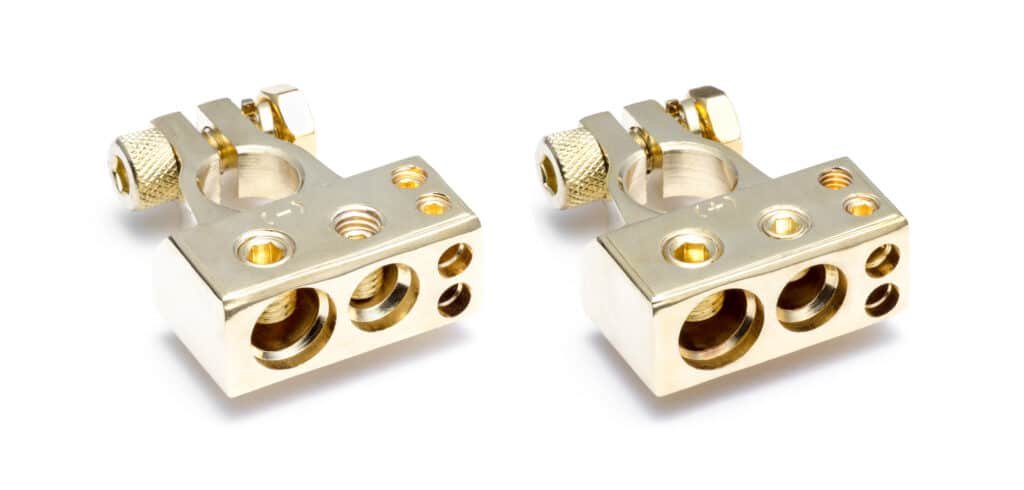
Choosing between brass and aluminum car battery connectors affects contact resistance, corrosion performance, weight, and long-term reliability at every joint from a 12V lead-acid terminal to a 400V EV high-voltage busbar. Brass delivers superior conductivity over aluminum, better mechanical strength under repeated torque cycles, and lower sensitivity to oxidation-driven contact resistance growth. Aluminum wins on weight and cost — but demands tighter surface treatment discipline to stay electrically sound. This guide gives OEM engineers and procurement teams the material properties, surface finish specs, and manufacturing criteria to specify the right connector for the right application.
TL;DR — Key Takeaways
- Brass (CuZn37/C26000) delivers electrical conductivity of 26–28% IACS — roughly 3× higher than 6061 aluminum’s ~8.5 µΩ·cm resistivity at comparable contact area.
- Aluminum connectors must be tin-plated, silver-plated, or hard-anodized to prevent oxide layer buildup that raises contact resistance over time.
- For EV battery pack connectors, aluminum with tin or silver plating is the weight-optimized default; brass remains standard for 12V/24V ICE terminal clamps and heavy truck applications.
- Standard battery connector bore tolerances follow ISO 286-1 H7/f7 fits on mating post diameters.
- Automotive battery connector programs require IATF 16949 supplier certification and full PPAP for serialized production.
What’s the Functional Difference Between Brass and Aluminum Car Battery Connectors?
The functional difference comes down to one variable: what happens at the contact interface over time.
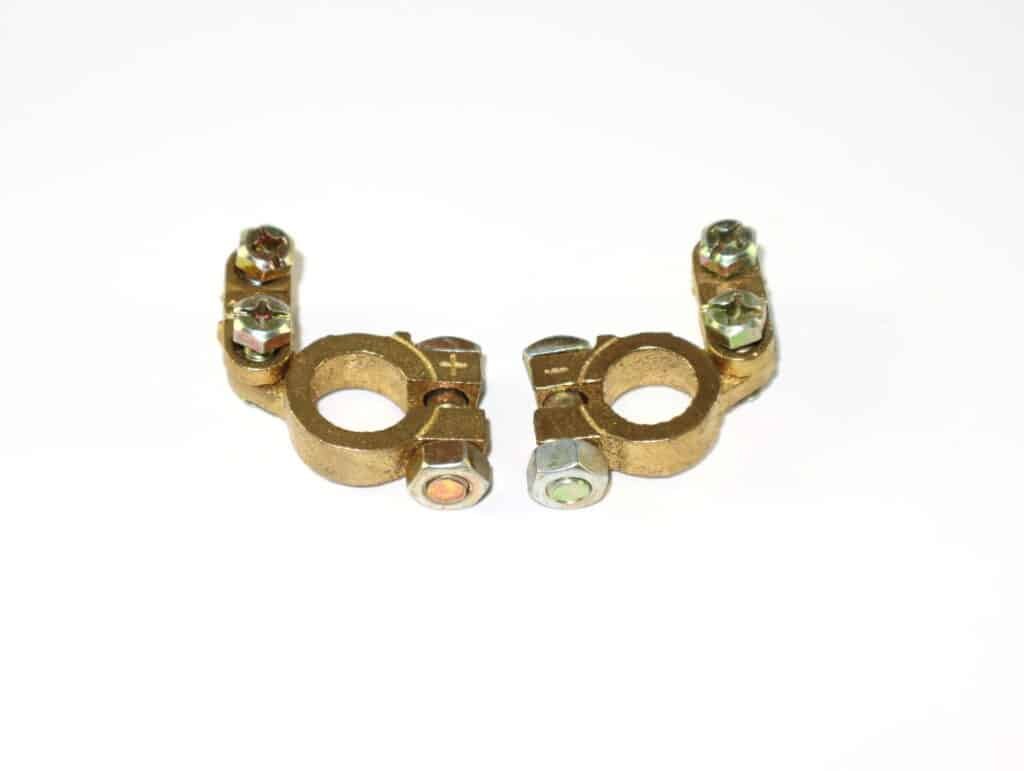
Brass maintains a stable, low-resistance contact surface through its service life. Its copper-zinc alloy (CuZn37, C26000) forms a thin oxide layer that’s electrically conductive enough not to matter in most automotive joint designs. Brass connectors in 12V and 24V ICE applications routinely survive 10+ years under hood without measurable increase in contact resistance.
Aluminum is different. Aluminum oxidizes immediately upon exposing new metal, and aluminum oxides are not good electrical conductors — unlike copper oxides, which retain decent conductivity. An unprotected aluminum connector will see rising contact resistance within weeks of installation in a damp under-hood environment.
The engineering response to that problem is surface treatment: tin plating, silver plating, or nickel plating applied over the aluminum substrate. Done correctly, the plating acts as the contact surface — the aluminum becomes a structural and weight-saving body, not the electrical interface.
Brass vs Aluminum: Key Properties for Car Battery Connectors
| Property | Brass (CuZn37 / C26000) | Aluminum (6061-T6) |
|---|---|---|
| Electrical conductivity | ~26–28% IACS | ~9% IACS |
| Density | 8.5 g/cm³ | 2.70 g/cm³ |
| Tensile strength | 380–525 MPa | 310 MPa |
| Thermal conductivity | ~120 W/m·K | 167 W/m·K |
| Machinability | Excellent (free-cutting C36000: ~100% rating) | Excellent |
| Native oxide behavior | Conductive — stable contact | Non-conductive — must be plated |
| Typical surface treatment | Tin plate, nickel plate, bare | Tin plate, silver plate, hard anodize |
| Relative raw material cost | Moderate–high (copper content) | Lower |
The density gap is decisive in EV programs. Aluminum is significantly lighter than brass, and on a typical EV battery pack with 40–80 connector interfaces, switching from brass to aluminum-bodied, tin-plated connectors cuts several hundred grams from the pack — meaningful when range targets drive every gram of BOM weight.
💡 Engineer’s Note: Don’t compare bare conductivity numbers in isolation. What matters is contact resistance at the joint, which is a function of contact force, surface finish, plating thickness, and assembly torque — not bulk conductivity alone. A properly plated aluminum connector with correct clamp force will outperform a corroded brass connector with inadequate torque every time.
When Should You Specify Brass Battery Connectors?
Brass is the right default for 12V/24V ICE terminals, heavy truck battery clamps, and any connector where long service intervals, minimal maintenance, and no surface treatment are the program requirements.
Brass battery connectors are commonly used in marine applications because they are low-corrosion and low-resistance, and in equipment that needs top performance and maximum output. That same logic applies to under-hood automotive environments where connectors face acid vapor, temperature cycling from −40°C to +125°C, and vibration loads that a poorly plated aluminum connector can’t sustain over a 15-year vehicle life.
Specific applications where brass wins:
- 12V/24V lead-acid terminal clamps (top-post and side-post) on ICE vehicles
- Heavy truck battery disconnect connectors where torque loads on the terminal post exceed what thin-wall aluminum can handle
- Marine and off-road battery connectors exposed to salt spray, mud, and water immersion without regular maintenance
- Connector studs and inserts that require press-fit or staked assembly into a housing — brass resists galling better than aluminum under the assembly force
⚠️ Common Pitfall: Specifying aluminum for a terminal clamp application that uses a bolt-through-the-lug clamping design. Aluminum under repeated clamp-bolt torque creeps at the thread engagement, causing gradual loss of contact force. Either use brass for the threaded section, or design a stainless steel insert into the aluminum body before machining.
When Should You Specify Aluminum Battery Connectors?
Aluminum dominates EV high-voltage (HV) connector bodies, battery management system (BMS) bus bar brackets, and lightweight automotive programs where plating is specified and installed torque is controlled.
Aluminum connectors are applied in powertrain systems, EV battery packs, and signal connectors that must withstand vibration and thermal cycling. The EV market has standardized on aluminum bodies for HV connector housings precisely because the weight saving over a full pack is significant, and tin or silver plating resolves the oxidation problem definitively.
Specific applications where aluminum wins:
- EV battery pack HV connector housings — 6061-T6 body, silver-plated contact surfaces
- BMS bus bar mounting brackets — 6061-T6, hard anodized
- Lightweight terminal blocks for hybrid and PHEV auxiliary battery systems
- Motorcycle and bicycle battery connectors where weight reduction is a direct customer requirement
🔧 Keyfix in Practice: For EV battery connector programs, Keyfix machines 6061-T6 aluminum bodies to ±0.01 mm on contact bore diameters, coordinates silver or tin plating with qualified automotive plating partners, and ships with full 3.1 MTR on bar stock and plating thickness reports. IATF 16949 documentation covers the full process flow from raw material to packed-out connector.
What Surface Treatments Are Required for Automotive Battery Connectors?
Surface treatment is where most battery connector failures originate — and where your drawing must be most specific.
For brass connectors:
- Tin plating (2–10 µm per IEC 60068-2-52): most common, good solderability, resists fretting corrosion in vibration environments
- Nickel plating (3–12 µm): higher hardness, better wear resistance at mating contacts, common for high-cycle connector applications
- Bare / passivated: acceptable for 12V clamp-style terminals with high clamping force; not suitable for precision mating contacts
For aluminum connectors:
- Tin plating (5–15 µm): standard for EV HV connector contact surfaces; requires zincate pre-treatment on aluminum to ensure adhesion
- Silver plating (3–8 µm): lowest contact resistance, highest cost, specified for high-current bus bars and contacts above 200A
- Hard anodize (Type III per MIL-A-8625): for non-contact structural surfaces; 25–75 µm, hardness equivalent to ~60 HRC — do not apply to contact areas that need plating
| Application | Material | Required Finish | Standard Reference |
|---|---|---|---|
| 12V ICE terminal clamp | Brass C36000 | Tin plate 3–5 µm | IEC 60068-2-52 |
| Heavy truck battery lug | Brass CuZn37 | Nickel plate 5–10 µm | SAE J163 |
| EV HV connector body | 6061-T6 Al | Hard anodize (non-contact) + silver plate (contact) | MIL-A-8625 |
| BMS bus bar bracket | 6061-T6 Al | Hard anodize or clear anodize | MIL-A-8625 |
| Marine battery terminal | Brass C26000 | Tin plate + topcoat | SAE J163 |
Need help deciding? Send your battery connector drawing to Keyfix engineers and we’ll confirm the right material, plating route, and tolerance callouts — with a DFM quote usually within 48 hours.
What Manufacturing Tolerances Apply to Custom Battery Connectors?
A battery connector is a precision-machined part, not a stamped commodity — especially on EV programs.
Bore diameters on terminal post fits follow ISO 286-1: H7 tolerance on the connector bore, with f7 or h6 on the mating post. For a 10 mm post, that means the connector bore is held to +0.015/0.000 mm to achieve the required running clearance.
Thread engagement on stud-type connectors should be called out per ISO 965-1, with class 6H internal thread tolerance as the default. Specifying only “M8 thread” without a tolerance class lets a supplier deliver anywhere from 6H to 7H — and in a connector application under vibration, 7H costs you preload.
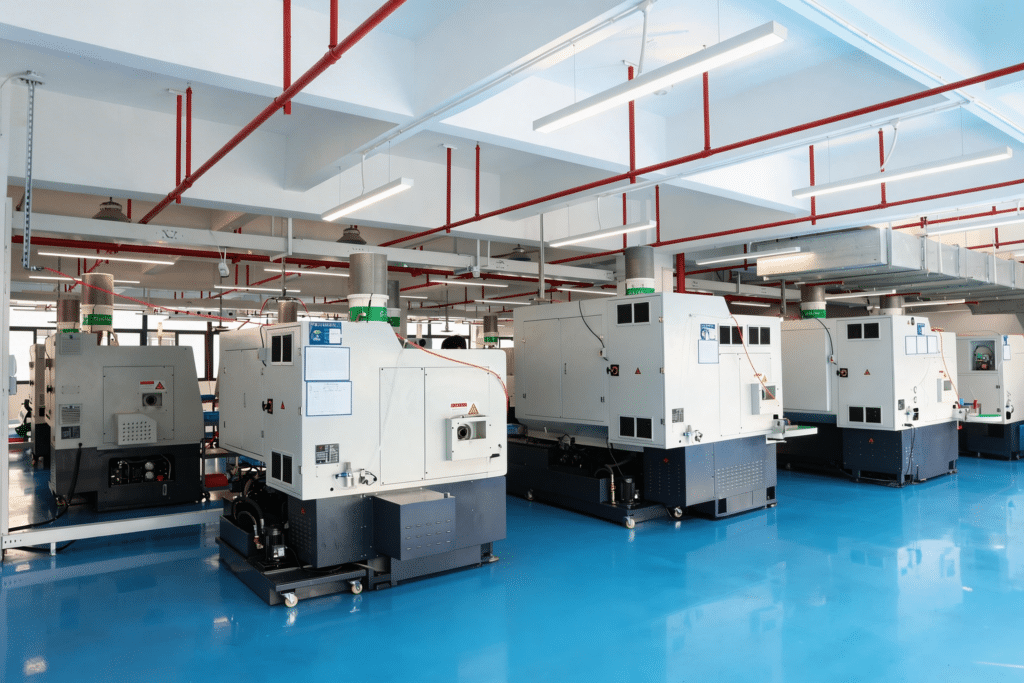
Wall thickness on thin-wall aluminum connector bodies requires 4-jaw independent chuck or hydraulic mandrel fixturing during finish turning. Standard 3-jaw chucks distort thin-wall bores during clamping, producing out-of-round conditions that fail gauge inspection after unclamping. At Keyfix, CNC turning cells hold ±0.005 mm roundness on aluminum connector bores up to 80 mm diameter using custom soft-jaw setups.
Frequently Asked Questions
What’s the MOQ for custom brass or aluminum car battery connectors?
CNC-machined custom battery connectors typically start at 50–200 pieces for first samples with no hard tooling cost — just programming and fixturing. For cold-headed terminals at production volumes, MOQs start at 5,000–10,000 pieces to amortize heading tooling. Keyfix offers low-MOQ CNC samples for design validation before any tooling commitment is required.
What’s the lead time for custom car battery connector samples?
First CNC samples ship in 1–2 weeks for standard brass or 6061-T6 aluminum geometries. Add 1–2 weeks if tin or silver plating is specified, as automotive plating requires process qualification and salt-spray testing. Full Level 3 PPAP adds another 2–4 weeks after sample approval for production release.
Do brass or aluminum connectors require any special torque specifications?
Yes, and it should be on your drawing or assembly spec. Brass connector clamp bolts typically use M6 or M8 flange bolts at 10–15 N·m for 12V terminal applications. Aluminum connector bodies require lower torque limits due to aluminum’s lower yield strength and creep tendency at elevated temperatures — specify a torque value, not just a bolt size, on the assembly drawing.
What certifications come with each shipment?
Standard documentation includes a 3.1 Mill Test Report per EN 10204 on bar stock, dimensional inspection records with CMM data on critical features, plating thickness measurements, salt-spray test results where applicable, and a Certificate of Conformance. For automotive programs, full PPAP Level 3 with FMEA, control plan, MSA, and IMDS submission is available.
Can Keyfix machine connectors in both brass and aluminum under one program?
Yes. Keyfix runs brass (free-cutting C36000 and CuZn37) and aluminum (6061-T6 and 7075-T6) on the same CNC turning and milling centers, under one IATF 16949 quality plan. Mixed-material programs — for example, an aluminum connector body with a brass insert for the stud engagement — are handled in-house with no sub-supplier interface for machining.
What Incoterms do you support for battery connector programs?
FOB/FCA Guangzhou is the standard. CIF, CIP, and DDP are available. Ocean freight to Los Angeles runs 18–22 days; to Hamburg 25–30 days. Air freight is available for first-article and urgent orders, typically 3–5 days. All connectors ship in anti-corrosion VCI packaging as standard.
Send your battery connector drawing — including material, plating spec, annual volume, and target application — to the Keyfix engineering team. We’ll review the DFM, confirm material and surface treatment, and return a quote with a realistic production and PPAP timeline, usually within 48 hours.
Author: Keyfix Engineering Team Published: May 10, 2026 Last Updated: May 10, 2026