5 axis aluminum CNC machining parts and CNC turned parts cover the two complementary processes behind most precision aluminum components — milling complex 3D geometry in a single setup, and turning rotationally symmetric parts at high throughput. For buyers sourcing aluminum housings, brackets, shafts, manifolds, or optical mounts, the choice between 5-axis machining and CNC turning (or a combination of both) determines tolerance, surface finish, lead time, and unit cost. This guide explains the engineering logic, material behavior, tolerance philosophy, and sourcing criteria — with the spec-level detail you need to write an accurate RFQ.
TL;DR — Key Takeaways
- 5-axis machining holds the workpiece in one setup while approaching from five directions, eliminating the repositioning errors that stack up across multiple 3-axis setups.
- CNC turning is the throughput champion for round parts — shafts, bushings, pins — reaching ±0.005 mm on diameters with Swiss-type lathes.
- Aluminum 6061-T6 and 7075-T6 dominate CNC aluminum work; 6061 balances cost and machinability, 7075 delivers aerospace-grade strength at higher cost.
- 5-axis aluminum parts achieve ±0.01 mm on complex contoured surfaces; turned aluminum parts reach ±0.005 mm on critical diameters.
- Verified material traceability via OES, dimensional inspection, and documented Cpk separate OEM-grade suppliers from commodity job shops.
What Is the Difference Between 5-Axis Machining and CNC Turning?
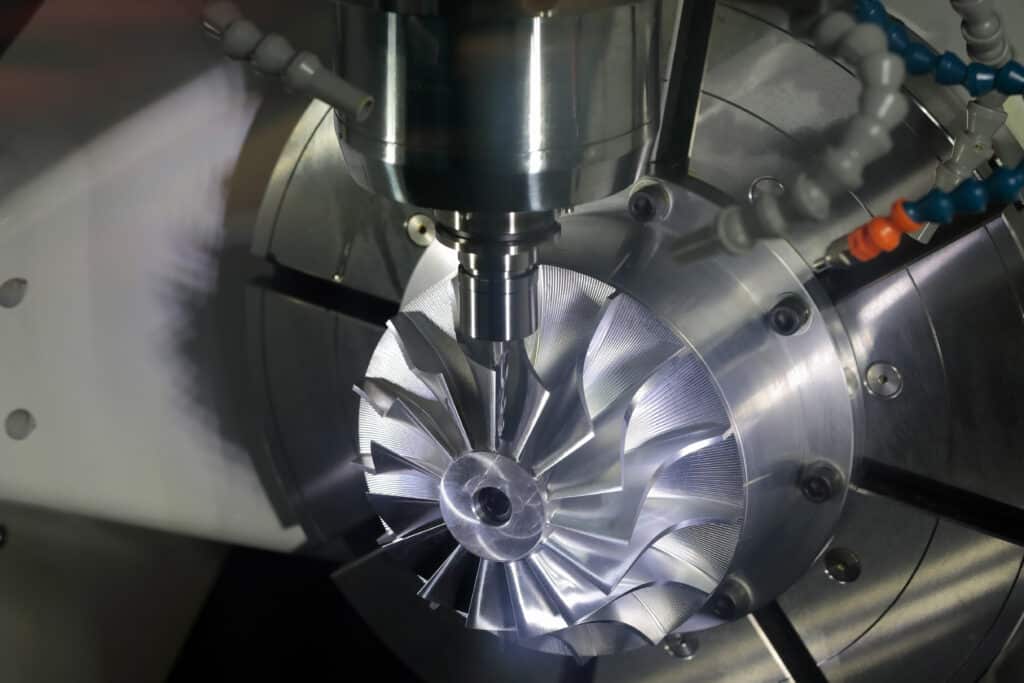
The two processes solve different geometric problems. 5-axis machining moves a cutting tool around a stationary or rotating workpiece along five axes — three linear (X, Y, Z) plus two rotary (typically A and C). This lets the tool reach undercuts, angled bosses, and contoured surfaces without re-fixturing. CNC turning spins the workpiece against a stationary cutting tool, ideal for any part with rotational symmetry.
| Attribute | 5-Axis Machining | CNC Turning |
|---|---|---|
| Best geometry | Complex 3D contours, undercuts, angled features | Round parts: shafts, bushings, pins, fittings |
| Number of setups | One (single fixturing) | One to two |
| Tolerance (aluminum) | ±0.01 mm on contours | ±0.005 mm on diameters |
| Surface finish (Ra) | 0.4–1.6 μm | 0.4–1.6 μm |
| Volume sweet spot | 1–2,000 pieces | 50–1,000,000+ pieces |
| Cycle time | Longer (multi-axis interpolation) | Short (high spindle speed) |
| Typical cost index | 2.0× | 0.6–1.0× |
Many real components need both. A turned aluminum shaft with a milled flat and a cross-drilled hole starts on a lathe and finishes on a mill — or runs on a mill-turn center that combines both in one machine. KeyFix’s CNC machining capability covers both ends of this spectrum, running YCM NFX 380A 5-axis centers alongside CNC lathes and mill-turn centers under one roof.
💡 Engineer’s Note: If your part is round with a few off-axis features, specify a mill-turn (live tooling) lathe rather than separate turning and milling operations. Mill-turn consolidates both into a single setup, eliminating the re-fixturing error that degrades position tolerance between the turned and milled features.
Why Choose Aluminum for CNC Machined Parts?
Aluminum is the most-machined metal in precision manufacturing for four reasons: machinability, weight, conductivity, and corrosion resistance.
Machinability — Aluminum cuts faster than steel, stainless, or titanium, with a machinability rating around 70–90 % of free-cutting brass. Higher cutting speeds mean shorter cycle times and lower per-part cost.
Weight — At 2.70 g/cm³, aluminum is roughly one-third the density of steel, making it the default for weight-critical aerospace, automotive, and robotics components.
Thermal and electrical conductivity — Aluminum’s high conductivity suits heat sinks, electronic enclosures, and RF housings.
Corrosion resistance — Aluminum forms a self-protecting oxide layer; anodizing enhances it further for outdoor and marine service.
| Aluminum Alloy | Yield Strength (MPa) | Machinability | Corrosion | Best Application |
|---|---|---|---|---|
| 6061-T6 | 276 | Excellent | Good (anodize improves) | General-purpose brackets, housings, plates |
| 7075-T6 | 503 | Good | Moderate (anodize required) | Aerospace structural, high-stress parts |
| 2024-T3 | 345 | Good | Moderate | Aircraft fittings, fatigue-critical parts |
| 5052-H32 | 193 | Good (gummy) | Excellent (marine) | Sheet enclosures, marine hardware |
| 6063-T5 | 145 | Excellent | Good | Extruded profiles, architectural |
For most 5 axis aluminum CNC machining parts and CNC turned parts, 6061-T6 is the volume default — it balances cost, machinability, and mechanical performance. 7075-T6 is reserved for applications where strength-to-weight is paramount and the higher material cost is justified.
What Tolerances Can 5-Axis Aluminum Machining Achieve?
Tolerance capability drives cost more than any other specification. The principle: specify the tolerance your function requires, not the tightest the machine can hold.
| Tolerance Class | Value (mm) | Cost Multiplier | Inspection Method | Aluminum Application |
|---|---|---|---|---|
| General (ISO 2768-m) | ±0.10–0.20 | 1.0× | Caliper | Non-critical brackets |
| Fine (ISO 2768-f) | ±0.05–0.10 | 1.3× | Micrometer, height gauge | Mounting interfaces |
| Precision | ±0.02–0.05 | 1.8× | Dial indicator, 2D video measuring | Bearing fits, alignment |
| High Precision | ±0.01–0.02 | 2.5× | 2D video measuring | Optical mounts, sealing faces |
| Ultra Precision | ±0.005–0.01 | 4.0× | 2D video measuring, 3D scanning | Semiconductor tooling |
A well-specified aluminum drawing identifies a few critical features at tight tolerance and allows general tolerances elsewhere — cutting inspection time by 40–60 % without compromising function. KEYFIX verifies critical features by 2D video measuring (0.001 mm measurement resolution) and Shining3D 3D scanning, with full first-article inspection documentation through its quality control and inspection standards program.
⚠️ Common Pitfall: Applying a blanket ±0.01 mm tolerance to every dimension on an aluminum part — including non-functional features — can double the inspection cost and triple the scrap rate. Reserve ultra-precision tolerances for the 3–8 features that actually need them.
What Surface Finishes and Treatments Apply to Aluminum CNC Parts?
Aluminum CNC parts often need surface treatment for corrosion protection, wear resistance, electrical properties, or appearance. The native oxide layer protects raw aluminum, but engineered finishes extend service life significantly.
| Treatment | Thickness (μm) | Key Property | Appearance | Best Use |
|---|---|---|---|---|
| Type II Anodize | 5–25 | Corrosion + color | Clear or dyed | Indoor/outdoor, decorative |
| Type III Hard Anodize | 25–75 | Wear resistance (400+ HV) | Grey to black | High-wear, industrial |
| Chromate Conversion (Alodine) | 0.5–4 | Electrical conductivity + corrosion | Gold or clear | Grounding, RF housings |
| Bead Blast | Surface texture | Uniform matte | Satin grey | Cosmetic prep |
| Powder Coat | 60–120 | Corrosion + color | Any RAL color | Outdoor enclosures |
| Brushed + Clear Anodize | 8–15 | Premium aesthetic | Brushed metallic | Consumer products |
KeyFix supplies anodizing, chromate conversion, and powder coating for aluminum parts, and zinc-nickel and DACROMET for steel components — detailed on its raw material and surface treatment page.
How Are 5-Axis Aluminum Parts and CNC Turned Parts Manufactured?
The production route depends on geometry, volume, and tolerance. The table below maps process to part type.
| Process | Best For | Volume | Tolerance | KeyFix Capability |
|---|---|---|---|---|
| 5-axis simultaneous milling | Impellers, contoured housings, undercuts | 1–2,000 | ±0.01 mm | YCM NFX 380A 5-axis centers |
| 3+2 positional milling | Angled holes, multi-face prismatic parts | 1–5,000 | ±0.02 mm | 5-axis in positional mode |
| CNC turning (2-axis) | Shafts, bushings, simple round parts | 50–100,000 | ±0.02 mm | Swiss-type and chucker lathes |
| Swiss-type turning | Small slender precision parts (≤32 mm) | 500–1,000,000+ | ±0.005 mm | CNC lathes (Shengtesi H46/H52) |
| Mill-turn (live tooling) | Round parts with off-axis features | 50–50,000 | ±0.01 mm | Combined turn-mill cells |
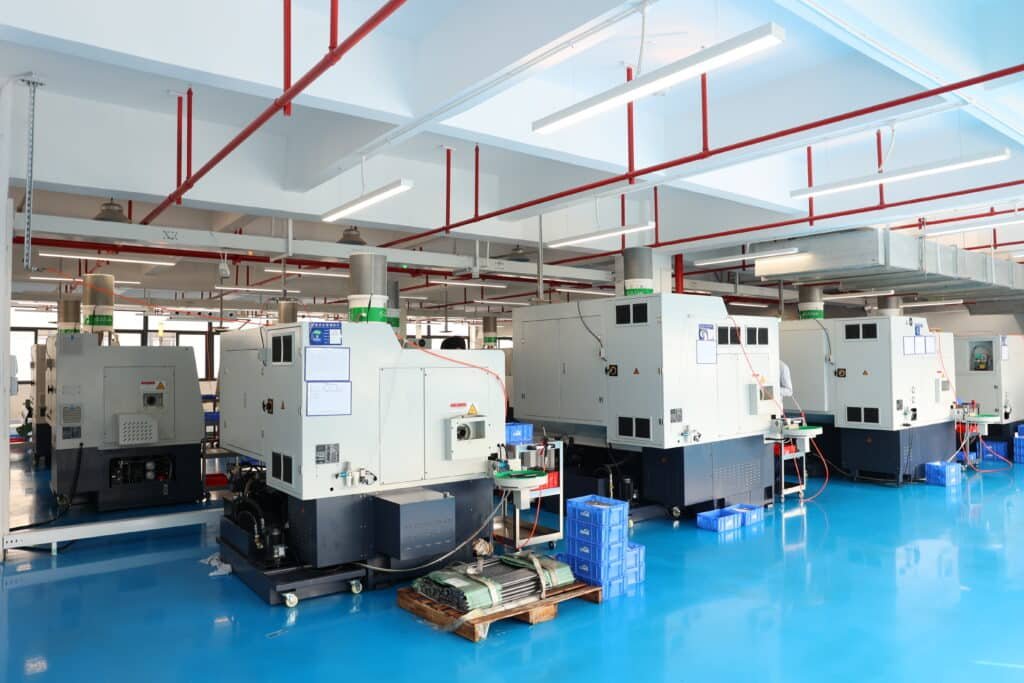
KeyFix runs 2 YCM NFX 380A 5-axis machining centers holding ±0.005 mm on complex components. This equipment profile — explained in full on the machining technology overview — covers everything from prototype 5-axis aluminum housings to high-volume turned production runs.
Need a quote on 5-axis aluminum or CNC-turned parts? Send your STEP file or drawing to KeyFix engineers — you’ll get a DFM review and quotation within 48 hours. Get a quote here or email sales@keyfixpro.com.
What Should You Specify on an Aluminum CNC Drawing?
A complete drawing prevents the back-and-forth that delays quotes and inflates rejection rates.
| Drawing Call-Out | What to Specify | Why It Matters |
|---|---|---|
| Alloy and temper | e.g., 6061-T6, 7075-T6 | Drives strength, machinability, cost |
| Critical tolerances | Feature-specific (e.g., ±0.01 mm bore) | Controls fit and function |
| Surface finish (Ra) | Per surface (e.g., Ra 0.8 μm sealing face) | Drives finishing cost |
| Surface treatment | Type, thickness, masking areas | Defines corrosion + appearance |
| Thread callouts | Standard ISO/UNC threads | Avoids specialty tooling surcharge |
| Edge condition | Deburr, chamfer, radius spec | Affects handling safety and assembly |
| Material certification | Mill cert, RoHS/REACH if required | Required for regulated industries |
KeyFix machines aluminum parts across automotive, electronics, and machinery sectors — its automotive fastener and component programs and lightweight racing components demonstrate the range of aluminum work delivered to OEM specification.
How Do You Qualify a 5-Axis Aluminum CNC Manufacturer?
Sourcing precision aluminum parts requires verifying both equipment and quality systems.
| Audit Point | Minimum Requirement | KeyFix Status |
|---|---|---|
| Quality system | ISO 9001 minimum | IATF 16949 + ISO 9001 + ISO 14001 |
| 5-axis equipment | Modern multi-axis centers | YCM NFX 380A 5-axis |
| Material verification | OES on incoming aluminum | SPECTRO (Germany) OES on 100 % of heats |
| Dimensional control | 2D video measuring and 3D scanning with documented accuracy | 2D video measuring (0.001 mm resolution) and Shining3D 3D scanning |
| Surface finish testing | Profilometer | Digital roughness testers |
| SPC implementation | Cpk ≥ 1.33 on critical dims | Cpk ≥ 1.67, real-time SPC |
| First article reports | Full dimensional layout | AS9102 / PPAP Level 3 capable |
| Traceability | Per-lot to material heat | Digital per-lot traceability |
KeyFix’s vertically integrated campus combines 5-axis CNC machining, cold forging, and precision stamping under a single IATF 16949 quality system, with AQL 0.4 outgoing inspection and a target below 25 PPM.
What Are the Logistics and Shipping Terms?
| Term | Detail |
|---|---|
| Manufacturing location | Guangdong Province |
| Standard shipping term | FCA at our Guangdong plant |
| Sea freight term | FOB Shenzhen Yantian Port |
| Prototype lead time | 7–14 business days (air-expressed) |
| Production lead time | 4–6 weeks after PPAP approval |
The proximity of our Guangdong production base to Shenzhen Yantian Port streamlines export logistics — finished aluminum parts move from machining to port within a short inland haul, reducing transit time and freight cost for international buyers.
Frequently Asked Questions
What’s the minimum order quantity for 5-axis aluminum CNC parts?
CNC-machined aluminum parts have no MOQ — prototypes can start from a single piece, with lead times of 7–14 days air-expressed. Production volumes scale with tiered pricing at 1,000, 10,000, and 100,000+ quantities. Swiss-type turning production is most cost-effective at 10,000+ pieces.
What certifications does KeyFix hold for CNC machining?
KeyFix holds IATF 16949, ISO 9001, and ISO 14001 certifications. Full first-article inspection reports, material certificates, and PPAP Level 3 documentation are standard for OEM programs. The complete quality system is detailed in the inspection standards documentation.
Can KeyFix machine both 5-axis milled and CNC-turned aluminum parts?
Yes. KeyFix runs YCM NFX 380A 5-axis machining centers for complex contoured parts and CNC lathes for precision turned components, plus mill-turn cells for round parts with off-axis features. This combination handles the full geometry spectrum from a single supplier.
What aluminum alloys does KeyFix machine?
KeyFix machines 6061-T6, 7075-T6, 2024-T3, 5052-H32, and 6063-T5 aluminum alloys, with incoming material verified by SPECTRO (Germany) OES. Custom alloy requests are accommodated with mill certification.
What lead time and shipping terms apply?
Prototype lead time is 7–14 business days; production runs ship 4–6 weeks after PPAP approval. Standard shipping is FCA at our Guangdong plant, with sea freight as FOB Shenzhen Yantian Port from our Guangdong production base.
How does KeyFix ensure dimensional accuracy on 5-axis aluminum parts?
Through 2D video measuring (0.001 mm measurement resolution) and Shining3D 3D scanning on critical features, with IPQC checks every two hours during production. Every new part number receives a documented first-article inspection report.
If your next project needs 5-axis aluminum CNC machining parts or CNC turned parts — housings, brackets, shafts, manifolds, or precision components — send your drawing or STEP file to KeyFix’s engineering team for a free DFM review and quotation within 48 hours. Explore the full product portfolio or contact KeyFix at sales@keyfixpro.com.
Author: KeyFix Engineering Team Published: May 31, 2026 Last Updated: May 31, 2026