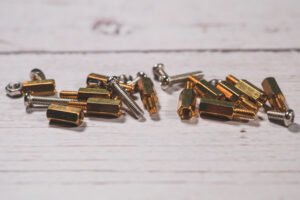
304 stainless steel dowel pins are solid cylindrical rods that locate, align, and support mating components through a precision interference or slip fit. The same core geometry serves two distinct worlds: industrial machine-building, where ground dowel pins set the position of jigs and fixtures to micron accuracy, and furniture and cabinetry, where cylindrical shelf support pegs carry shelf loads in bookcases and cabinets. This guide covers the metallurgy, dimensional standards, fit classes, load behavior, and sourcing criteria for 304 stainless dowel pins, shelf support pegs, and pin rods.
TL;DR — Key Takeaways
- 304 stainless steel (A2, 18-8) delivers 515–620 MPa tensile strength, excellent corrosion resistance, and non-magnetic behavior — ideal for moisture-exposed and food-adjacent applications.
- Industrial dowel pins follow ISO 2338 / DIN 7 (unhardened) and ASME B18.8.2 standards; shelf support pegs follow furniture-industry conventions (typically 5 mm and 6.3 mm / ¼” diameters).
- Interference fit (press fit) locates pins permanently; slip fit (clearance) allows removable shelf pegs — the fit class is the single most important dimensional decision.
- A 5 mm 304 stainless dowel pin in double shear carries roughly 8–10 kN before failure; a shelf peg of the same size supports furniture loads far below that limit.
- Verified material traceability via OES, precision dimensional inspection, and documented Cpk separate OEM-grade suppliers from commodity pin shops.
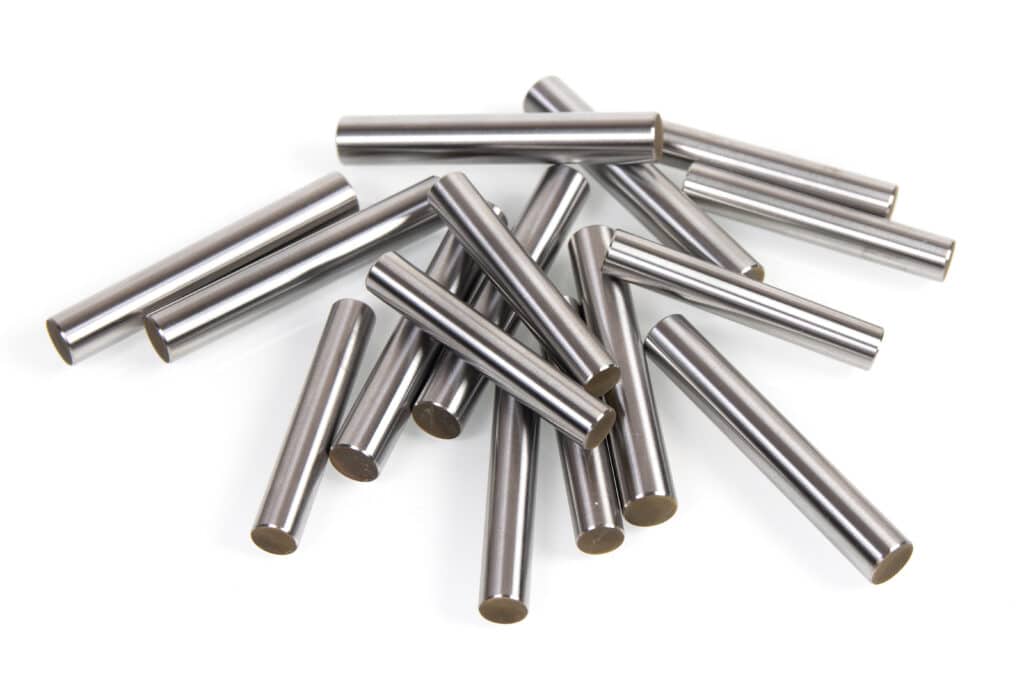
What Is a 304 Stainless Steel Dowel Pin?
A dowel pin is a solid cylindrical rod, usually chamfered at one or both ends, that fits precisely into a reamed or drilled hole. Its function is location and alignment — holding two components in exact relative position while resisting shear loads. Unlike a screw, a dowel pin carries no thread and provides no clamping force.
The cylindrical shelf support peg is the furniture-industry variant. It inserts into a drilled hole in a cabinet side panel and projects outward to carry a shelf’s weight. The engineering principle is identical; only the load class and fit tolerance differ.
| Pin Type | Function | Fit Class | Typical Diameter | Primary Use |
|---|---|---|---|---|
| Industrial dowel pin (precision) | Location + shear transfer | Interference (press) | 1–25 mm | Jigs, fixtures, machine assembly |
| Slip-fit dowel pin | Removable alignment | Clearance (slip) | 2–20 mm | Serviceable assemblies, tooling |
| Cylindrical shelf support peg | Shelf load support | Clearance (removable) | 5 mm, 6.3 mm (¼”) | Furniture, cabinetry, shelving |
| Pin rod (cut-to-length) | Custom location/support | Per application | 1–25 mm | Custom mechanical assemblies |
| Spring/coiled pin | Self-retaining location | Interference (radial) | 1.5–20 mm | Vibration-prone joints |
KeyFix machines all of these variants from 304 stainless and other materials through its CNC machining capability, running CNC lathes well-suited to high-precision cylindrical pin production.
Why Choose 304 Stainless Steel for Dowel Pins and Pegs?
304 stainless steel (also designated A2 or 18-8, for its ~18 % chromium and ~8 % nickel) is the workhorse stainless grade for pins and pegs. Four properties drive its dominance.
Corrosion resistance — The chromium forms a self-healing passive oxide layer, ideal for humid, washdown, and food-adjacent environments where carbon steel rusts.
Non-magnetic behavior — In annealed state, 304 is essentially non-magnetic, suited to electronics, instrumentation, and medical applications.
Strength with ductility — At 515–620 MPa tensile, 304 resists shear while tolerating minor misalignment without cracking.
Aesthetic finish — The clean silver appearance suits visible furniture pegs without additional coating.
| Material | Tensile (MPa) | Corrosion | Magnetic? | Cost Index | Best Pin Application |
|---|---|---|---|---|---|
| 304 Stainless (A2) | 515–620 | Excellent | No (annealed) | 1.0× | General-purpose, furniture, food-adjacent |
| 316 Stainless (A4) | 515–620 | Outstanding (chloride) | No | 1.4× | Marine, chemical, coastal |
| Carbon Steel (hardened) | 600–800 | Poor (needs coating) | Yes | 0.7× | High-wear industrial dowels |
| Alloy Steel (4140) | 655–900 | Poor (needs coating) | Yes | 0.9× | High-shear machine dowels |
| Brass (C36000) | 310–380 | Excellent | No | 1.6× | Electrical, decorative pegs |
| Aluminum (6061-T6) | 276 | Good | No | 0.8× | Lightweight, non-structural |
For corrosion-exposed or visible applications, 304 stainless is the default; 316 is reserved for marine and chloride-rich environments where the extra molybdenum justifies the cost premium.
💡 Engineer’s Note: For shelf support pegs in kitchen and bathroom cabinetry — humid, occasionally wet environments — 304 stainless outperforms zinc-plated steel pegs that corrode and stain surrounding wood over time. The small cost premium is trivial against a warranty callback for rust-stained cabinetry.
What Dimensional Standards Apply to Stainless Dowel Pins?
Industrial dowel pins follow international dimensional standards defining diameter tolerance, chamfer geometry, and surface finish. Furniture shelf pegs follow looser industry conventions.
| Standard | Region | Scope | Diameter Tolerance |
|---|---|---|---|
| ISO 2338 | International | Unhardened cylindrical dowel pins | m6 or h8 |
| DIN 7 | Germany/EU | Cylindrical dowel pins (≈ ISO 2338) | m6 or h8 |
| ASME B18.8.2 | USA | Hardened ground machine dowel pins | +0.0002″ oversize |
| ISO 8734 | International | Hardened dowel pins | m6 |
| GB/T 119 | China | Cylindrical pins (national standard) | m6 or h8 |
| Furniture convention | Global | Shelf support pegs | ±0.1 mm (looser) |
The fit class designation (m6, h8, etc.) defines how the pin diameter relates to the hole. An m6 pin is slightly oversized for an interference (press) fit; an h8 pin is undersized for a slip (clearance) fit. Specifying the wrong fit class is the most common dowel-pin error.
| Fit Type | Pin/Hole Relationship | Retention | Application |
|---|---|---|---|
| Interference (press) fit | Pin OD > hole ID by 0.005–0.025 mm | Permanent; held by friction | Machine assembly, jig location |
| Transition fit | Pin OD ≈ hole ID | Light retention | Precision alignment, occasional removal |
| Clearance (slip) fit | Pin OD < hole ID by 0.01–0.05 mm | Removable by hand | Shelf pegs, serviceable tooling |
KeyFix holds dowel pin diameter tolerances to m6 class and tighter, verified by 2D video measuring and Mitutoyo micrometers and documented through its inspection standards program.
⚠️ Common Pitfall: Ordering “5 mm dowel pins” without specifying the fit class (m6 vs h8) leaves the supplier guessing between press fit and slip fit. The diameter difference is only microns, but it determines whether the pin presses in permanently or slides out by hand. Always state the fit class.
How Much Load Can a 304 Stainless Dowel Pin Carry?
Dowel pins primarily resist shear loads — forces perpendicular to the pin axis. Shear capacity depends on cross-sectional area and material shear strength (roughly 60 % of tensile for 304 stainless).
| Pin Diameter | Cross-Section (mm²) | Single Shear (kN) | Double Shear (kN) | Typical Shelf Peg Load* |
|---|---|---|---|---|
| 3 mm | 7.07 | 2.1 | 4.2 | N/A (industrial) |
| 5 mm | 19.6 | 5.9 | 11.8 | 15–25 kg per peg |
| 6 mm | 28.3 | 8.5 | 17.0 | 20–35 kg per peg |
| 6.3 mm (¼”) | 31.2 | 9.4 | 18.7 | 25–40 kg per peg |
| 8 mm | 50.3 | 15.1 | 30.2 | 35–60 kg per peg |
| 10 mm | 78.5 | 23.6 | 47.1 | N/A (industrial) |
*Shelf peg load is governed by furniture safety factors and hole bearing strength in the panel material — far below the pin’s structural shear limit. The pin is rarely the weak link; the wood or particleboard hole usually fails first.
This large margin explains why shelf failures are almost never pin failures — they’re hole-bearing failures in the cabinet panel. For heavy shelving, larger peg diameter and a denser panel material matter more than pin metallurgy.
How Are 304 Stainless Dowel Pins Manufactured?
Two processes dominate stainless dowel pin and peg production, selected by volume and tolerance.
| Process | Best For | Volume | Tolerance | KeyFix Capability |
|---|---|---|---|---|
| Swiss-type CNC turning | Precision pins, tight tolerance | 500–1,000,000+ | ±0.005 mm | CNC lathes (Shengtesi H46/H52) |
| CNC turning (chucker) | Larger-diameter pins, short runs | 100–50,000 | ±0.01 mm | Multi-axis turning centers |
| Centerless grinding | Ultra-precision ground pins | 1,000–500,000 | ±0.002 mm | Available |
| Cold heading + cut-off | High-volume standard pegs | 50,000+ | ±0.02 mm | Multi-station headers |
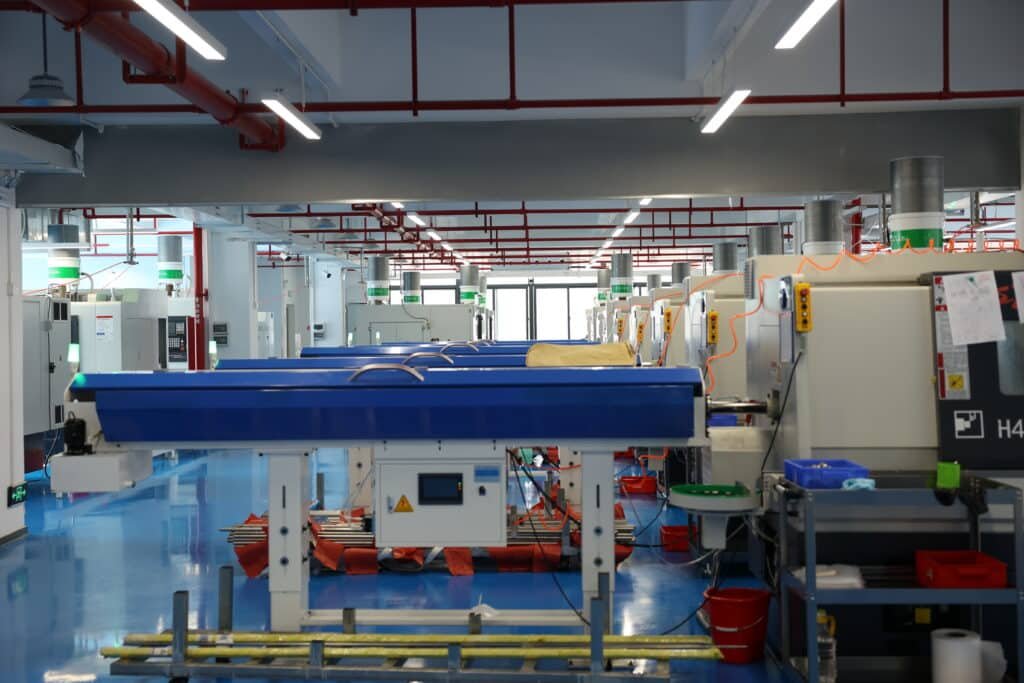
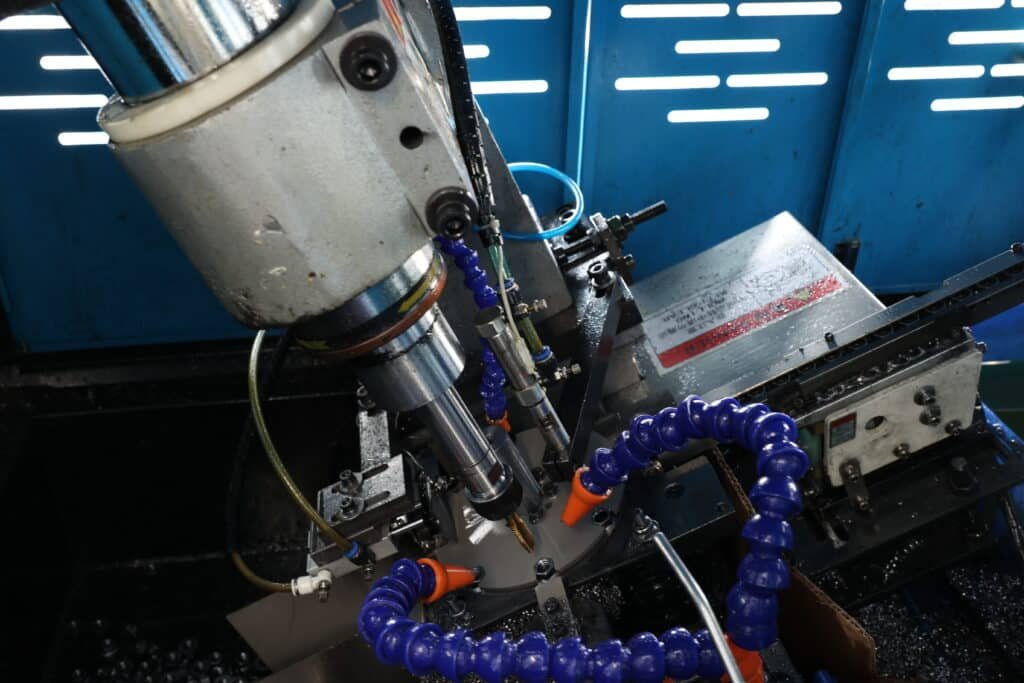
Swiss-type turning is the preferred process for precision 304 stainless dowel pins — the sliding guide bushing supports the workpiece adjacent to the cutting tool, enabling length-to-diameter ratios above 20:1 at tight tolerance. KeyFix runs CNC lathes alongside 5-axis machining centers, detailed on its machining technology overview, and verifies incoming 304 chemistry via SPECTRO (Germany) OES.
Need a quote on 304 stainless dowel pins or shelf pegs? Send your drawing or sample to KeyFix engineers — you’ll get a DFM review and quotation within 48 hours. Get a quote here or email sales@keyfixpro.com.
What Surface Finishes Apply to Stainless Pins and Pegs?
304 stainless needs no corrosion coating, but surface finish affects fit, friction, and appearance.
| Finish | Ra (μm) | Process | Best Application |
|---|---|---|---|
| As-turned | 0.8–1.6 | CNC turning | General industrial pins |
| Ground | 0.2–0.4 | Centerless grinding | Precision interference-fit dowels |
| Passivated | (chemical) | Nitric/citric passivation | Maximum corrosion resistance |
| Electropolished | 0.1–0.4 | Electrochemical | Medical, food-grade, visible pegs |
| Bead blasted | 0.8–2.0 | Glass bead | Matte decorative pegs |
Passivation is recommended for all 304 stainless pins in corrosive or food-contact service. KeyFix supplies passivation and electropolishing while documenting material integrity through its raw material verification process.
What Should You Specify on a Dowel Pin Drawing?
| Drawing Call-Out | What to Specify | Why It Matters |
|---|---|---|
| Material grade | 304 / A2, 316 / A4 | Drives corrosion, cost, magnetism |
| Diameter + fit class | e.g., 5 mm m6 (press) or h8 (slip) | Determines press vs slip fit |
| Length + tolerance | Overall length with ± | Ensures correct projection/engagement |
| Chamfer geometry | One end, both ends, or radius | Aids insertion, prevents galling |
| Surface finish (Ra) | e.g., Ra 0.4 μm ground | Affects fit and friction |
| Surface treatment | Passivated, electropolished | Corrosion + appearance |
| Standard reference | ISO 2338, ASME B18.8.2, etc. | Anchors dimensional defaults |
KeyFix machines stainless pins, pegs, and pin rods across furniture, machinery, and electronics sectors — its full CNC parts portfolio and machinery component programs illustrate the range.
How Do You Qualify a Stainless Dowel Pin Manufacturer?
| Audit Point | Minimum Requirement | KeyFix Status |
|---|---|---|
| Quality system | ISO 9001 minimum | IATF 16949 + ISO 9001 + ISO 14001 |
| Turning capability | Precision lathes for pins | CNC lathes (Shengtesi H46/H52) |
| Material verification | OES on incoming stainless | SPECTRO (Germany) OES on 100 % of heats |
| Dimensional control | Calibrated CMM, video measuring or precision gauges | 2D video measuring (0.001 mm optical resolution) + Mitutoyo micrometers |
| Surface finish testing | Profilometer | Digital roughness testers |
| SPC implementation | Cpk ≥ 1.33 on diameter | Cpk ≥ 1.67, real-time SPC |
| Traceability | Per-lot to material heat | Digital per-lot traceability |
KeyFix’s vertically integrated campus combines precision machining and cold forging under a single IATF 16949 quality system, with AQL 0.4 outgoing inspection and a target below 25 PPM.
What Are the Logistics and Shipping Terms?
KEYFIX manufactures in its own plant in Guangdong Province, close to South China’s export ports.
| Term | Detail |
|---|---|
| Manufacturing location | Guangdong Province |
| Standard shipping term | FCA at our Guangdong plant |
| Sea freight term | FOB Shenzhen Yantian Port |
| Prototype lead time | 7–14 business days (air-expressed) |
| Production lead time | Typically 4–6 weeks after sample approval |
The short inland haul from our Guangdong plant to Shenzhen Yantian Port reduces transit time and freight cost for international buyers.
Frequently Asked Questions
What’s the minimum order quantity for 304 stainless dowel pins?
CNC-turned pins have no MOQ — from prototypes to production runs, with tiered pricing at 10,000, 50,000, and 500,000+ quantities.
What’s the difference between a dowel pin and a shelf support peg?
Both are precision cylinders, but a dowel pin typically uses an interference (press) fit for permanent location in machine assemblies, while a shelf support peg uses a clearance (slip) fit so it can be repositioned in furniture.
Does KeyFix passivate or electropolish stainless pins?
Yes. Passivation (nitric or citric acid) and electropolishing are available, with passivation recommended for all corrosion-exposed and food-contact applications.
What standards does KeyFix manufacture dowel pins to?
KeyFix produces pins to ISO 2338, DIN 7, ISO 8734, ASME B18.8.2, and GB/T 119, plus custom furniture-peg specifications, with fit classes from m6 (press) through h8 (slip).
What shipping terms apply for international orders?
Standard shipping is FCA at our Guangdong plant, with sea freight as FOB Shenzhen Yantian Port from our Guangdong production base. Production typically ships 4–6 weeks after sample approval.
How does KeyFix ensure dowel pin diameter accuracy?
Through Swiss-type turning with sliding-guide support, 2D video measuring at 0.001 mm optical resolution, and SPC targeting Cpk ≥ 1.67 on the critical diameter. Incoming 304 stainless is verified by SPECTRO (Germany) OES.
If your next project needs 304 stainless steel dowel pins, cylindrical shelf support pegs, or custom pin rods, send your drawing or sample to KeyFix’s engineering team for a free DFM review and quotation within 48 hours. Explore the full product portfolio or contact KeyFix at sales@keyfixpro.com.Author: KeyFix Engineering Team Published: May 31, 2026 Last Updated: May 31, 2026