
High-quality self-lubricating bronze graphite bushings are plain bearings that carry load and reduce friction without external oil or grease — the solid graphite plugs embedded in a cast bronze body transfer a self-renewing lubricating film to the shaft as it moves. This makes them the bearing of choice wherever maintenance access is limited, contamination must be avoided, or oscillating and low-speed motion would starve a conventional oil film. From injection-mold die sets and stamping tools to hydro-turbine guides and construction equipment pivots, graphite-plugged bronze bushings deliver predictable, low-maintenance performance. This guide covers the metallurgy, graphite-plug geometry, load-speed limits, and sourcing criteria — with the spec-level detail you need to write an accurate RFQ.
TL;DR — Key Takeaways
- Self-lubricating bronze graphite bushings combine a cast bronze matrix (typically C86300, C93200, or CuAl10Fe) with embedded solid-graphite plugs covering 15–40 % of the bearing surface.
- They operate without external lubrication across a wide temperature band (typically −40 °C to +300 °C, higher for special grades), where oil-film bearings fail.
- Maximum static load reaches 100–250 MPa depending on bronze grade; the PV limit (pressure × velocity) defines the safe operating envelope.
- Graphite plug pattern (diameter, spacing, percentage) is tuned to the motion type — higher graphite area for oscillating/low-speed, lower for rotating service.
- Verified material traceability via OES, dimensional CMM inspection, and documented Cpk separate OEM-grade suppliers from commodity bushing shops.
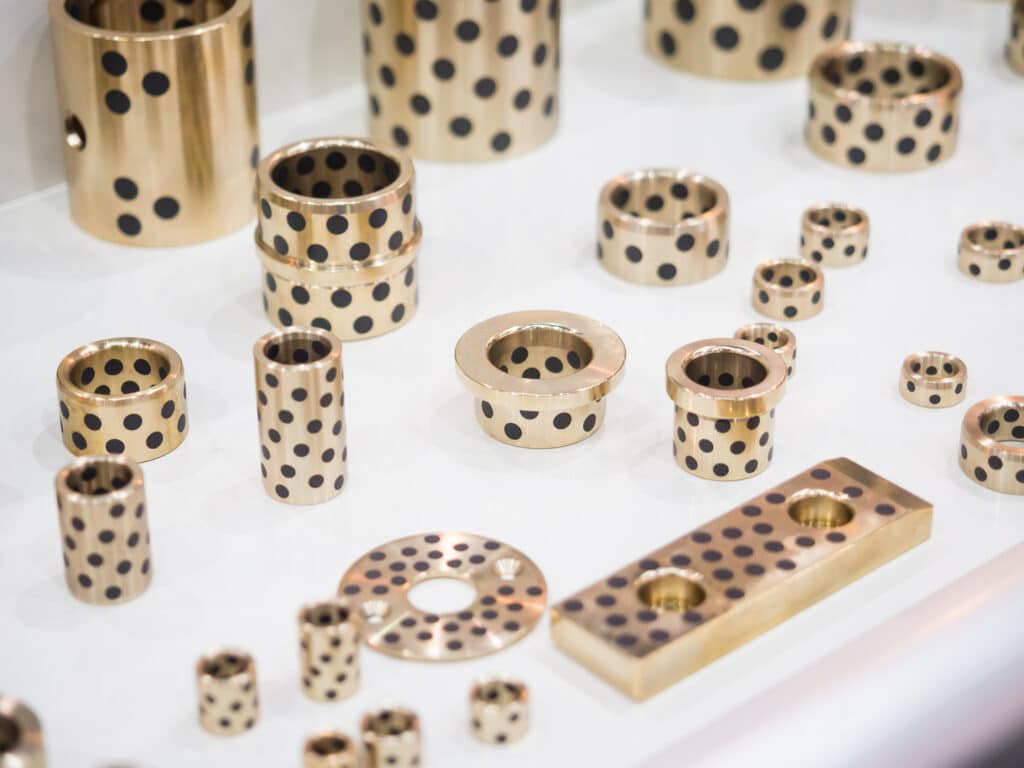
What Is a Self-Lubricating Bronze Graphite Bushing?
A self-lubricating bronze graphite bushing is a plain bearing made from a cast bronze body into which solid graphite plugs are press-fitted in a regular pattern. As the shaft rotates or slides against the bushing, it picks up a thin layer of graphite, forming a dry lubricating film that continuously renews from the embedded plugs. Unlike oil-impregnated sintered bronze (which relies on a finite oil reservoir), the graphite supply lasts the bearing’s full service life.
The engineering principle is solid-film lubrication. Graphite’s layered crystal structure shears easily along its basal planes, transferring low-friction material to the mating surface. This works in vacuum, underwater, at high temperature, and under oscillating motion — conditions that defeat conventional liquid lubricants.
| Bearing Type | Lubrication Source | Maintenance | Best Condition |
|---|---|---|---|
| Bronze graphite (plugged) | Embedded solid graphite | None (lifetime) | Oscillating, low-speed, high-temp, contaminated |
| Oil-impregnated sintered bronze | Finite oil reservoir in pores | Periodic re-oiling | Continuous rotation, moderate speed |
| Solid bronze (greased) | External grease | Frequent re-greasing | Heavy load with maintenance access |
| Polymer-lined (PTFE) | PTFE transfer film | None | Light load, dry, low-temp |
| Rolling-element bearing | External oil/grease | Periodic | High speed, low friction |
KeyFix manufactures bronze graphite bushings and other precision components through its CNC machining capability, holding tight bore and outside-diameter tolerances for press-fit installation.
Which Bronze Alloys Are Used for Graphite Bushings?
The bronze matrix carries the mechanical load; the graphite handles lubrication. Alloy selection balances load capacity, corrosion resistance, and cost.
| Bronze Alloy | Designation | Tensile (MPa) | Max Load (MPa) | Best Application |
|---|---|---|---|---|
| High-Lead Tin Bronze | C93200 (SAE 660) | 240 | 100–140 | General-purpose, moderate load |
| Manganese Bronze | C86300 (SAE 430B) | 820 | 200–250 | Heavy load, high strength |
| Aluminum Bronze | CuAl10Fe3 (C95400) | 585 | 180–220 | Corrosion + high load, marine |
| Tin Bronze | C90500 (SAE 62) | 310 | 120–160 | Moderate load, good wear |
| Cast Bronze (CuSn) | CuSn12 | 280 | 110–150 | General industrial |
Manganese bronze (C86300) and aluminum bronze (CuAl10Fe3) are the high-load workhorses — their high tensile strength lets the bushing carry static loads up to 200–250 MPa, suited to die sets, presses, and heavy construction equipment. For corrosion-exposed or marine service, aluminum bronze combines high load capacity with seawater resistance.
💡 Engineer’s Note: Match the bronze grade to the load type, not just magnitude. For shock-loaded applications (stamping dies, forging equipment), manganese bronze (C86300) resists the impact that would fatigue softer tin bronze. For steady high loads with corrosion, aluminum bronze is the better engineering choice despite its higher cost.
How Does Graphite Plug Geometry Affect Performance?
The graphite plug pattern — diameter, spacing, and percentage of surface area — is the key tuning parameter. More graphite area means more lubrication but less load-bearing bronze; less graphite means higher load capacity but a thinner lubricating film.
| Motion Type | Recommended Graphite Area | Plug Pattern | Rationale |
|---|---|---|---|
| Oscillating / swinging | 25–40 % | Dense, large plugs | Low speed starves oil film; needs more solid lube |
| Low-speed rotating | 20–30 % | Medium plugs | Moderate film renewal demand |
| High-speed rotating | 15–25 % | Sparse, small plugs | Speed generates film; load capacity prioritized |
| Reciprocating / linear | 25–35 % | Axial plug rows | Linear motion needs continuous lube along travel |
| Thrust / axial load | 30–40 % | Radial plug array | Face contact needs broad lube coverage |
| Intermittent / start-stop | 30–40 % | Dense plugs | Frequent boundary-lubrication starts |
The percentage of graphite coverage directly governs the friction coefficient: typical self-lubricating bronze graphite bushings achieve a dynamic friction coefficient of 0.05–0.15 depending on graphite area, load, and speed. Higher graphite percentage lowers friction but reduces the PV (pressure-velocity) limit.
KeyFix machines the bronze body and installs graphite plugs to the specified pattern, verifying dimensional accuracy through its inspection standards program and confirming bronze chemistry by AMETEK OES on incoming material.
What Are the Load and Speed Limits?
The operating envelope of a self-lubricating bushing is defined by three limits: maximum static pressure, maximum sliding velocity, and the combined PV factor (pressure × velocity). Exceeding the PV limit generates heat faster than the bushing can dissipate it, leading to graphite-film breakdown.
| Parameter | Typical Range | Notes |
|---|---|---|
| Max static pressure (P) | 100–250 MPa | Bronze-grade dependent |
| Max dynamic pressure | 40–100 MPa | For continuous motion |
| Max sliding velocity (V) | 0.5–2.5 m/s | Higher for low-load service |
| PV limit (dry) | 1.8–3.6 MPa·m/s | Combined operating envelope |
| Operating temperature | −40 to +300 °C | Special grades to +600 °C |
| Friction coefficient | 0.05–0.15 | Graphite-area dependent |
The PV limit is the single most important design constraint. A bushing carrying high load (high P) must run slowly (low V); one running fast (high V) must carry light load (low P). Calculating the actual PV against the rated limit prevents the most common failure mode — thermal breakdown of the graphite film.
⚠️ Common Pitfall: Specifying a self-lubricating bushing on load alone, without checking sliding velocity, often pushes the design past its PV limit. A bushing rated for 200 MPa static load may fail at only 60 MPa if the shaft speed is high — because the PV product exceeds the thermal limit. Always calculate PV, not just P.
What Forms and Configurations Are Available?
Self-lubricating bronze graphite bushings are produced in several standard geometries to suit different mounting and load directions.
| Form | Load Direction | Typical Application |
|---|---|---|
| Cylindrical sleeve | Radial | Shaft bearings, pivot pins, linkages |
| Flanged sleeve | Radial + light axial | Vertical shafts, located bearings |
| Thrust washer | Axial | Turntables, rotary tables, axial loads |
| Wear plate / slide plate | Linear/sliding | Die sets, machine ways, guides |
| Spherical bearing | Misalignment | Articulating joints, suspension |
| Custom machined | Per application | Bespoke geometry, special bronze |
KeyFix produces all of these forms across machinery, automotive, and heavy-equipment sectors — its CNC parts portfolio and machinery component programs demonstrate the range of precision bronze components delivered to specification.
How Are Bronze Graphite Bushings Manufactured?
Production combines bronze casting or bar stock, precision machining, and graphite plug installation.
| Process Step | Purpose | KeyFix Capability |
|---|---|---|
| Bronze stock verification | Confirm alloy chemistry | AMETEK OES on incoming material |
| CNC turning / boring | Form bore, OD, length to tolerance | STS C-series + Swiss-type lathes, ±0.005 mm |
| Graphite plug drilling | Drill plug holes in pattern | CNC-positioned hole array |
| Graphite plug press-fit | Install solid graphite plugs | Controlled press process |
| Finish machining | Final bore/OD to print | CMM-verified to ±0.001 mm |
| Inspection | Dimensional + visual | 100 % optical + CMM |
Precision bore and outside-diameter tolerances are critical for self-lubricating bushings because they install by press-fit into a housing and run on a shaft with a controlled clearance. KeyFix holds these tolerances through its precision machining capability, with bronze chemistry verified through the raw material control process.
Need a quote on self-lubricating bronze graphite bushings? Send your drawing or specification to KeyFix engineers — you’ll get a DFM review and quotation within 48 hours. Get a quote here or email sales@keyfixpro.com.
What Should You Specify on a Bushing Drawing?
| Drawing Call-Out | What to Specify | Why It Matters |
|---|---|---|
| Bronze alloy | e.g., C86300, CuAl10Fe3 | Drives load capacity, corrosion |
| Bore diameter + tolerance | Inner diameter with fit class | Determines shaft clearance |
| Outside diameter + tolerance | OD with press-fit allowance | Ensures housing retention |
| Graphite area / pattern | Percentage + plug layout | Tunes friction and PV limit |
| Length | Overall length with ± | Sets bearing area |
| Operating P, V, temperature | Load, speed, temp range | Validates against PV limit |
| Form | Sleeve, flanged, thrust, plate | Defines geometry |
How Do You Qualify a Bronze Bushing Manufacturer?
| Audit Point | Minimum Requirement | KeyFix Status |
|---|---|---|
| Quality system | ISO 9001 minimum | IATF 16949 + ISO 9001 + ISO 14001 |
| Bronze machining | CNC turning/boring for bronze | STS C-series + Swiss lathes |
| Material verification | OES on incoming bronze | AMETEK OES on 100 % of heats |
| Dimensional control | CMM with documented accuracy | CMM at ±0.001 mm |
| Graphite plug process | Controlled pattern + press-fit | CNC-positioned, validated |
| SPC implementation | Cpk ≥ 1.33 on bore/OD | Cpk ≥ 1.67, real-time SPC |
| Traceability | Per-lot to material heat | Digital per-lot traceability |
KeyFix’s vertically integrated campus combines precision machining, cold forging, and stamping under a single IATF 16949 quality system — its project portfolio and company background document a 0 PPM defect record across 100+ programs in 20+ countries.
What Are the Logistics and Shipping Terms?
KeyFix manufactures in Huizhou, Guangdong, close to South China’s export ports.
| Term | Detail |
|---|---|
| Manufacturing location | Huizhou, Guangdong Province |
| Standard shipping term | FCA Dongguan |
| Sea freight term | FOB Shenzhen Yantian Port |
| Prototype lead time | 7–14 business days (air-expressed) |
| Production lead time | 4–6 weeks after sample approval |
The short inland haul from Huizhou to Dongguan and Shenzhen Yantian Port reduces transit time and freight cost for international buyers.
Frequently Asked Questions
How long do self-lubricating bronze graphite bushings last?
Because the graphite supply spans the embedded plugs through the full wall thickness, the lubrication lasts the bearing’s entire service life — there is no oil reservoir to deplete. Service life depends on load, speed, and PV factor; within the rated PV limit, these bushings routinely deliver tens of thousands of operating hours maintenance-free.
What’s the difference between graphite-plugged and oil-impregnated bronze bushings?
Graphite-plugged bronze uses solid graphite plugs for dry, lifetime lubrication that works at high temperature, in vacuum, underwater, and under oscillating motion. Oil-impregnated sintered bronze relies on a finite oil reservoir in its porous structure, suited to continuous rotation at moderate speed but requiring conditions that retain the oil.
What temperature range can these bushings handle?
Standard self-lubricating bronze graphite bushings operate from approximately −40 °C to +300 °C. Special graphite formulations and bronze grades extend the upper limit to +600 °C — well beyond the range where conventional oil and grease lubricants break down.
What bronze alloys does KeyFix machine for bushings?
KeyFix machines C93200, C86300, C90500, CuAl10Fe3 (aluminum bronze), and CuSn12, with incoming chemistry verified by AMETEK OES. Alloy selection is matched to the application’s load type, corrosion environment, and PV requirement.
What certifications does KeyFix hold?
KeyFix holds IATF 16949, ISO 9001, and ISO 14001 certifications. Material certificates, dimensional CMM reports, and PPAP Level 3 documentation are standard for OEM programs.
What shipping terms apply for international orders?
Standard shipping is FCA Dongguan, with sea freight as FOB Shenzhen Yantian Port from the Huizhou production base. Production ships 4–6 weeks after sample approval.
If your next project needs high-quality self-lubricating bronze graphite bushings — sleeve, flanged, thrust washer, or custom geometry — send your drawing to KeyFix’s engineering team for a free DFM review and quotation within 48 hours. Explore the full product portfolio or contact KeyFix at sales@keyfixpro.com.
Author: KeyFix Engineering Team Published: May 31, 2026 Last Updated: May 31, 2026