Automotive Bushings: A Professional Manufacturer’s Engineering Guide
Automotive bushings are the unsung components that determine how a vehicle rides, handles, and isolates noise. Found at virtually every moving joint — control arms, sway bars, engine mounts, subframe connections, and suspension pivots — these cylindrical sleeves absorb vibration, accommodate controlled movement, and maintain precise geometry between mating parts. Sourcing them from a professional automotive bushing manufacturer means more than buying a metal-and-rubber sleeve: it means specifying the right material system, durometer, dimensional tolerance, and corrosion protection for a component that endures millions of load cycles across a 15-year vehicle life. This guide breaks down bushing types, material engineering, manufacturing processes, and supplier qualification — with the spec-level detail procurement engineers and product developers need to write an accurate RFQ.
TL;DR — Key Takeaways
- Automotive bushings span three families: elastomeric (rubber/polyurethane), metal (bronze/steel sleeve), and hybrid composite — each tuned to a specific balance of compliance, durability, and NVH control.
- Suspension bushings trade ride comfort against handling precision: softer rubber isolates vibration, stiffer polyurethane sharpens response but transmits more road noise.
- Metal sleeve bushings (bronze, steel-backed) carry high radial loads at pivot points, with self-lubricating variants eliminating maintenance.
- Critical specifications include durometer (Shore A/D hardness), radial and torsional stiffness, press-fit interference, and corrosion endurance — typically 480–1,000 hr salt spray for under-vehicle positions.
- Verified material traceability, precision dimensional inspection, and documented Cpk separate IATF 16949–certified manufacturers from commodity bushing shops.
What Is an Automotive Bushing and What Does It Do?
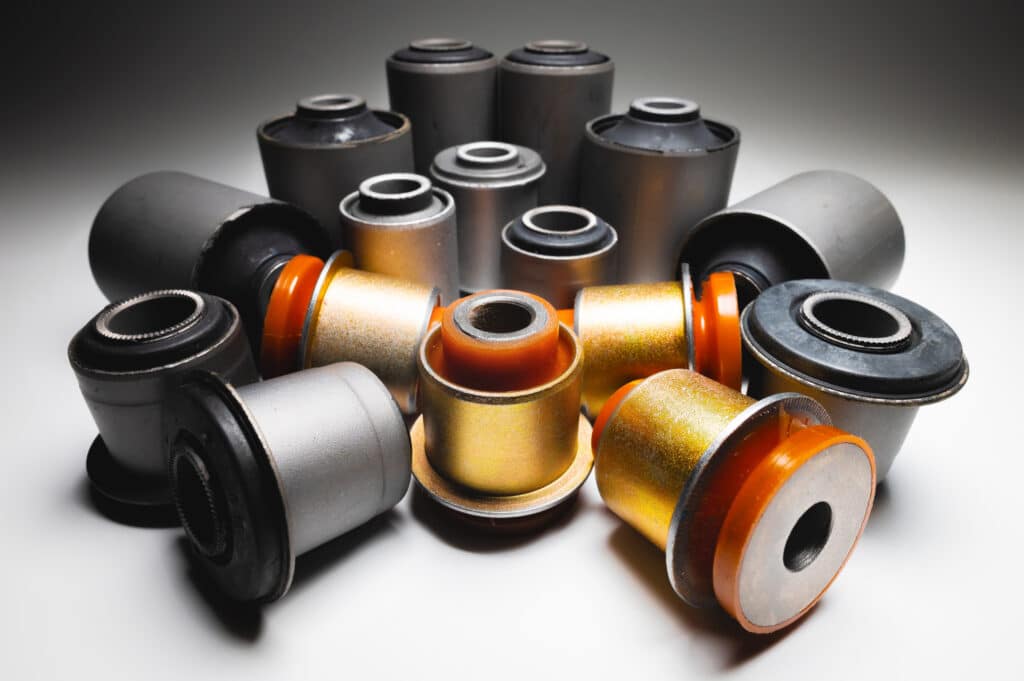
An automotive bushing is a component placed between two parts to cushion movement, absorb vibration, and control the relative motion of mechanical joints. In its most common form, it consists of an inner metal sleeve, an outer metal sleeve, and a compliant material (rubber, polyurethane, or a bearing material) bonded or pressed between them. The bushing allows controlled rotation or deflection at a joint while preventing metal-to-metal contact that would generate noise and wear.
Bushings perform four distinct engineering functions across a vehicle. They isolate vibration by absorbing high-frequency road and powertrain inputs before they reach the cabin. They accommodate articulation by flexing as suspension components move through their travel. They maintain alignment by holding suspension and drivetrain geometry within tight tolerances under load. And they reduce wear by eliminating direct metal contact at pivot points.
| Function | How the Bushing Delivers It | Vehicle Benefit |
|---|---|---|
| Vibration isolation | Elastomer absorbs/damps high-frequency input | Quieter, smoother cabin (NVH) |
| Articulation | Compliant material flexes with joint movement | Smooth suspension travel |
| Geometry control | Controlled stiffness limits unwanted deflection | Predictable handling, tire wear |
| Wear reduction | Eliminates metal-to-metal contact | Longer joint life, less maintenance |
The engineering tension at the heart of every bushing is the trade-off between compliance and control. A softer bushing isolates more vibration but allows more unwanted movement, blurring handling response. A stiffer bushing sharpens handling but transmits more noise and harshness. A professional automotive bushing manufacturer engineers each part to the precise point on this spectrum that the vehicle program requires.
KeyFix manufactures precision automotive components — including bushings, sleeves, and related machined parts — through its CNC machining capability, holding the tight tolerances that press-fit bushing installation demands.
What Are the Main Types of Automotive Bushings?
Automotive bushings are categorized by both their location on the vehicle and their material construction. Understanding both dimensions is essential to specifying the right part.
| Bushing Type | Location | Primary Load | Typical Material |
|---|---|---|---|
| Control arm bushing | Suspension control arms | Radial + torsional | Rubber or polyurethane |
| Sway bar (stabilizer) bushing | Anti-roll bar mounts | Radial + rotational | Rubber or polyurethane |
| Engine/transmission mount | Powertrain attachment | Multi-axis + damping | Rubber (often hydraulic) |
| Subframe bushing | Subframe-to-body | Radial + isolation | Rubber, voided |
| Shock/strut mount bushing | Damper attachment | Axial + radial | Rubber + bearing |
| Leaf spring bushing | Leaf spring eyes | Radial + rotational | Rubber or bronze |
| Shackle bushing | Spring shackles | Radial + rotational | Bronze or polyurethane |
| Pivot/trunnion bushing | Steering, linkages | Radial (rotating) | Bronze, metal sleeve |
| Differential mount | Diff-to-subframe | Multi-axis + damping | Rubber, voided |
Suspension bushings (control arm, sway bar, subframe) are the most numerous, collectively numbering 20–40 bushings per vehicle depending on platform complexity. Powertrain mounts are fewer but more sophisticated, often incorporating hydraulic damping. Pivot and trunnion bushings — where continuous rotation occurs — favor metal sleeve or bronze construction over elastomers.
💡 Engineer’s Note: When specifying replacement or upgrade bushings, always consider the system, not the individual joint. Replacing soft rubber control arm bushings with stiff polyurethane sharpens turn-in response, but if the sway bar and subframe bushings remain soft, the suspension’s behavior becomes unbalanced. Match the compliance characteristics across the whole corner for predictable handling.
How Do Bushing Materials Compare?
Material selection is the single most consequential bushing decision — it governs ride quality, durability, noise transmission, and cost. The three primary material families each occupy a distinct performance zone.
| Material | Hardness (Shore) | Vibration Isolation | Durability | Noise Transmission | Cost Index | Best Application |
|---|---|---|---|---|---|---|
| Natural Rubber | 40–70 A | Excellent | Moderate (5–10 yr) | Low | 1.0× | OEM ride comfort, NVH-critical |
| Polyurethane | 75–95 A | Good | High (15+ yr) | Moderate-high | 1.5× | Performance, longevity |
| Bronze (sleeve) | — (metal) | Poor | Very high | High | 2.0× | Rotating pivots, high load |
| Steel-backed PTFE | — (metal) | Poor | Very high | High | 2.2× | Maintenance-free pivots |
| Hydraulic (fluid-filled) | Rubber + fluid | Outstanding | Moderate | Very low | 3.5× | Premium engine mounts |
| Thermoplastic (POM) | 80 D | Low | High | Moderate | 1.3× | Light-load linkages |
Natural rubber remains the OEM default for suspension bushings because it delivers the best vibration isolation at the lowest cost — critical for the ride comfort and NVH targets that mainstream vehicles must hit. Polyurethane is the performance and longevity choice: it lasts far longer than rubber and resists oil, ozone, and road chemicals, but transmits more noise and harshness. For rotating pivot points, bronze and steel-backed bearing materials carry high radial loads that would quickly destroy an elastomer.
The durometer (Shore hardness) within each material family is itself a tuning parameter. A 50 Shore A rubber control arm bushing isolates more vibration than a 70 Shore A version of the same geometry, but allows more deflection. Performance vehicle programs often specify higher durometers to sharpen handling at the cost of some refinement.
KeyFix verifies the metallurgy of metal-sleeve bushing components through its raw material control process, with bronze and steel chemistry confirmed by SPECTRO optical emission spectrometry on every incoming lot.
What Engineering Properties Define Bushing Performance?
Beyond material, a bushing’s behavior is defined by measurable engineering properties. A professional drawing specifies these explicitly rather than leaving them to interpretation.
| Property | What It Measures | Typical Range | Why It Matters |
|---|---|---|---|
| Radial stiffness | Resistance to radial deflection | 1,000–10,000 N/mm | Controls handling precision |
| Axial stiffness | Resistance to axial movement | 200–2,000 N/mm | Limits fore-aft compliance |
| Torsional stiffness | Resistance to twist | 1–50 Nm/° | Affects articulation, wind-up |
| Conical (cardanic) stiffness | Resistance to angular tilt | Application-specific | Accommodates misalignment |
| Durometer | Material hardness (Shore A/D) | 40–95 A / 80 D | Governs isolation vs control |
| Damping ratio | Energy dissipation | 0.05–0.30 | Controls resonance, NVH |
| Press-fit interference | OD vs housing bore | 0.05–0.30 mm | Ensures retention |
The relationship between these stiffness values defines the bushing’s character. A bushing can be engineered with high radial stiffness for handling precision but low torsional stiffness for smooth articulation — a decoupling that voided and hydraulic bushings achieve through geometry. This multi-axis tuning is where bushing engineering becomes genuinely sophisticated, and where a professional manufacturer’s design support adds the most value.
⚠️ Common Pitfall: Specifying a bushing by hardness alone (e.g., “70 Shore A rubber”) without defining the required stiffness values leaves the most important performance parameters undefined. Two bushings of identical durometer can have radically different radial stiffness depending on geometry, voiding, and bonding. Always specify the target stiffness in each axis, not just the material hardness.
How Are Automotive Bushings Manufactured?
Bushing production combines metalworking (for the sleeves) with elastomer molding or bearing-material processing (for the compliant element). The exact process chain depends on the bushing type.
| Process Step | Purpose | Applicable Bushing Type |
|---|---|---|
| Sleeve machining/forming | Produce inner/outer metal sleeves | All metal-sleeve bushings |
| Surface preparation | Clean/prime for rubber bonding | Bonded elastomeric |
| Rubber compounding | Mix elastomer to durometer spec | Rubber, hydraulic |
| Injection/compression molding | Form and bond rubber to sleeves | Elastomeric |
| Vulcanization | Cure rubber, set properties | Elastomeric |
| Polyurethane casting | Pour and cure PU element | Polyurethane |
| Bearing material installation | Press/line bearing surface | Metal sleeve, PTFE-lined |
| Finish machining | Final bore/OD to print | Metal sleeve |
| Corrosion coating | Protect metal components | All under-vehicle |
| Inspection | Dimensional + property verification | All |
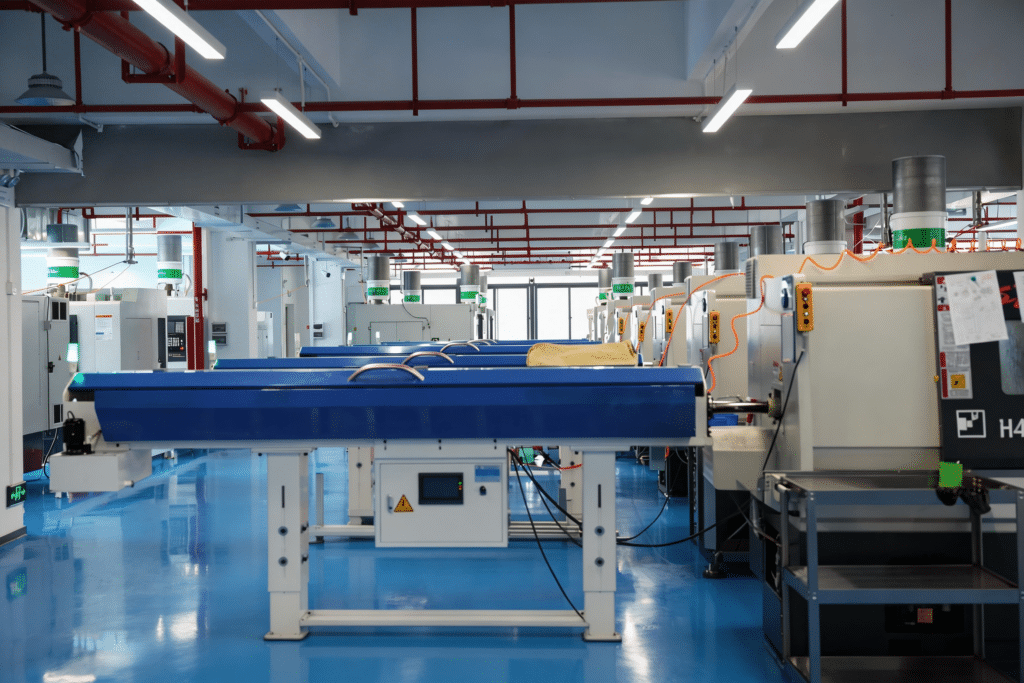
The metal sleeves at the heart of every bushing demand precise dimensional control — the inner sleeve runs on a bolt or shaft, and the outer sleeve press-fits into a housing with controlled interference. KeyFix produces these precision sleeves through its precision machining and cold forging capabilities, holding bore and outside-diameter tolerances to ±0.005 mm on CNC-turned features, verified by 2D video measuring at 0.001 mm optical resolution. For high-volume sleeve production, the stamping process forms sleeves efficiently.
After forming, sleeves and finished bushings undergo dimensional verification and, where specified, property testing — radial stiffness, push-out force, and durability cycling — documented through the inspection standards program.
Need a quote on automotive bushings or precision sleeves? Send your drawing or specification to KeyFix engineers — you’ll get a DFM review and quotation within 48 hours. Get a quote here or email sales@keyfixpro.com.
What Surface Treatments Protect Automotive Bushing Components?
The metal components of automotive bushings — inner sleeves, outer sleeves, and metal-sleeve bearing bodies — face the harsh under-vehicle environment: road salt, water immersion, stone-chip impact, and brake dust. Surface treatment must protect these components for the vehicle’s full service life.
| Coating | Thickness (μm) | Salt Spray (hrs) | Cost Index | Best Use |
|---|---|---|---|---|
| Trivalent Zinc | 8–12 | 200–400 | 1.0× | Interior, mild exposure |
| Zinc-Nickel (12–15% Ni) | 8–15 | 720–1,000+ | 1.6× | Suspension, under-vehicle |
| Dacromet / Geomet | 6–10 | 500–1,000 | 1.8× | Chassis, high-strength components |
| Phosphate + Oil | 3–8 | 48–96 | 0.7× | Temporary, sub-assembly |
| E-Coat (cathodic) | 15–25 | 500–750 | 1.4× | Outer sleeves, large parts |
| Mechanical Zinc | 8–15 | 200–500 | 1.3× | High-strength, no H₂ risk |
Zinc-nickel and Dacromet coatings dominate under-vehicle bushing component protection because they deliver the 720–1,000+ hour salt-spray endurance that suspension positions require. KeyFix supplies zinc-nickel and Dacromet coatings specified to the neutral salt spray hours the drawing requires (per ASTM B117), with coating thickness reported for every production lot.
What Should You Specify on an Automotive Bushing Drawing?
A complete bushing drawing prevents the misinterpretation that creates rejection rates and field failures. Here’s what belongs on every print.
| Drawing Call-Out | What to Specify | Why It Matters |
|---|---|---|
| Bushing type | Control arm, sway bar, mount, pivot | Anchors geometry and function |
| Material system | Rubber durometer, PU, bronze grade | Drives all performance |
| Inner sleeve dimensions | Bore + tolerance | Determines shaft/bolt fit |
| Outer sleeve dimensions | OD + press-fit interference | Ensures housing retention |
| Radial stiffness | N/mm with tolerance | Controls handling |
| Torsional stiffness | Nm/° if applicable | Controls articulation |
| Durometer | Shore A/D | Material hardness |
| Surface treatment | Coating type, thickness, salt spray | Corrosion protection |
| Operating temperature | Range (°C) | Material compatibility |
| Service life target | Cycles or years | Durability validation |
KeyFix manufactures automotive bushing components across suspension, powertrain, and chassis applications — supporting OEM, Tier 1, and Tier 2 programs as detailed in its work for the automotive sector, with the same precision applied to motorcycle and powersports components.
How Do Bushings Control Noise, Vibration, and Harshness (NVH)?
NVH performance is one of the most demanding requirements an automotive bushing must satisfy. The bushing sits directly in the path between road and powertrain vibration sources and the vehicle cabin, acting as a tuned filter that must absorb unwanted frequencies while preserving the structural connection.
Vibration enters the vehicle across a broad frequency spectrum, and different bushings target different bands. Low-frequency inputs come from body motion and large road undulations; mid-frequency inputs come from road texture and powertrain firing orders; high-frequency inputs manifest as audible booming, droning, and harshness.
| Frequency Band | Source | Bushing Strategy | Target Bushings |
|---|---|---|---|
| 1–20 Hz (body motion) | Large road inputs, body roll | Controlled stiffness, damping | Subframe, control arm |
| 20–80 Hz (primary ride) | Road texture, suspension resonance | Tuned rate, hydraulic damping | Engine mount, subframe |
| 80–200 Hz (boom/drone) | Powertrain firing orders | Decoupled stiffness, voiding | Engine mount, diff mount |
| 200 Hz–1 kHz (harshness) | Road impact, gear noise | Soft isolation path | Sway bar, strut mount |
| 1–2 kHz (squeak/rattle) | Stick-slip, contact | Compliant interface | Trim, linkage bushings |
The most sophisticated NVH solution is the hydraulic (fluid-filled) bushing, used primarily in engine and differential mounts. By forcing fluid through an internal track as the bushing deflects, it provides frequency-dependent damping — soft and isolating at high frequency, firm and controlling at the low-frequency resonance where engine shake occurs. This frequency-selective behavior cannot be achieved with a simple rubber bushing, which is why premium vehicle programs specify hydraulic mounts despite their higher cost.
Voided bushings achieve a different kind of tuning. By molding voids (cavities) into the rubber element, engineers create direction-dependent stiffness — stiff in the direction that controls handling, soft in the direction that isolates road harshness. This decoupling lets a single bushing satisfy two competing requirements that would otherwise demand a compromise.
💡 Engineer’s Note: When NVH targets and handling targets conflict at a given joint, the answer is usually geometry, not just material. A voided or hydraulic bushing can deliver high stiffness in one axis and low stiffness in another, resolving the conflict that a uniform-durometer solid bushing cannot. Specify the stiffness target separately for each axis, and let the manufacturer’s engineering team propose the geometry that achieves it.
What Are the Installation and Torque Requirements?
Correct bushing installation is as critical as the bushing’s own specification. An incorrectly installed bushing — pressed to the wrong depth, torqued at the wrong suspension position, or installed with damaged sleeves — fails prematurely regardless of how well it was manufactured.
| Installation Parameter | Requirement | Consequence of Error |
|---|---|---|
| Press-fit force | Within spec for OD interference | Too high: sleeve damage; too low: loose fit |
| Press alignment | Square to bore axis | Misalignment: uneven load, early failure |
| Bolt torque | Per OEM spec, in Nm | Over/under-torque affects clamp and life |
| Torque-at-ride-height | Tighten at design ride position | Wrong position: permanent rubber preload |
| Lubrication (PU/metal) | Specified grease on contact | Dry installation: squeak, accelerated wear |
| Sleeve protection | No scoring during install | Scored sleeve: corrosion initiation |
The torque-at-ride-height rule is the most frequently violated installation requirement for elastomeric bushings. Because rubber bonds to both the inner and outer sleeves, tightening the bolt locks the bushing’s neutral position. If a control arm bushing is torqued with the suspension hanging at full droop, the rubber sits permanently twisted once the vehicle returns to ride height — pre-loading the element, reducing its travel, and dramatically shortening its fatigue life. Professional installation specifications always require final torque to be applied at design ride height.
For metal-sleeve and polyurethane bushings, lubrication at the contact interface is essential. Unlike bonded rubber bushings (which never slide), these designs allow relative movement between the bushing and the shaft, and dry contact generates the squeak complaints that plague poorly specified polyurethane installations. The correct grease — typically a waterproof, high-temperature synthetic — must be specified as part of the bushing delivery.
What Are the Failure Modes and How Are They Prevented?
Understanding how automotive bushings fail enables proactive specification. The table below catalogs failure modes by frequency in warranty analysis.
| Failure Mode | Root Cause | Field Symptom | Prevention |
|---|---|---|---|
| Elastomer cracking | Ozone, oil, UV, age | Clunking, free play | Specify ozone-resistant compound or PU |
| Bond separation | Poor sleeve prep, overload | Squeaking, movement | Verified bonding process, primer control |
| Bushing wear (metal) | Inadequate lubrication | Knocking, play | Self-lubricating bearing material |
| Corrosion of sleeve | Coating failure | Seized joint, rust stain | Zn-Ni or Dacromet, 720+ hr salt spray |
| Compression set | Sustained load, heat | Permanent deflection, misalignment | Higher durometer, correct material |
| Press-fit loosening | Insufficient interference | Rattle, movement in housing | Correct OD interference spec |
| Torsional fatigue | Excessive wind-up cycling | Cracking at bond line | Lower torsional stiffness design |
Elastomer degradation (cracking, bond separation) is the most common bushing failure mode in field service, driven by the harsh chemical and thermal environment under the vehicle. Specifying ozone- and oil-resistant compounds — or switching to polyurethane for longevity-critical positions — addresses the root cause. For metal-sleeve pivot bushings, self-lubricating bearing materials eliminate the wear that inadequate lubrication causes.
How Do You Qualify a Professional Automotive Bushing Manufacturer?
Sourcing automotive bushings requires verifying both manufacturing capability and quality systems. The audit framework below separates professional manufacturers from commodity shops.
| Audit Point | Minimum Requirement | KeyFix Status |
|---|---|---|
| Quality system | IATF 16949 (automotive) | IATF 16949 + ISO 9001 + ISO 14001 |
| Sleeve machining | Precision CNC for inner/outer sleeves | CNC lathes + Swiss-type lathes, ±0.005 mm |
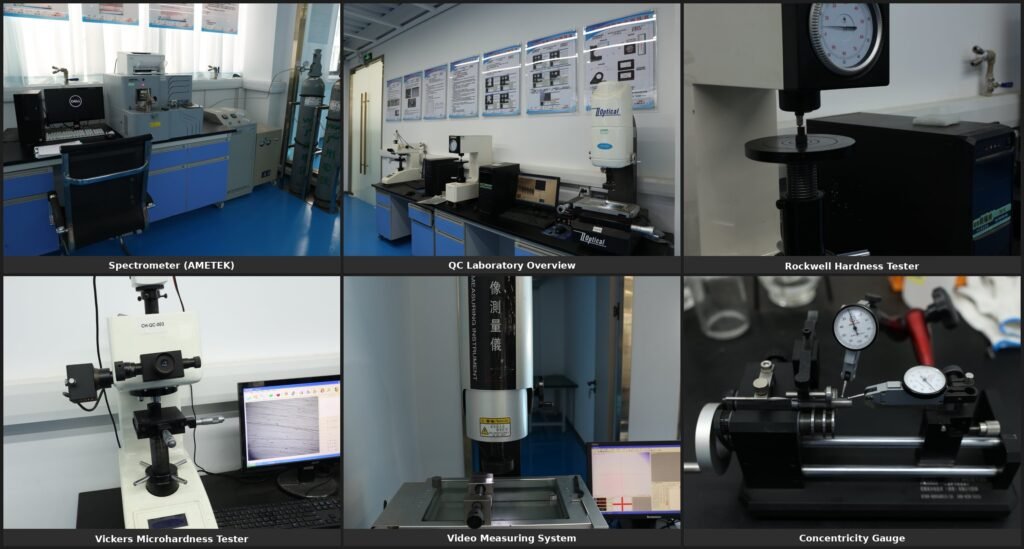
| Material verification | OES on incoming metal | SPECTRO (Germany) OES on 100% of heats |
| Dimensional control | Calibrated precision metrology (CMM or video measuring) | 2D video measuring (0.001 mm resolution) + Shining3D 3D scanning |
| Coating capability | In-house or qualified, salt spray records | In-house Zn-Ni + Dacromet, 1,000+ hr |
| Property testing | Stiffness, push-out, durability | Available on production samples |
| SPC implementation | Cpk ≥ 1.33 on critical dims | Cpk ≥ 1.67, real-time SPC |
| PPAP readiness | Level 3 minimum | Level 3–5 with digital traceability |
| Traceability | Per-lot to material heat | Digital per-lot traceability |
| Capacity | 100K+ components/month | Multi-line CNC, forging, stamping |
A professional automotive bushing manufacturer demonstrates not just the equipment to make the part, but the quality infrastructure to prove it meets specification consistently. KeyFix’s vertically integrated campus combines precision machining, cold forging, and stamping under a single IATF 16949 quality system — the global automotive quality benchmark. Its project portfolio and company background describe a quality system built on AQL 0.4 outgoing inspection and a target below 25 PPM — the track record that OEM and Tier 1 buyers require for safety-relevant chassis components.
What Industries and Applications Use These Bushings?
While the automotive sector is the largest consumer, the bushing technologies discussed here serve adjacent industries with similar requirements.
| Industry | Typical Bushing Application | Key Requirement |
|---|---|---|
| Passenger Vehicles (OEM) | Suspension, engine mounts, subframe | NVH, durability, cost |
| Commercial Trucks | Leaf spring, cab mount, heavy pivot | High load, longevity |
| EV Platforms | Battery tray isolation, motor mount | Vibration, weight, sealing |
| Motorcycles/Powersports | Swingarm, engine mount, linkage | Compactness, vibration |
| Agricultural Equipment | Heavy pivots, implement mounts | Extreme load, contamination |
| Construction Machinery | Articulation joints, cab isolation | Shock load, dust |
| Performance/Racing | Stiff handling-focused suspension | Precision, durability |
EV platforms represent a rapidly growing segment for automotive bushings. The shift to electric powertrains changes the NVH profile — without engine noise to mask them, road and motor vibrations become more noticeable, increasing the importance of well-engineered isolation bushings. EV battery tray and motor mount isolation bushings are an emerging high-value application where vibration control directly affects perceived vehicle quality.
KeyFix supports automotive and adjacent-industry bushing programs across this full application range. Its complete product portfolio and machinery component capabilities demonstrate the breadth of precision components delivered to OEM specification.
What Are the Logistics and Shipping Terms?
KeyFix manufactures in Guangdong, positioning production close to South China’s mature precision-manufacturing supply chain and export ports.
| Term | Detail |
|---|---|
| Manufacturing location | Guangdong Province |
| Standard shipping term | FCA at our Guangdong plant |
| Sea freight term | FOB Shenzhen Yantian Port |
| Prototype lead time | 7–14 business days (air-expressed) |
| Production lead time | 4–6 weeks after PPAP approval |
The short inland haul from our Guangdong production base to Shenzhen Yantian Port streamlines export logistics, reducing transit time and freight cost for international buyers of automotive bushing components.
Frequently Asked Questions
What’s the difference between rubber and polyurethane automotive bushings?
Rubber bushings provide superior vibration isolation and a quieter, more comfortable ride, making them the OEM default for mainstream vehicles. Polyurethane bushings last significantly longer (15+ years vs 5–10 for rubber), resist oil and road chemicals, and sharpen handling response — but transmit more road noise and harshness. The choice depends on whether ride comfort or longevity and handling precision is the priority.
How long do automotive bushings last?
Rubber suspension bushings typically last 5–10 years or 80,000–160,000 km before elastomer degradation creates noticeable play. Polyurethane bushings can last 15+ years. Metal-sleeve and self-lubricating pivot bushings, within their rated load, often last the full vehicle life. Service life depends heavily on operating environment, load, and material selection.
What does a professional automotive bushing manufacturer provide beyond the part?
A professional manufacturer provides DFM (design for manufacturing) review, material and durometer recommendations matched to the application’s stiffness targets, full dimensional and property validation, PPAP documentation, material traceability, and consistent quality backed by SPC. The value lies in engineering support and proven quality systems, not just producing a metal-and-rubber sleeve.
What materials does KeyFix machine for bushing components?
KeyFix machines bronze (C86300, C93200, aluminum bronze), carbon and alloy steel sleeves, and stainless components, with incoming chemistry verified by SPECTRO (Germany) OES. Material selection is matched to the bushing’s load type, rotation requirement, and corrosion environment.
What certifications does KeyFix hold for automotive components?
KeyFix holds IATF 16949, ISO 9001, and ISO 14001 certifications. Full material certificates, dimensional inspection reports, coating thickness reports, and PPAP Level 3 documentation are standard for OEM and Tier 1 programs.
Can KeyFix support both prototype and high-volume bushing production?
Yes. CNC-machined components have no MOQ, so prototypes can start from a single piece. Production scales through combined CNC, cold forging, and stamping capabilities, with cost reductions at higher volume tiers.
What shipping terms apply for international orders?
Standard shipping is FCA at our Guangdong plant, with sea freight as FOB Shenzhen Yantian Port from our Guangdong production base. Prototype lead time is 7–14 business days; production ships 4–6 weeks after PPAP approval.
If your next program needs automotive bushings or precision bushing components — suspension, engine mount, subframe, or pivot applications — partner with a professional manufacturer that combines precision machining, controlled coating, and IATF 16949 quality. Send your drawing to KeyFix’s engineering team for a free DFM review and quotation within 48 hours. Explore the full product portfolio or contact KeyFix at sales@keyfixpro.com.
Author: KeyFix Engineering Team Published: May 31, 2026 Last Updated: May 31, 2026