
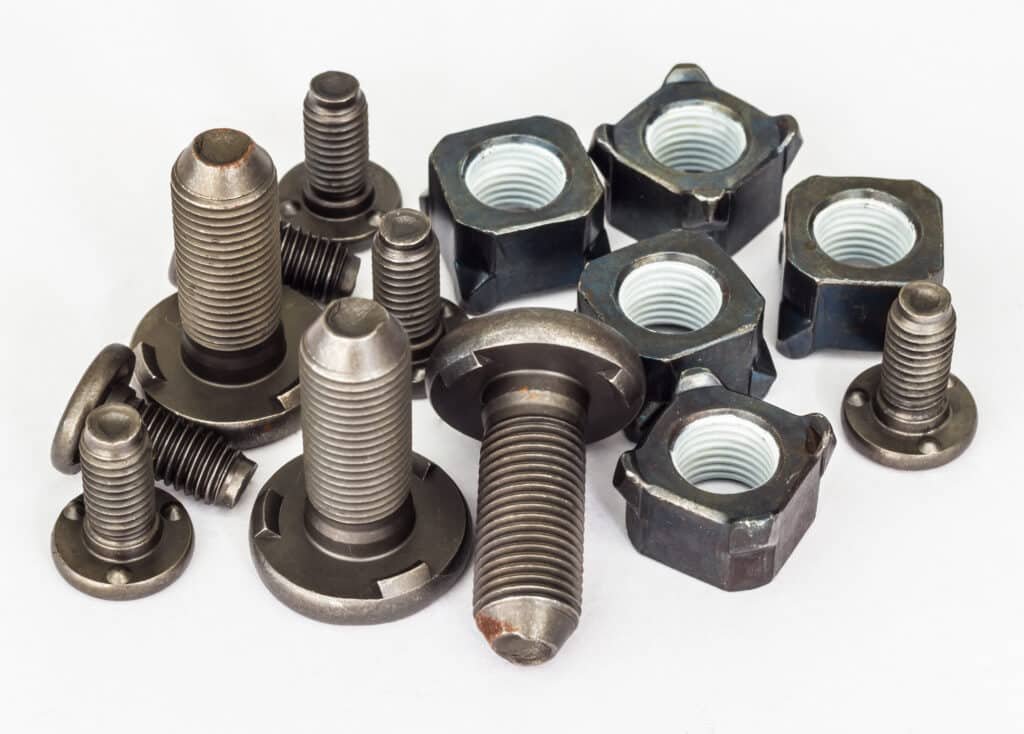
A square insert nut is the fastener you install once and never touch again with a wrench. Dropped into a matching pocket, slid into an extrusion channel, pressed into a wood panel, or molded into plastic, its four flat sides bear against the surrounding walls and stop it from turning — so the bolt can be torqued entirely from the other side. That single property is why square nuts survive in blind pockets, aluminum framing, furniture panels, and plastic housings where a hex nut would simply spin. This guide covers the anti-rotation geometry, the pocket clearance rule that decides whether the joint works, the DIN standards, materials, manufacturing, and how to qualify a supplier.
TL;DR — Key Takeaways
- A square nut resists rotation by form-fit against flat walls, not by friction or tool grip — so it needs no access on its own side.
- Pocket clearance is the whole ballgame: aim for 0.1–0.3 mm total across the flats. Tighter jams on assembly; looser lets the nut skew and chew the pocket.
- DIN 557 (standard), DIN 562 (thin), and DIN 928 (square weld nut) cover the common sizes; T-slot variants follow the extrusion profile instead.
- Four flats spread torque over twice the bearing area of a hex’s two effective faces at the same across-flats dimension — the pocket, not the nut, is normally the weak link.
- A qualified supplier cold-forges the nut, verifies steel by OES, and documents outgoing quality below 25 PPM at AQL 0.4.
What Is a Square Insert Nut?
A square insert nut is a four-sided nut designed to sit captive inside a mating recess rather than be held by a tool. The recess may be a machined or cast pocket, a routed slot in a wood panel, the channel of an aluminum extrusion, or a cavity formed around the nut during plastic molding. Once seated, the nut’s flats register against the pocket walls, and tightening the bolt from the opposite face develops full clamp load without anything gripping the nut.
| Variant | How It Is Retained | Typical Host |
|---|---|---|
| Standard square nut (DIN 557) | Seats in a machined or cast pocket | Metal brackets, machine frames |
| Thin square nut (DIN 562) | Shallow pocket, low profile | Sheet assemblies, tight stacks |
| Square weld nut (DIN 928) | Projection-welded to sheet | Automotive body, appliance chassis |
| T-slot / channel nut | Slides or drops into extrusion slot | Aluminum framing, machine guarding |
| Insert-molded square nut | Plastic flows around it | Housings, enclosures, toys |
| Panel / furniture insert nut | Pressed into routed pocket | Flat-pack furniture, plywood joints |
The distinction that matters for sourcing: the first three are dimensional standards you can order to a DIN number, while T-slot and insert-molded variants are profile-specific and usually drawn as custom parts. KeyFix produces all six families — see the CNC parts portfolio and the broader product portfolio.
Why Does Square Geometry Prevent Rotation?
A hex nut in a hex pocket also resists rotation, so the square’s advantage is not uniqueness — it is manufacturability of the pocket. A square recess can be routed, milled with a single end mill pass, broached, extruded as a channel, or cast with simple tooling. A hex pocket needs a shaped tool or a far more complex cavity. In sheet, wood, plastic, and extruded aluminum, the square pocket is simply the one you can make at reasonable cost.
| Property | Square Nut in Pocket | Hex Nut in Pocket | Hex Nut with Wrench |
|---|---|---|---|
| Tool access needed on nut side | None | None | Required |
| Pocket manufacturability | Simple (mill, rout, extrude, cast) | Complex tooling | N/A |
| Bearing faces resisting torque | 4 flats | 6 flats (2 effective pairs) | Tool flats |
| Bearing area at equal across-flats | Larger per contact face | Smaller per face | N/A |
| Alignment forgiveness on insertion | 90° indexing | 60° indexing | N/A |
| Cost to produce the nut | Low (cold forged) | Low | Low |
The torque path is worth understanding. When the bolt is tightened, reaction torque pushes two opposing flats of the nut into the pocket walls. Because a square flat is wider than a hex flat at the same across-flats dimension, the contact pressure on the host material drops — which matters enormously in wood, plastic, or aluminum, where the pocket is far softer than the nut.
💡 Engineer’s Note: In every soft-host application, size the joint by the pocket’s bearing strength, not the nut’s strength. A steel nut will not fail; the plywood, nylon, or extrusion wall it bears against will crush first. If a joint keeps loosening, widening the nut (more bearing area) beats upgrading the nut’s property class.
Which Standards and Sizes Apply?
| Standard | Description | Typical Range |
|---|---|---|
| DIN 557 | Square nut, standard height | M4–M16 |
| DIN 562 | Square nut, thin | M3–M12 |
| DIN 928 | Square weld nut with projections | M4–M12 |
| ISO 898-2 | Property classes for nuts | Applies to all steel nuts |
| Extrusion-specific | T-slot nuts per profile family | Slot widths 6, 8, 10 mm |
Representative DIN 557 and DIN 562 dimensions, useful for first-pass pocket design:
| Thread | Across Flats (s) | DIN 557 Height | DIN 562 Height |
|---|---|---|---|
| M4 | 7 mm | 3.2 mm | 2.2 mm |
| M5 | 8 mm | 4.0 mm | 2.7 mm |
| M6 | 10 mm | 5.0 mm | 3.2 mm |
| M8 | 13 mm | 6.5 mm | 4.0 mm |
| M10 | 17 mm | 8.0 mm | 5.0 mm |
| M12 | 19 mm | 10.0 mm | 6.0 mm |
T-slot nuts break this pattern entirely: their width is dictated by the extrusion’s slot opening and internal channel, so specify by profile series (for example, a 6 mm slot on a common 20-series extrusion) rather than by DIN number.
How Do You Design the Anti-Rotation Pocket?
This is where most square insert nut applications succeed or fail, and it comes down to one number: total clearance across the flats.
| Total Clearance (pocket width − nut across flats) | Behavior |
|---|---|
| < 0.05 mm | Jams on insertion; plating scrapes off; assembly line stops |
| 0.1–0.3 mm | Target — drops in cleanly, minimal rotation before lockup |
| 0.4–0.8 mm | Nut skews under torque; corners dig into pocket walls |
| > 1.0 mm | Nut rotates far enough to climb the pocket; joint loosens |
Depth matters almost as much. A pocket 0.1–0.2 mm deeper than the nut lets the clamped part pull the joint tight against the host surface; a pocket shallower than the nut leaves the nut proud, so the bolt clamps the nut rather than the parts, and nothing holds.
| Pocket Feature | Specification | Reason |
|---|---|---|
| Width across flats | Nut s + 0.1–0.3 mm total | Insertion without rotation slop |
| Depth | Nut height + 0.1–0.2 mm | Nut must not stand proud |
| Corner radius | Relief at corners, or radiused nut corners | Milled pockets have round corners; square nuts do not |
| Entry chamfer | 0.3–0.5 mm lead-in | Speeds assembly, protects plating |
| Bolt clearance hole | Thread + 0.5–1.0 mm | Allows for pocket position tolerance |
⚠️ Common Pitfall: Milling a square pocket with an end mill leaves rounded internal corners, and a sharp-cornered square nut will not seat flat in it — it rocks on its corners and the assembly reads as “wrong size nut.” Either add corner relief slots to the pocket or specify a nut with radiused corners. This single detail causes more square-nut assembly complaints than every other factor combined.
Pocket and nut dimensions are verified together on KeyFix production through 2D video measuring and calibrated Mitutoyo gauges from its 145-gauge library, documented under the inspection standards program.
Where Are Square Insert Nuts Used?
| Application | Why Square | Typical Size |
|---|---|---|
| Aluminum extrusion framing | Slides in slot; no access behind | M5, M6, M8 |
| Flat-pack furniture | Pressed into routed panel pocket | M6, M8 |
| Plastic housings (insert molded) | Plastic flows around flats | M3, M4, M5 |
| Automotive body panels (weld nut) | Welded blind behind sheet | M6, M8 |
| Machine guarding and enclosures | Fast reconfiguration in channel | M5, M6 |
| Sheet metal brackets | Captive in a punched square hole | M4, M6 |
| Woodworking jigs and fixtures | Simple routed pocket | M6, M8 |
Aluminum framing is the volume driver. Modular extrusion systems rely on square and T-slot nuts because a technician can add a bracket anywhere along a beam without drilling — the nut slides in, the bolt goes through the bracket, and the flats do the rest. Delivered programs of this kind appear in KeyFix’s project case studies and machinery hardware programs.
Insert molding deserves a caution of its own: the nut is placed in the mold and plastic flows around it, so the nut must tolerate melt temperature and hold its thread free of resin. Specify a thread protection method — a core pin or plug — and a nut finish that will not outgas or discolor the polymer.
Which Materials and Finishes Apply?
| Material | Property Class | Corrosion | Best Use |
|---|---|---|---|
| Carbon steel + zinc | 4 / 5 / 8 | Coating-dependent | General indoor, furniture |
| Carbon steel + zinc-nickel | 8 | 720–1,000+ hr salt spray | Automotive, outdoor framing |
| Stainless 304 (A2) | A2-70 | Excellent | Food equipment, humid areas |
| Stainless 316 (A4) | A4-70 | Outstanding | Marine, chemical |
| Brass | — | Excellent | Electrical, non-magnetic needs |
Two finish notes specific to insert nuts. Coating thickness eats pocket clearance: a nut plated at 8–12 μm per surface grows across the flats, so specify plating before the pocket is toleranced, not after. And in magnetic or electrical assemblies, brass or stainless avoids the flux disturbance and galvanic pairing that plated carbon steel introduces.
Every incoming wire and bar lot is verified by SPECTRO optical emission spectrometry through KeyFix’s raw material control process, with zinc-nickel and DACROMET applied on in-house lines validated beyond 1,000 hours neutral salt spray.
How Are Square Insert Nuts Manufactured?
| Step | What Happens | KeyFix Capability |
|---|---|---|
| Wire verification | Grade confirmed by OES | SPECTRO (Germany), 100% of heats |
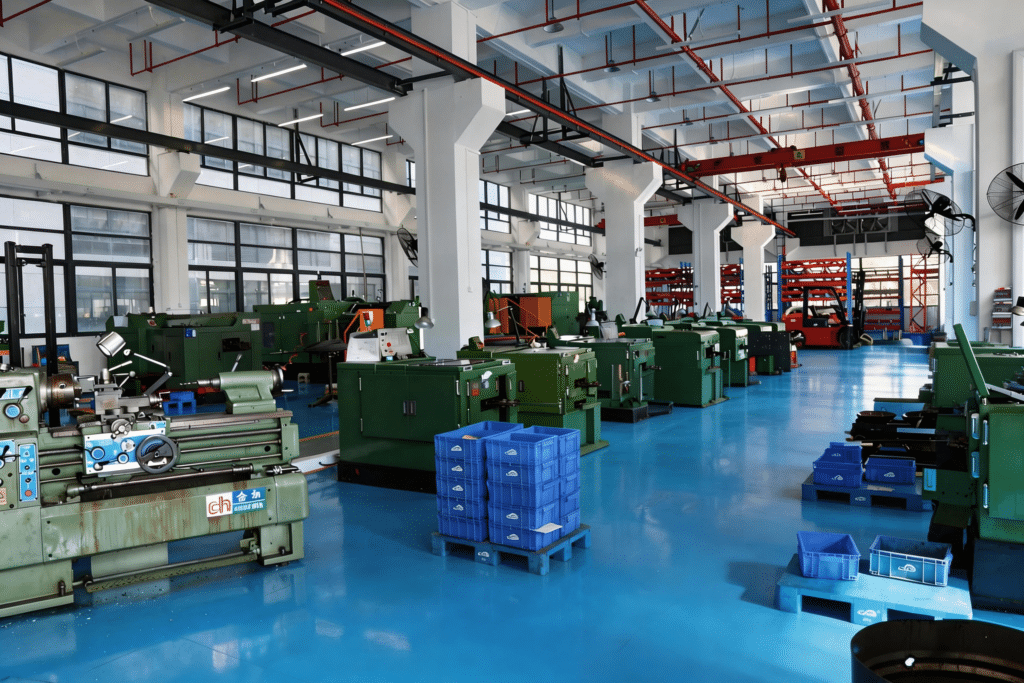
| Cold heading | Square body formed in multi-station die | 25 cold heading machines |
| Tapping | Internal thread cut or formed | 10 nut tapping machines |
| Heat treatment | Quench and temper to class | Controlled-atmosphere furnaces |
| Plating | Zinc, zinc-nickel, or DACROMET | In-house coating lines |
| Machining (specials) | Non-standard or oversized variants | 32-machine CNC line |
| Stamping (thin/T-slot) | Blanked and formed profiles | 50–300 T stamping presses |
| Verification | Across flats, height, thread | Mitutoyo gauges + 2D video measuring, 100% optical sorting |
Cold heading is the right process for square nuts precisely because the square is formed, not cut: the die shapes all four flats simultaneously with continuous grain flow, giving 40–60 % higher strength than a machined equivalent while wasting almost no material. Process detail sits on the cold forging page and the technology overview.
Need a quote on square nuts or custom captive hardware? Send your drawing or pocket dimensions to KeyFix — DFM review and quotation within 48 hours. Get a quote or email sales@keyfixpro.com.
What Should the Drawing Specify?
| Call-Out | What to Specify | Why It Matters |
|---|---|---|
| Standard or profile | DIN 557 / 562 / 928, or extrusion series | Anchors all dimensions |
| Across flats + tolerance | s dimension with tolerance | Pairs with pocket clearance |
| Height | Nut thickness | Sets pocket depth |
| Corner condition | Sharp or radiused, radius value | Prevents rocking in milled pockets |
| Thread + class | e.g., M6 × 1.0, 6H | Mating bolt fit |
| Property class | ISO 898-2 class or A2-70 | Strength and material |
| Finish | Zinc, Zn-Ni, passivated, plain | Corrosion; affects across-flats |
| Plated or unplated dimension | State which the tolerance applies to | The most common dimensional dispute |
📋 Spec Tip: Add one line — “across-flats tolerance applies after plating” — and an entire category of incoming-inspection arguments disappears. Unplated nuts gauge fine and then refuse to enter the pocket once coated; stating the measurement condition on the print settles it before the first shipment.
How Do You Qualify a Square Nut Manufacturer?
| Audit Point | Minimum Requirement | KeyFix Status |
|---|---|---|
| Quality system | ISO 9001 minimum | IATF 16949 + ISO 9001 + ISO 14001 |
| Forming method | Cold headed, not machined, at volume | 25 cold heading machines |
| Tapping capacity | Dedicated nut tapping | 10 nut tapping machines |
| Material verification | OES per heat | SPECTRO OES, 100% of heats |
| Dimensional control | Across flats gauged, plated condition | Mitutoyo gauges + 2D video measuring |
| Finish validation | Salt spray records | Zn-Ni / DACROMET, 1,000+ hr |
| Outgoing quality | Documented defect rate | <25 PPM at AQL 0.4 |
Nut chemistry follows ASTM material specifications and thread classes follow ISO 965, under the quality system documented in KeyFix’s company background.
What Are the Logistics and Shipping Terms?
KeyFix manufactures in Huizhou, Guangdong, near South China’s export ports.
| Term | Detail |
|---|---|
| Manufacturing location | Huizhou, Guangdong Province |
| Standard shipping term | FCA Dongguan |
| Sea freight term | FOB Shenzhen Yantian Port |
| Prototype lead time | 7–14 business days (air-expressed) |
| Production lead time | 4–6 weeks after sample approval |
Frequently Asked Questions
What clearance should a square nut pocket have?
Target 0.1–0.3 mm total across the flats — that is, pocket width minus nut across-flats. Below 0.05 mm the nut jams during assembly; above roughly 0.8 mm it skews under torque and damages the pocket walls.
Why does my square nut rock instead of sitting flat?
Almost always rounded internal corners in a milled pocket meeting the sharp corners of the nut. Add corner relief to the pocket or order nuts with radiused corners — the fix is geometry, not a different nut size.
Can square nuts be molded into plastic?
Yes, and the flats give excellent rotational holding in polymer. Protect the thread with a core pin during molding, and select a material and finish that tolerate melt temperature without outgassing into the resin.
What is the difference between DIN 557 and DIN 562?
Only height. DIN 557 is the standard-thickness square nut; DIN 562 is the thin version — roughly 60 % of the height at the same across-flats dimension — for shallow pockets and tight stacks.
What is the minimum order quantity?
Cold-headed production typically starts at 10,000 pieces per size; sample and validation lots of 500–1,000 pieces are available, and machined specials run from 100 pieces. Contact sales@keyfixpro.com for quotations.
What shipping terms apply for international orders?
Standard shipping is FCA Dongguan, with sea freight as FOB Shenzhen Yantian Port from the Huizhou production base.
If your next assembly needs square insert nuts — DIN standard, thin, weld, T-slot, or a custom profile matched to your pocket — send your drawing to KeyFix for a free DFM review and a quotation within 48 hours. Explore the product portfolio or contact KeyFix at sales@keyfixpro.com.
Author: KeyFix Engineering Team Published: July 6, 2026 Last Updated: July 6, 2026