
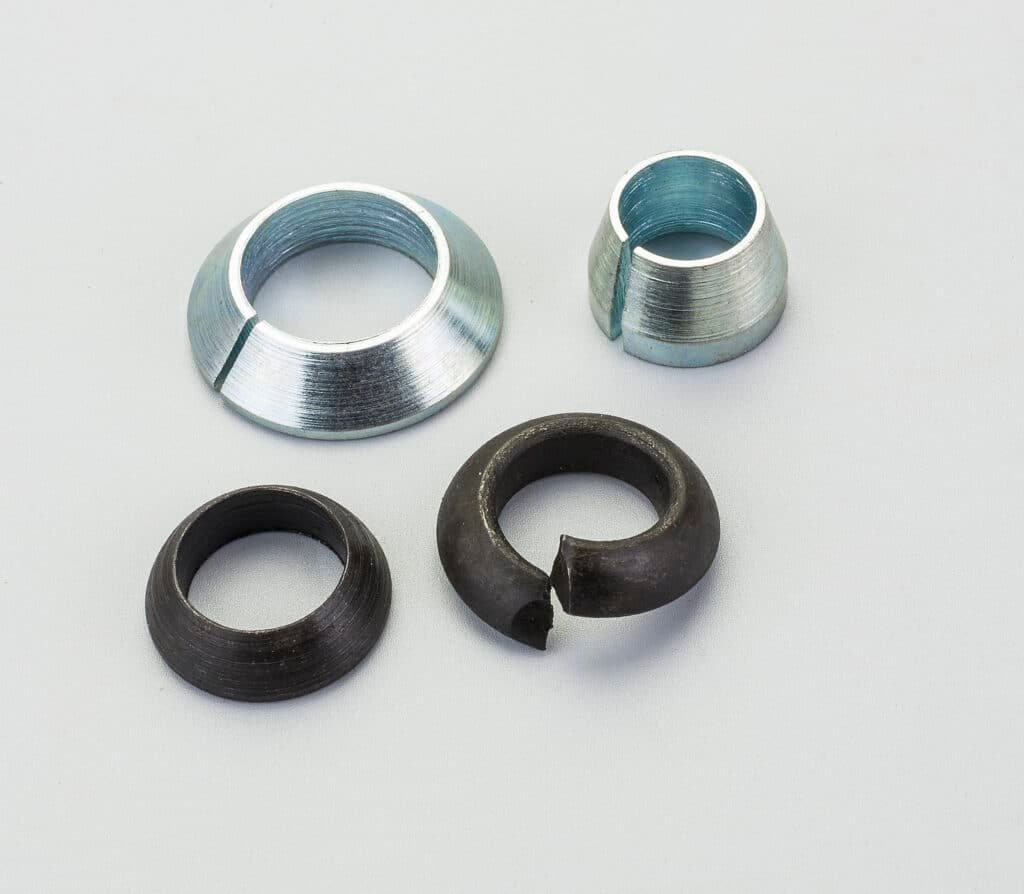
Spherical washers exist to solve one problem that flat washers cannot touch: a bolt clamping against a surface that is not square to it. When the bearing face sits at an angle — a tapered beam flange, a cast boss, a welded bracket that pulled during cooling — a flat washer forces the bolt head to seat unevenly, and the fastener picks up a bending stress it was never rated for. Spherical washer pairs, conical seat washers, and ogee washers each attack a different version of that geometry problem. This guide covers how angular misalignment destroys bolts, the DIN 6319 washer forms, ogee and bevelled washers in structural work, contact stress and hardness, materials, and how to specify and source custom parts.
TL;DR — Key Takeaways
- A bolt clamped against an angled face carries bending stress on top of tension, and bending — not tension — is what drives fatigue failure at the head-to-shank fillet.
- DIN 6319 covers the family: form C (convex), form D (concave), and conical seat forms. C and D work as a matched pair, never alone.
- A spherical pair typically corrects ±3–4° of angular misalignment, letting the bolt stay straight while the joint face stays crooked.
- Ogee washers — heavy cast or forged washers with a curved profile — spread load across timber and uneven structural surfaces where a flat washer would crush in.
- Spherical pairs must be hardened; a soft convex washer brinells into its mate and the joint loses preload within a few cycles.
Why Does Angular Misalignment Break Bolts?
A properly loaded bolt carries pure tension: the head bears evenly on a face perpendicular to the shank, and stress distributes uniformly around the section. Tilt that bearing face by even a couple of degrees and the picture changes completely. The head contacts on one side first, the shank flexes to follow, and a bending moment superimposes itself on the tension.
Bending is far more damaging than tension because it concentrates. The peak stress lands on one side of the shank, at the head-to-shank fillet — the exact location where fatigue cracks start. A joint that would run indefinitely under pure tension can fail in service under the same clamp load with a two-degree seating error.
| Condition | Stress State | Practical Result |
|---|---|---|
| Square bearing face | Pure tension, uniform | Full rated fatigue life |
| 1–2° misalignment | Tension + moderate bending | Reduced fatigue life, uneven preload |
| 3–5° misalignment | Tension + severe bending | Early fatigue cracking at fillet |
| Misalignment + vibration | Bending reversal each cycle | Rapid failure; loosening |
The washers in this guide all exist to restore that square bearing face — either by pivoting to meet the bolt (spherical), by matching a tapered hole (conical), or by spreading load across a surface too soft or irregular to bear it (ogee).
💡 Engineer’s Note: If bolts in one position keep failing at the head fillet while identical bolts elsewhere survive, stop increasing the property class and check the seating angle with a square. Upgrading 8.8 to 12.9 in a bending situation often shortens life — harder steel is more notch-sensitive, and the fillet is the notch.
What Are the DIN 6319 Washer Forms?
The spherical washer family is standardised, and the forms are designed to work in specific combinations.
| Form | Description | Function |
|---|---|---|
| Form C | Convex (male) spherical surface | Sits under the bolt head or nut; pivots |
| Form D | Concave (female) spherical seat | Receives form C; sits on the joint face |
| Form G | Conical seat washer | Mates a tapered hole or countersink |
| Form K | Conical seat, alternative angle | Profile-specific applications |
The essential rule: C and D are a set. A convex washer alone has nothing to rock against; a concave washer alone gives the bolt head a cup it cannot pivot inside. Ordering one half of the pair is the most common mistake in this product family, and the parts look complete enough that it often reaches the assembly line before anyone notices.
| Property | Spherical Pair (C + D) | Conical Seat (G) | Ogee Washer |
|---|---|---|---|
| Corrects angular error | Yes, ±3–4° | No — fixed angle | No |
| Spreads load | Moderate | Moderate | Primary function |
| Mating requirement | Matched pair | Tapered hole | Flat or timber surface |
| Typical host | Machinery, fixtures, jigs | Countersunk assemblies | Timber, structural steel |
| Hardness requirement | High — both halves | Moderate | Moderate |
How Much Misalignment Can a Spherical Pair Absorb?
The correction range comes from the geometry of the spherical surfaces and the clearance around the bolt.
| Size Range | Typical Angular Correction | Bolt Clearance Needed |
|---|---|---|
| M6–M10 | ±3° | Through-hole with generous clearance |
| M12–M20 | ±3–4° | Clearance proportional to angle |
| M24–M36 | ±3–4° | Larger absolute offset at the hole |
Two design points follow from this. The through-hole must be oversized: as the washer pair pivots, the bolt shank swings within the hole, and a close-fitting hole defeats the whole arrangement by forcing the shank to bear against the hole wall. And correction is angular, not positional — a spherical pair fixes a sloped face, not a mislocated hole.
⚠️ Common Pitfall: Specifying a spherical washer pair and then reaming the through-hole to a close fit “for accuracy.” The pair can only work if the bolt is free to tilt inside the hole; a tight hole converts the intended pivot into a jam, and the bolt ends up bent in exactly the way the washers were bought to prevent. Size the hole for the full swing.
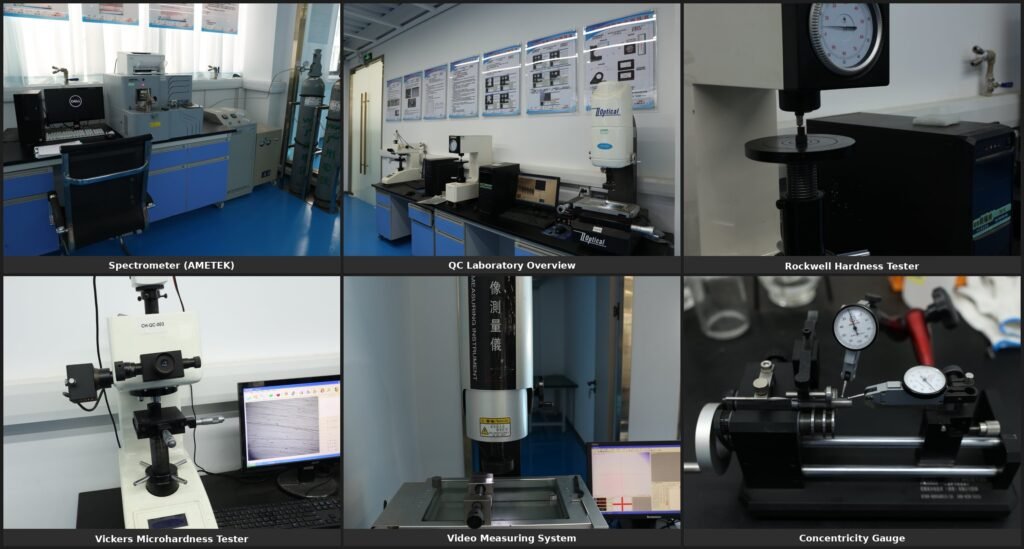
Dimensional conformance of the mating spherical surfaces is verified by 2D video measuring and calibrated Mitutoyo gauges, documented under KeyFix’s inspection standards program.
What Are Ogee Washers and Bevelled Washers For?
Ogee washers solve the opposite problem. Where spherical washers correct an angle, ogee washers manage bearing pressure across a soft or uneven surface. They are heavy washers — typically cast or forged, far thicker than a plain washer — with a curved, S-profile section that stiffens them against dishing.
| Washer Type | Construction | Primary Job | Typical Use |
|---|---|---|---|
| Ogee washer | Cast or forged, curved section | Spread load; resist dishing | Timber construction, bridges, marine piling |
| Bevelled washer | Tapered thickness (commonly 8–14 % slope) | Match a sloped structural flange | Steel I-beam and channel flanges |
| Heavy flat washer | Thick flat plate | Raw bearing area | General structural |
| Plate washer | Large square plate | Maximum spread on timber | Post bases, heavy timber frames |
Bevelled washers deserve a mention alongside them because they address the same structural world with the opposite method. Standard steel I-beam and channel flanges are not flat — they taper by roughly 8 to 14 percent toward the tip. A bolt through such a flange with a plain washer sits at that angle permanently. A bevelled washer carries a matching taper that cancels it, which is why they appear in structural bolting specifications so consistently.
The choice between them is simple. If the surface is soft (timber, composite, thin plate) the problem is pressure, and the answer is bearing area — ogee or plate washer. If the surface is hard but sloped (a rolled steel flange), the problem is angle, and the answer is a bevelled washer or a spherical pair.
Why Must Spherical Washers Be Hardened?
This is the specification that separates a working pair from an expensive failure. The two spherical surfaces bear against each other over a curved contact patch, and the whole bolt preload passes through it. If either half is soft, the contact area brinells — the harder surface presses a permanent indent into the softer one.
Once that happens, the pair stops pivoting, the indentation deepens, and the joint quietly loses preload as the material yields. A spherical washer set that “worked at assembly” but showed loose bolts a month later has almost always brinelled.
| Material | Typical Condition | Suitability |
|---|---|---|
| Case-hardened carbon steel | Hardened surface, tough core | The standard for spherical pairs |
| Alloy steel, through-hardened | HRC 40+ | High-load machinery |
| Stainless 17-4PH (H900) | ~1,170 MPa yield | Corrosion plus load capacity |
| Stainless 304 / 316 | Soft, unhardenable | Light duty only — brinells under load |
| Ductile / malleable cast iron | As cast | Ogee washers (bearing area, not pivoting) |
| Bronze | Soft | Sacrificial or low-load pivots |
The stainless entry carries the same warning that applies across precision hardware: 304 cannot be hardened by heat treatment. For a corrosion-resistant spherical pair carrying real load, 17-4PH in the H900 condition is the grade that delivers both properties. Incoming material is confirmed by SPECTRO optical emission spectrometry through KeyFix’s raw material control process, with hardness recorded per lot.
Galling is the second surface concern. Two hardened steel spherical faces sliding under load can seize, particularly in stainless. A dry-film lubricant or phosphate coating on one half keeps the pivot working through repeated assembly.
How Are Custom Spherical and Conical Washers Made?
| Step | What Happens | KeyFix Capability |
|---|---|---|
| Material verification | Grade and condition by OES | SPECTRO (Germany), 100 % of heats |
| Blank forming | Near-net blanks at volume | Cold forging, 25 heading machines |
| Turning / profiling | Spherical and conical surfaces cut | 32 CNC machines incl. two 5-axis, ±0.005 mm |
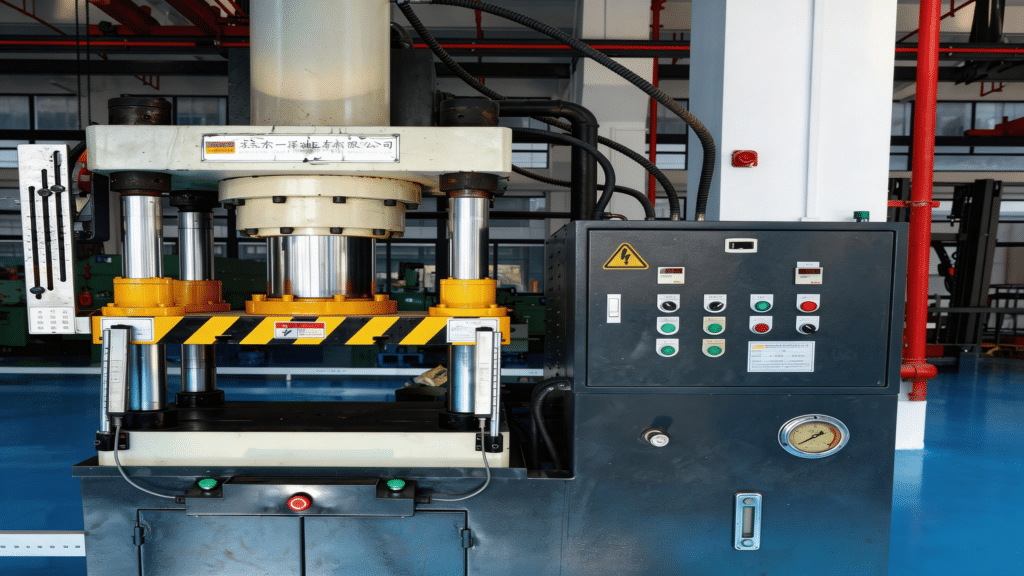
| Flat washer production | Blanked at high volume | 50–300 T stamping presses |
| Heat treatment | Case hardening or through-hardening | Controlled-atmosphere furnaces |
| Finishing | Zinc-nickel, DACROMET, passivation | In-house lines, 1,000+ hr salt spray |
| Verification | Sphere radius, angle, thickness, hardness | 2D video measuring + Shining3D scanning, Mitutoyo gauges, 100 % optical sorting |
Matched pairs bring one requirement beyond ordinary washer production: the convex and concave radii must be produced and controlled as a set, because a mismatch concentrates contact on a ring instead of distributing it across the spherical band. KeyFix machines both halves to the same radius specification on the CNC production line, with process detail on the technology overview and related precision families in the CNC parts portfolio.
Need a quote on spherical, conical seat, or ogee washers? Send your drawing or a sample to KeyFix — DFM review and quotation within 48 hours. Get a quote or email sales@keyfixpro.com.
Where Are These Washers Used?
| Application | Washer Type | Why |
|---|---|---|
| Machine tool fixtures and jigs | Spherical pair | Clamps against irregular workpieces |
| Structural steel flanges | Bevelled or spherical | Tapered flange, 8–14 % slope |
| Timber frame construction | Ogee or plate washer | Wood crushes under point load |
| Cast housings and bosses | Spherical pair | As-cast faces are rarely square |
| Hydraulic and press tooling | Spherical pair, hardened | High preload, angular tolerance |
| Countersunk assemblies | Conical seat (form G) | Matches the tapered hole |
| Marine piling and bridges | Ogee washer | Heavy load, uneven bearing |
Machine fixturing is the clearest case for a spherical pair. A clamp bearing on a rough casting or an angled workpiece face has no square surface at all, and without the pair every clamping bolt bends slightly on each cycle. Delivered programs across these families appear in KeyFix’s project case studies and machinery hardware programs.
What Should the Drawing Specify?
| Call-Out | What to Specify | Why It Matters |
|---|---|---|
| Standard + form | DIN 6319 form C, D, or G | Defines the geometry family |
| Matched pair | State “supplied as C + D set” | Prevents half-set ordering |
| Spherical radius | Radius with tolerance, both halves | Mismatch causes ring contact |
| Cone angle (form G) | Included angle with tolerance | Must match the mating hole |
| Bore diameter | With clearance for pivot swing | Tight bore defeats the pair |
| Material + condition | e.g., case-hardened, 17-4PH H900 | Brinelling resistance |
| Hardness | HRC range on the bearing surface | The critical load property |
| Finish | Zn-Ni, DACROMET, passivated, dry-film | Corrosion and anti-galling |
📋 Spec Tip: Put the words “supplied as matched pairs” and the through-hole diameter on the same assembly note. Those two lines prevent the two failure modes that account for most spherical washer complaints — half-sets shipped, and a reamed hole that stops the pivot.
How Do You Qualify a Manufacturer?
| Audit Point | Minimum Requirement | KeyFix Status |
|---|---|---|
| Quality system | ISO 9001 minimum | IATF 16949 + ISO 9001 + ISO 14001 |
| Profile machining | Spherical/conical surfaces to radius spec | 32 CNC machines, ±0.005 mm |
| Material verification | OES per heat | SPECTRO OES, 100 % of heats |
| Heat treatment | Case or through-hardening, records | Controlled, documented per lot |
| Hardness testing | Per lot on bearing surface | Recorded |
| Pair matching | Radii controlled as a set | Documented process |
| Outgoing quality | Stated defect rate | <25 PPM at AQL 0.4 |
Washer dimensions and material follow ASTM and ISO reference standards, under the quality system documented in KeyFix’s company background, with the broader range visible in the product portfolio.
What Are the Logistics and Shipping Terms?
KeyFix manufactures in Huizhou, Guangdong, near South China’s export ports.
| Term | Detail |
|---|---|
| Manufacturing location | Huizhou, Guangdong Province |
| Standard shipping term | FCA Dongguan |
| Sea freight term | FOB Shenzhen Yantian Port |
| Prototype lead time | 7–14 business days (air-expressed) |
| Production lead time | 4–6 weeks after sample approval |
Frequently Asked Questions
What do spherical washers do that flat washers cannot?
They correct angular misalignment. A convex and concave pair pivots so the bolt head seats square even when the joint face is sloped, removing the bending stress that causes fatigue cracking at the head fillet. A flat washer transmits the angle straight into the bolt.
Do spherical washers have to be used in pairs?
Yes. Form C (convex) and form D (concave) are a matched set — one provides the pivot surface for the other. A single half has nothing to articulate against and behaves like a poorly shaped flat washer.
How much misalignment can they correct?
Typically ±3–4° depending on size and form. The through-hole must be sized to let the bolt shank swing through that angle; a close-fitting hole prevents the pair from working.
What is an ogee washer used for?
Spreading load on soft or uneven surfaces — timber construction, bridge work, marine piling. Its heavy curved section resists dishing under high load, where a plain washer would deform and sink into the material.
Can spherical washers be made from stainless steel?
For light duty, yes in 304 or 316. For real load, those grades are too soft and will brinell. Specify 17-4PH in the H900 condition for a hardened, corrosion-resistant pair.
What is the minimum order quantity?
CNC-machined spherical and conical washers run from 100–500 pieces for validation, scaling into the thousands with price breaks; stamped flat washers start higher. Contact sales@keyfixpro.com for quotations.
If your next assembly needs spherical washers, conical seat washers, or ogee washers — matched hardened pairs, custom radii, or heavy load-spreading profiles — send your drawing to KeyFix for a free DFM review and a quotation within 48 hours. Explore the CNC parts portfolio or contact KeyFix at sales@keyfixpro.com.
Author: KeyFix Engineering Team Published: July 8, 2026 Last Updated: July 8, 2026