
Fasteners for Automotive

Production 

Rivew More Successful Samples

1. Industry Challenges For Automotive Fasteners

The automotive supply chain faces unique fastening challenges as Tier 2/3 suppliers serve multiple OEMs with diverse requirements:

Multi-Model Small Batch Complexity

  • Different insert sizes and thread specifications
  • Unique positioning and spacing requirements
  • Custom flange diameters for various plastic wall thicknesses
  • Standard catalog inserts cannot accommodate this diversity

Injection Molding Process Compatibility

  • Thermal shock: 180-250°C molten plastic flow around inserts
  • Positional accuracy: ±05mm tolerance to prevent mold damage
  • Pull-out resistance: Minimum 800N for knurled brass inserts in PA66+GF30
  • Standard inserts often deform, misalign, or lose retention strength

Assembly Efficiency Demands

  • Pre-installed inserts (no secondary operations)
  • Compatible with robotic assembly (consistent thread height)
  • Anti-cross-threading features for high-speed assembly
  • Mismatch between insert quality and assembly line speed causes defects

Lightweight Material Transitions

  • Traditional steel inserts too heavy for lightweight frames
  • Aluminum-to-steel galvanic corrosion risks
  • Composite materials require specialized insert designs (expanding sleeves, thermal bonding)
  • Lack of suitable insert solutions delays new model development

2. Customized Solutions

A) Heat-Staking / Thermal Press-In Inserts

For Thermoplastic Interior Components

Product Specifications:

Insert Type

Material

Applications

Key Features

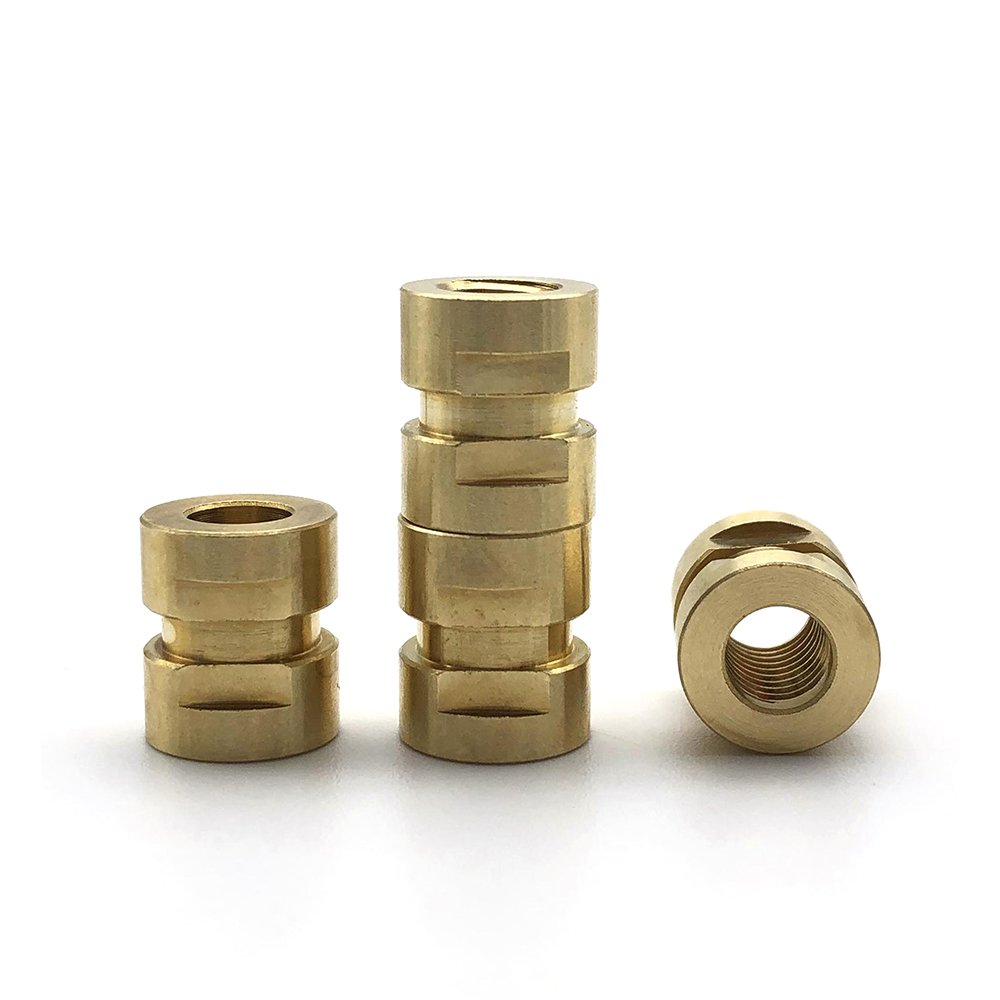
Knurled Brass Inserts

CuZn39Pb3 / C38500

Dashboard, door panels, glove box

Diamond knurl pattern, thermal expansion fit

Ultrasonic Inserts

Brass or Stainless 303

Instrument clusters, A-pillar trim

Undercut design for ultrasonic welding

Molded-In Inserts

Stainless 303/304

Center console, armrests

Barbed or knurled OD, positioned in mold


Technical Performance:

 Thermal Press-In Inserts (Post-Molding Installation)

  • Installation: Heated insert (300-350°C) pressed into pilot hole
  • Pull-out strength: 800-1,200N in PA66+GF30 (3mm wall)
  • Torque resistance: 15-25 Nm without rotation
  • Dimensional tolerance: Length ±05mm, OD h8 tolerance
  • Surface: Knurl depth 0.3-0.5mm, 90° diamond pattern

 Ultrasonic Weld Inserts

  • Installation: Ultrasonic horn drives insert into pilot hole (2-3 seconds)
  • Design features: Undercut grooves melt plastic into locking channels
  • Pull-out strength: 1,000-1,500N (superior to thermal press)
  • Advantage: No thermal damage to surrounding plastic, faster cycle time
  • Ideal for: Thin-wall components (<2mm), close to decorative surfaces

 Molded-In Inserts (In-Mold Placement)

  • Process: Insert positioned in mold cavity before injection
  • Design: External knurls/barbs + axial ribs prevent rotation and pull-out
  • Pull-out strength: 1,500-2,500N (strongest method)
  • Challenge: Requires precise mold design and insert positioning fixtures
  • Best for: High-load attachments (seat adjusters, armrest pivots)


3. Material & Quality Specifications

Material Standard

Material

Standard

Typical Hardness

Applications

Brass CuZn39Pb3

EN 12164 / C38500

80-110 HV

Thermal press inserts (cost-effective)

Stainless 303

ASTM A582

160-200 HV

Ultrasonic inserts, corrosion resistance

Stainless 304

ASTM A193

150-190 HV

Molded-in inserts, marine/humid environments

Aluminum 5052

ASTM B211

60-75 HRB

Lightweight rivet nuts for aluminum structures

Surface Treatments for Plastic Compatibility

Treatment

Purpose

Specifications

Passivation (Stainless)

Remove free iron, enhance corrosion resistance

ASTM A967, citric acid method

Zinc Plating (Steel inserts)

Corrosion protection, NOT for high-temp molding

8-12 μm, yellow chromate (avoid if heat-staking)

Bare Brass

Direct thermal conductivity for heat-staking

No coating (natural oxide acceptable)

Anodizing (Aluminum)

Hard anodized Type III for wear resistance

25-50 μm, clear or black

4. Quality Control Process

  • Thread pitch diameter: GO/NO-GO gauges per ISO 1502
  • Overall length tolerance: ±0.05mm (critical for robotic installation)
  • Knurl depth verification: Optical comparator, 0.3-0.5mm specification
  • Flange diameter/thickness: Caliper measurement, ±0.1mm
  • Pull-out test: Installed insert in representative plastic sample, tensile machine test
    • Acceptance: ≥800N for thermal press, ≥1,000N for ultrasonic, ≥1,500N for molded-in
  • Torque-out test: Apply increasing torque until insert rotates in plastic
    • Acceptance: ≥15 Nm for M5, ≥25 Nm for M6 brass inserts
  • Thread verification: Bolt engagement test, minimum 80% thread contact

5. Custom Development Process

5-Step Collaboration Workflow

Step 1: Technical Assessment (1-2 Days)

  • Submit: Plastic part drawing, material specification (PA66, PP, ABS, etc.), wall thickness
  • We analyze: Pilot hole size, insert length, knurl/undercut design, installation method
  • Output: Feasibility report + insert design recommendation + installation guidance

Step 2: Prototype Samples (1-2 Weeks)

  • We produce: 20-50 pcs prototype inserts per your specifications
  • You test: Install in molded parts, perform pull-out/torque-out testing
  • Iteration: Adjust knurl pattern, length, or flange design based on test results

Step 3: Production Quotation (2-3 Days)

  • Detailed pricing: Per-piece cost (200-1,000 pcs), tooling cost (if custom size)
  • Lead time: 3-5 weeks for standard production batches
  • MOQ: 200 pieces per specification (multi-spec orders combined)

Step 4: Production & Quality Verification (3-5 Weeks)

  • Manufacturing: Precision turning (brass/stainless), knurling, thread rolling
  • Inspection: 100% thread gauge check, statistical dimensional sampling
  • Testing: Pull-out samples from each production batch

Step 5: Packaging & Delivery

  • Packaging: Plastic bags (500-1,000 pcs) or tape-and-reel (for automated feeders)
  • Labeling: Part number, specification, quantity, batch code
  • Documentation: Material certificate, dimensional report, test data

6. Application Cases

Interior Module Assembly Case

Client Profile: European Tier 2 dashboard module supplier
Challenge: Required 8 different thermal press-in insert sizes for multi-model instrument panel program. Existing supplier’s inserts had inconsistent knurl depth, causing 3% pull-out failures during assembly.

Our Solution:

  • Material: CuZn39Pb3 brass per EN 12164
  • Design: Optimized diamond knurl (0.4mm depth, 1.0mm pitch)
  • Specifications: 8 sizes from M4×6mm to M6×12mm
  • Quality control: 100% knurl depth inspection + pull-out testing (10 samples/batch)
  • Quantity: 5,000 pcs total (multi-spec combined order)

Results: ✓ Pull-out strength improved to 950-1,100N (target 800N minimum)
✓ Assembly defect rate reduced from 3% to 0.2%
✓ Delivered complete set in 4 weeks
✓ Established long-term supply agreement for 5 vehicle programs

6. Request a Technical Quote

What We Need:

Technical Information:

  • Plastic part drawing (showing insert location, wall thickness)
  • Insert specifications (thread size, length, installation method) or sample inserts
  • Plastic material (PA66, PP, ABS, etc.) and glass fiber content
  • Quantity per specification and delivery timeline

Application Details:

  • Installation process (thermal press / ultrasonic / in-mold)
  • Pull-out/torque-out requirements (if specified by OEM)
  • Assembly equipment (for tape-and-reel compatibility)

You Will Receive:

REVIEW MORE SAMPLES

Check more successful parts we did before for our heavy clients.

TECHNOLOGY

Review what technology we can do in our factory.

Get in Touch


Contact Us To Realize Your Project!

Phone Number

+86 130 3230 2505

Email Address

sales@keyfixpro.com

 200 pieces per specification. We accept multi-spec orders (e.g., 200 pcs each of 5 sizes = 1,000 total) which qualifies for volume pricing. For prototype/testing, we offer 20-50 pcs sample quantities.

Yes. Send us sample inserts or detailed drawings (thread, length, knurl pattern, flange dimensions). We reverse-engineer and manufacture to your exact specifications, or suggest improvements based on our testing.

Through controlled manufacturing and testing:

  • Knurl precision: CNC turning with ±02mm depth control
  • Material verification: Hardness testing on each batch
  • Functional testing: Destructive pull-out tests on 10 samples per 1,000 pcs
  • Statistical control: Track pull-out force data, alert if trending toward lower limit

Typical results: 900-1,100N for thermal brass inserts (target ≥800N) with <5% variation.

We have validated designs for common interior plastics:

  • PA66 (Nylon 66)with 15-30% glass fiber: Excellent (most common)
  • PP (Polypropylene): Good (requires larger knurl pattern)
  • ABS: Good (lower temperature heat-staking required)
  • PC/ABS blends: Good (watch for stress cracking around insert)
  • PC (Polycarbonate): Fair (use ultrasonic method, not thermal press)

For new materials, we recommend pull-out testing in your actual plastic formulation.

Standard lead time is 3-5 weeks after order confirmation. Rush service available:

  • 2-week delivery: +20% premium, subject to capacity (max 2,000 pcs)
  • 1-week samples: 50-200 pcs for urgent testing needs

Yes, engineering consultation included:

  • Insert type recommendation (thermal/ultrasonic/molded-in) based on your process
  • Sizing calculation: Pilot hole diameter, insert length for your wall thickness
  • Material selection: Brass vs. stainless based on environment and cost targets
  • Installation parameter guidance: Temperature, force, cycle time

Get in touch

Let's talk about project!