
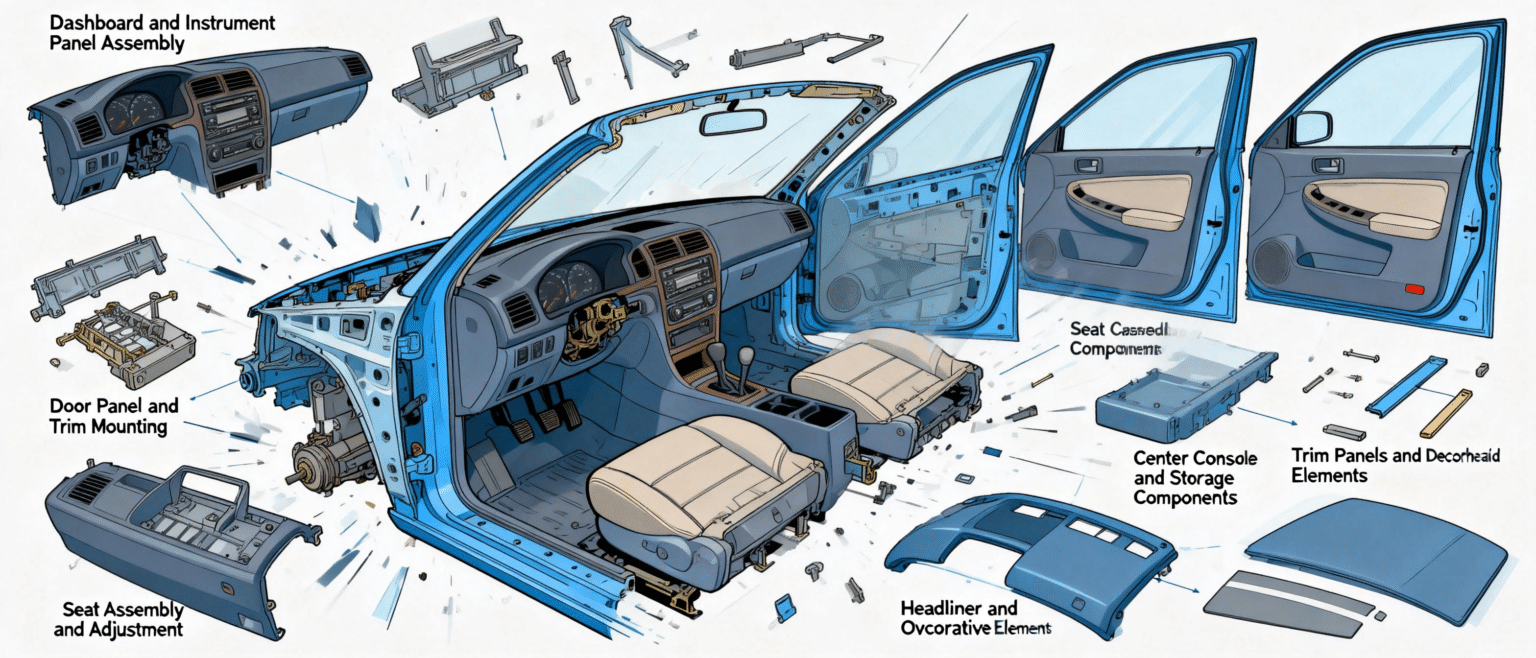
Introduction: Trim Nuts Define Perceived Vehicle Quality
Automotive trim nuts china manufacturers supply one of the most underestimated fastener categories on any vehicle. While engineers devote months to optimizing powertrain bolts and structural fasteners, the trim nuts that secure dashboard panels, door cards, pillar covers, and exterior mouldings often receive minimal specification attention — until the first warranty claim arrives citing an interior rattle at 3,000 km.
That rattle is not a structural failure. It is a Noise, Vibration, and Harshness (NVH) defect caused by a trim nut that has lost clamp load, shifted position, or allowed micro-movement between mating surfaces. In customer satisfaction surveys conducted by J.D. Power and similar agencies, wind noise and interior squeaks/rattles consistently rank among the top five quality complaints — directly impacting brand perception and repurchase intent.
This reality means that specifying automotive trim nuts china sources requires more than matching a thread size to a panel hole. It demands understanding how nut geometry, spring preload, material damping, and surface friction interact to produce — or prevent — the Buzz-Squeak-Rattle (BSR) events that erode perceived quality. This guide provides that NVH-focused specification framework.
Trim Nut Types and Their NVH Performance Characteristics
Different trim nut geometries produce fundamentally different vibration-response behaviors. The ta1ble below classifies common automotive trim nut variants by their NVH performance profile.
| Trim Nut Type | Attachment Method | NVH Damping Behavior | Float / Compliance | BSR Risk Level | Primary Application |
|---|---|---|---|---|---|
| Weld Nut (Projection Weld) | Permanently fused to panel | Rigid; zero compliance | None | Low (if welded correctly) | Structural bracket, seat mount |
| Clinch Nut (Self-Clinching) | Pressed into pre-punched hole | Semi-rigid; panel absorbs micro-vibration | None | Low | ECU bracket, instrument cluster |
| Cage Nut (Floating Captive) | Snapped into square hole; nut floats | Compliant; absorbs ±2 mm misalignment | ±1.5 – ±2.5 mm | Medium (float can introduce rattle) | Cross-car beam, structural trim |
| U-Nut (Speed Nut) | Clips onto panel edge | Spring-loaded; provides controlled preload | Slight axial compliance | Medium-Low | Fender liner, splash shield |
| J-Nut (Hook Clip) | Hooks into hole from one side | Spring-loaded with directional retention | Slight lateral compliance | Medium | Door panel, quarter trim |
| Push-In Nut (Palnut / Tinnerman) | Pushed onto stud or screw | Progressive spring resistance | None (captive on stud) | Low | Visible trim panels, badges |
| Nylon Insert Nut (Flanged Nyloc) | Threaded onto stud/bolt | Prevailing torque from nylon insert | None | Very Low | Vibration-critical interior mounts |
Cage nuts present the highest BSR risk among trim nut types because the floating nut element can oscillate within its cage under road-induced vibration, generating metallic buzzing. Specifying cage nuts with integral rubber-damped cages — where a thin elastomeric sleeve separates the nut from the cage frame — reduces this risk by 60–80 % at a marginal cost increase. This is a specification refinement that premium automotive trim nuts china suppliers like KeyFixPro offer as a standard option.
Material Selection for Trim-Specific Performance
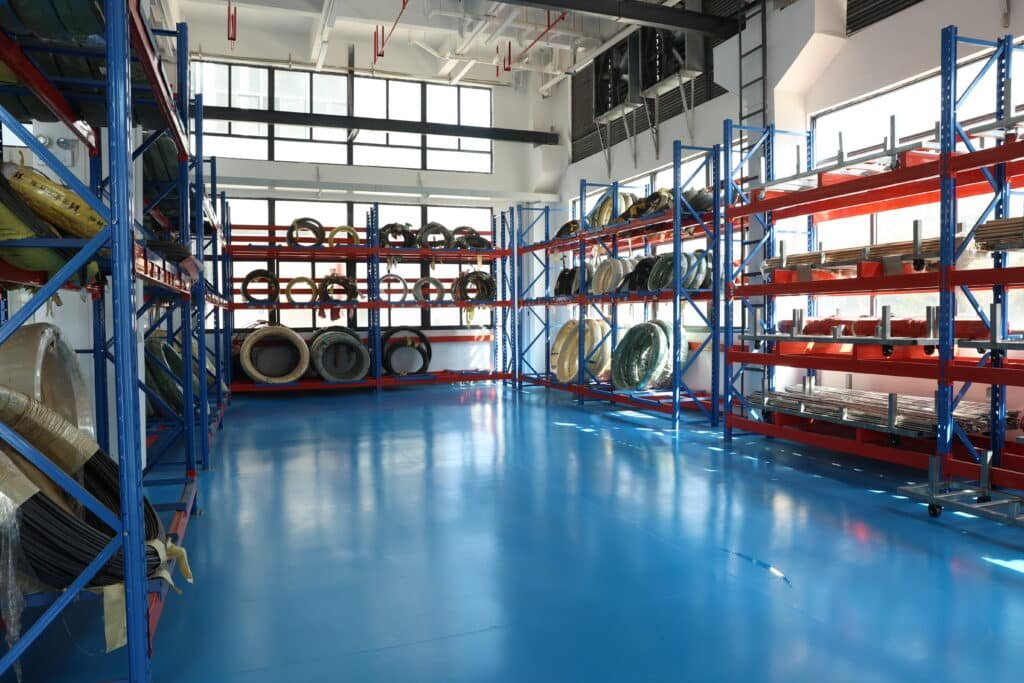
Trim nut material must balance formability (for complex stamped geometries), spring resilience (for clip-type retention), and — critically for NVH — vibration damping capacity.
| Material | Hardness (HV) | Damping Capacity | Formability | Corrosion Strategy | Cost Index | Best Application |
|---|---|---|---|---|---|---|
| Low-Carbon Steel (SAE 1008–1010) | 100 – 150 | Low | Excellent | Zinc or phosphate | 1.0× | Weld nuts, clinch nuts (non-spring) |
| Medium-Carbon Steel (SAE 1035–1050) | 200 – 350 | Low-Medium | Good | Zinc-nickel or DACROMET | 1.2× | U-nuts, J-nuts requiring spring action |
| Spring Steel (SAE 1065–1075) | 380 – 480 | Medium | Moderate (requires anneal-form-harden) | Zinc-nickel required | 1.5× | High-retention clip nuts, cage nut springs |
| Stainless Steel (301, 304) | 250 – 400 | Medium | Good (work-hardening) | Inherent | 2.5× | Exhaust-adjacent, coastal fleet |
| Brass (C26000, C36000) | 80 – 150 | High | Excellent | Inherent | 3.0× | Electrical ground nuts, decorative cap nuts |
| Nylon (PA66-GF30) | N/A | Very High | Injection-moulded | Inherent | 0.8× | Interior push-in nuts, non-load-bearing |
Brass and nylon offer the highest intrinsic vibration damping — a property that makes them ideal for interior trim positions where NVH sensitivity peaks. Nylon push-in nuts have largely replaced stamped steel Tinnerman nuts in premium-brand interior trim because they eliminate metal-on-metal contact entirely, removing the primary excitation mechanism for high-frequency buzzing.
Surface Treatment and Friction’s Role in BSR Prevention
Surface coating on trim nuts affects two NVH-critical parameters: the friction coefficient under the mating screw head (which governs clamp-load consistency) and the contact-surface micro-texture (which affects stick-slip squeak behavior between nut and panel).
| Coating | Friction Coefficient (μ) | Stick-Slip Tendency | Salt Spray (hrs) | Acoustic Suitability |
|---|---|---|---|---|
| Trivalent Zinc Electroplate | 0.12 – 0.18 | Moderate | 200 – 400 | Acceptable for most trim |
| Zinc-Nickel (12–15 % Ni) | 0.10 – 0.15 | Low | 720 – 1,000+ | Excellent; consistent μ reduces squeak |
| Zinc Flake (DACROMET) | 0.12 – 0.14 | Very Low | 500 – 1,000 | Excellent; engineered friction topcoat |
| Phosphate + Oil | 0.08 – 0.14 | Low | 48 – 96 | Good for interior (low μ = smooth seating) |
| E-Coat (Cathodic Epoxy) | 0.10 – 0.15 | Low | 500 – 750 | Good; uniform film suppresses micro-slip |
| Black Oxide + Wax | 0.10 – 0.16 | Moderate | 48 – 96 | Adequate for concealed interior positions |
Stick-slip is the primary mechanism behind “squeak” complaints in trim assemblies. When two surfaces (nut bearing face and panel) alternate between static and kinetic friction under vibration, the resulting oscillation produces audible tonal noise in the 500 Hz–4 kHz range — the frequency band to which human hearing is most sensitive. Zinc-nickel and zinc flake coatings with engineered friction topcoats minimize stick-slip by maintaining a stable, low-scatter μ corridor that prevents the static-kinetic friction transition.
KeyFixPro’s in-house zinc-nickel and DACROMET lines control friction coefficient to ±0.02 across production lots — the consistency level required to pass OEM BSR shake-table validation at the vehicle-assembly plant.
Dimensional Tolerances Affecting Assembly and NVH
Dimensional precision in trim nuts directly affects two outcomes: assembly-line efficiency (will the nut engage the screw on the first attempt?) and NVH performance (does the nut-to-panel interface create a rattle-free joint?).
| Critical Dimension | OEM Requirement | KeyFixPro Capability | NVH Consequence of Non-Conformance |
|---|---|---|---|
| Thread Class | 6H (ISO 965-1) | 6H verified by GO/NO-GO | Over-size → low clamp load → panel vibration |
| Float Range (Cage Nut) | ±2.0 mm ±0.3 mm | ±2.0 mm ±0.15 mm | Excess float → nut rattle inside cage |
| Flange Bearing Surface Flatness | ≤ 0.10 mm TIR | ≤ 0.05 mm TIR | Uneven contact → point loading → squeak |
| Clip Engagement Width | ±0.10 mm | ±0.05 mm | Loose → nut drops off; tight → assembly force spike |
| Height Under Flange | ±0.15 mm | ±0.08 mm | Over-height → screw bottoms out before clamping |
| Burr Height (Stamped Edge) | ≤ 0.10 mm | ≤ 0.05 mm | Burr scratches panel paint → corrosion initiation |
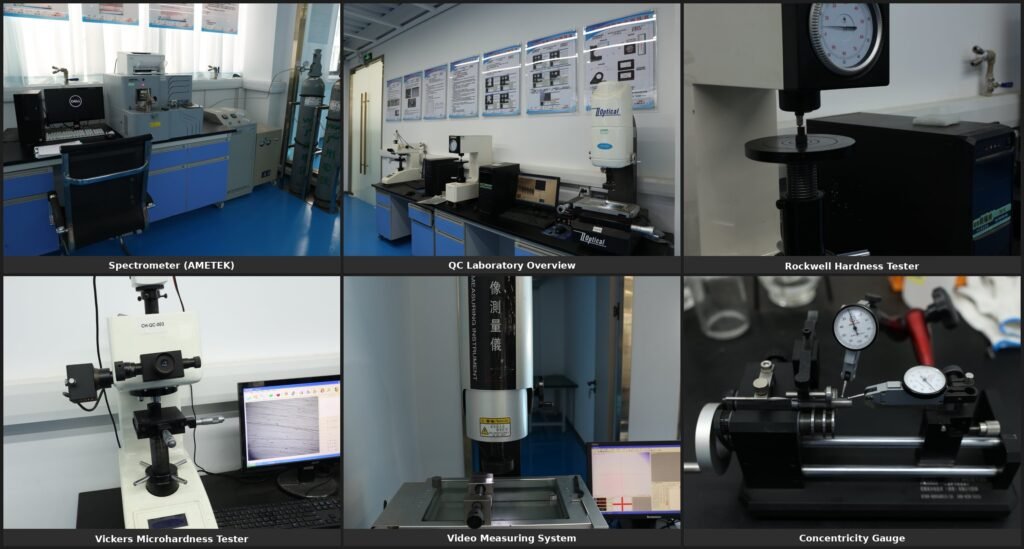
KeyFixPro achieves these tolerances through precision progressive stamping on 50–300 tonne presses with in-die sensor monitoring, complemented by CMM verification at ±0.001 mm resolution and 100 % optical sorting under IATF 16949 quality protocols.
Vehicle-Zone Application Map
| Vehicle Zone | Trim Component | Recommended Nut Type | Material | Coating | Thread Size |
|---|---|---|---|---|---|
| Dashboard / Instrument Panel | Cross-car beam covers, airbag tray | Cage nut (rubber-damped) | SAE 1010 + rubber | Phosphate + oil | M5, M6 |
| Door Card / Inner Panel | Speaker grille, armrest, map pocket | J-nut or push-in nut | SAE 1050 or nylon PA66 | Zinc or uncoated (nylon) | M4, M5 |
| A/B/C Pillar Cover | Pillar garnish, seat belt cover | Clinch nut (permanent) | SAE 1010 | E-coat | M5, M6 |
| Headliner | Overhead console, sun visor bracket | Push-in nut or nylon insert | Nylon PA66-GF30 | Uncoated | M4, M5 |
| Exterior Body Side Moulding | Chrome strip, protection moulding | U-nut (spring steel) | SAE 1065 | Zinc-nickel 15 μm | M5, M6 |
| Wheel Arch Liner / Splash Shield | Fender liner, mud flap bracket | U-nut (heavy gauge) | SAE 1065 | DACROMET | M6, M8 |
| Trunk / Cargo Area | Trunk liner, cargo net hook | Push-in nut or weld nut | SAE 1010 or nylon | Phosphate or uncoated | M5, M6 |
Qualifying an Automotive Trim Nuts China Supplier: NVH-Focused Checklist
Standard fastener audits verify dimensions and strength. Qualifying an automotive trim nuts china supplier for NVH-sensitive applications demands additional verification.
| Qualification Criterion | Standard Audit | NVH-Enhanced Audit (Additional) |
|---|---|---|
| IATF 16949 Certification | Verify scope covers stamped nuts | Confirm scope includes trim-specific product families |
| Dimensional SPC (Cpk) | Cpk ≥ 1.33 on thread and engagement dims | Cpk ≥ 1.67 on flange flatness and float range |
| Material Traceability | Mill certificate per heat lot | Spring-temper hardness verified per coil lot |
| Corrosion Validation | Salt spray per ASTM B117 | Friction coefficient (μ) tested per coated lot |
| Retention Force Testing | Push-on / pull-off per sample | 100 % in-line force testing with SPC monitoring |
| BSR Validation Capability | Not typically audited | Supplier can provide shake-table or modal test data |
| Rubber-Damped Cage Nut Option | Not typically audited | Supplier offers integrated elastomeric damping inserts |
| Nylon / Polymer Nut Capability | Not typically audited | Injection-moulding capability for PA66-GF30 push-in nuts |
KeyFixPro satisfies both standard and NVH-enhanced audit requirements: IATF 16949 / ISO 9001 / ISO 14001 certified, with progressive stamping, in-line force testing, friction-coefficient verification on every coated lot, rubber-damped cage nut production capability, and a documented 0 PPM quality record across 100+ automotive programs in 20+ countries.
Frequently Asked Questions
What causes interior rattles related to trim nuts?
Interior rattles originate from micro-movement between the trim panel and its mounting surface. This occurs when a trim nut loses clamp load (under-torqued screw, thread relaxation, or thermal cycling), when a cage nut’s floating element oscillates within its cage, or when the nut-to-panel bearing surface allows stick-slip vibration. Specifying rubber-damped cage nuts, controlled-friction coatings, and tight flange-flatness tolerances addresses all three mechanisms.
Are nylon trim nuts strong enough for automotive applications?
PA66-GF30 (30 % glass-fiber-reinforced nylon 66) push-in nuts provide 40–60 N retention force — sufficient for interior headliner, door card, and trunk liner applications where load requirements are below 200 N pull-out. Their key advantage is eliminating metal-on-metal contact, which removes the primary excitation source for high-frequency buzz in NVH-sensitive interior zones.
How does KeyFixPro ensure friction coefficient consistency on trim nuts?
Every coated production lot undergoes Amsler-method friction testing, measuring the torque-tension relationship on actual coated nuts to derive the K-factor. Lots falling outside the ±0.02 μ corridor specified by the OEM are rejected before shipment. This friction consistency is critical because it determines whether the trim screw achieves its target clamp load — the force that prevents panel micro-movement and the resulting BSR complaint.
What minimum order applies for custom automotive trim nuts?
Stamped prototypes start at 1,000 pieces. Production runs begin at 50,000 pieces per variant, with cost reductions at 100K, 500K, and 1M+ tiers. Contact sales@keyfixpro.com for program-specific quotations.
KeyFixPro — established in 2000, IATF 16949 / ISO 9001 / ISO 14001 certified — manufactures precision automotive trim nuts engineered for NVH-compliant vehicle assembly across 20+ countries. With 25+ years of stamping and cold-forging heritage, 50+ patents, ±0.001 mm inspection capability, in-house zinc-nickel and DACROMET coating lines, and friction-verified quality on every lot, KeyFixPro delivers the rattle-free trim fastening performance that premium vehicle programs demand. Visit www.keyfixpro.com or contact sales@keyfixpro.com.