
A stainless steel barrel nut — also called a cross dowel, dowel nut, or sleeve nut — is a cylindrical nut with a threaded hole running through its side rather than its end. This cross-axis thread lets a connector bolt pull two panels together at a right angle, forming a strong, demountable joint that bypasses the weak holding power of wood end grain. Used from knock-down (KD) furniture and bed frames to machinery panels and bicycle frames, barrel nuts are simple parts whose joint strength depends on thread engagement, material grade, and finish. This guide covers the engineering, the stainless-versus-galvanized finish decision, sizing, and sourcing.
TL;DR — Key Takeaways
- A stainless steel barrel nut carries the connector bolt through a cross-drilled threaded hole, converting a weak end-grain joint into a strong cross-axis connection with high pull-out resistance.
- Standard sizes run M4 to M10 (and ¼”–20 inch), with body diameters of 8–12 mm and a slotted end for thread alignment.
- Stainless steel (A2/304, A4/316) resists corrosion with no coating; galvanized (zinc-plated) carbon steel is a lower-cost alternative for dry indoor use — the two are different products, not interchangeable finishes.
- Joint strength depends on thread engagement length and bolt grade, not the barrel nut alone; an M6 stainless joint commonly resists several kN of pull-out.
- Verified material traceability, dimensional inspection, and documented process capability separate professional manufacturers from commodity hardware.
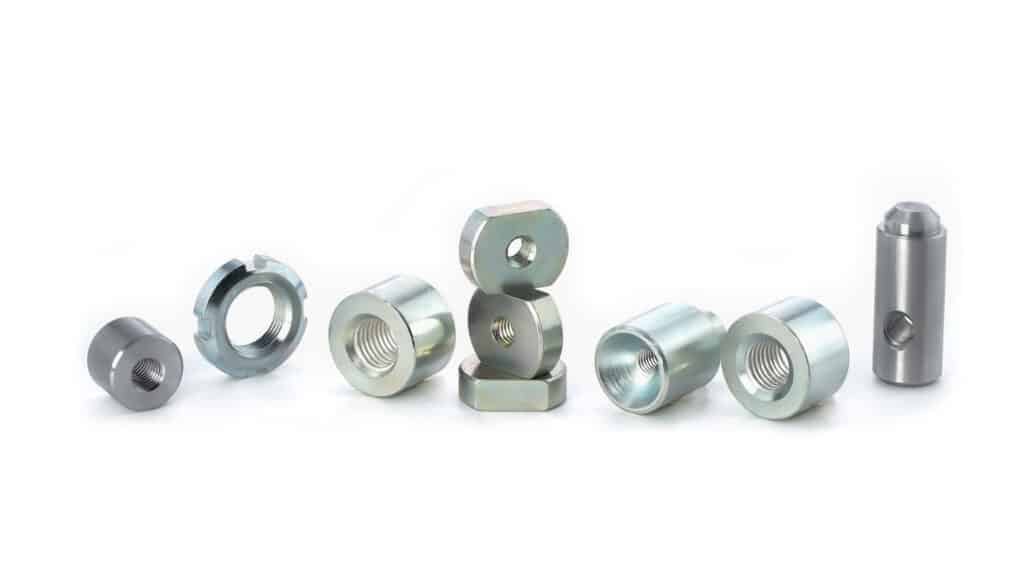
What Is a Stainless Steel Barrel Nut (Cross Dowel)?
A barrel nut is a short cylindrical metal dowel with a threaded hole drilled perpendicular to its long axis. One end is typically slotted so a screwdriver can rotate the nut to align its thread with the incoming bolt. The connector bolt passes through a clearance hole in the first panel, enters a lateral hole in the second, and threads into the barrel nut seated crosswise inside it.
Because the thread runs across the barrel rather than along it, the bolt clamps the two panels together while the barrel distributes load across the full width of its seating hole — a rigid right-angle joint that can be disassembled and reassembled repeatedly. This is the foundation of all flat-pack and knock-down furniture.
| Barrel Nut Variant | Feature | Typical Use |
|---|---|---|
| Standard (center hole) | Thread centered on length | General panel joints |
| Off-center hole | Thread offset to one end | Shallow panels, edges |
| Twin hole | Two cross holes | Double-bolt connections |
| Headed (lipped) | Flange controls depth | Visible joints |
| Slotted end | Screwdriver alignment slot | All variants |
KeyFix manufactures barrel nuts and other precision threaded components through its CNC machining capability, holding the cross-hole thread tolerance and body-diameter accuracy that reliable bolt engagement demands.
For any project, a stainless steel barrel nut provides the assurance of a robust joint that stands the test of time.
Why Do Barrel Nuts Solve the End-Grain Problem?
Choosing a stainless steel barrel nut can significantly impact the overall strength of the joint.
Wood holds fasteners poorly when driven into end grain — the cut ends of the wood fibers. A screw threaded into end grain pulls out at a fraction of the load it would hold in face grain, because little fiber grips the threads. This is the central structural weakness in furniture joinery.
A barrel nut sidesteps the problem. Instead of relying on wood to hold the thread, the metal barrel nut provides the thread, seated in a lateral hole through solid face-grain material. The wood only resists the bearing load of the barrel against its seating hole — far stronger than thread pull-out from end grain.
When using a stainless steel barrel nut, the design allows for easy alignment and secure fastening.
A stainless steel barrel nut is essential for creating strong connections in various applications. The durability and corrosion resistance of a stainless steel barrel nut make it the preferred choice for many engineers.
The efficiency of a stainless steel barrel nut in joining materials cannot be overstated. It ensures that the load is evenly distributed.
| Joint Method | Holds Thread In | Pull-Out Strength | Demountable? |
|---|---|---|---|
| Screw into end grain | Wood end grain | 1.0× (weak baseline) | Limited |
| Wood dowel + glue | Glued face grain | 2–3× | No |
| Barrel nut + bolt | Steel barrel nut | 5–10× | Yes (repeatable) |
| Threaded insert | Insert in face grain | 4–8× | Yes |
💡 Engineer’s Note: The barrel nut’s load path runs through metal threads into a face-grain bearing surface, so joint strength scales with bolt grade and thread engagement — not the wood’s own holding power. To strengthen a joint, increase bolt diameter and barrel length first; going from M6 to M8 typically does more than any change to the wood.
Engineers often choose a stainless steel barrel nut to enhance the longevity of the assembly, especially in demanding environments.
Stainless Steel vs Galvanized: Which Finish Should You Choose?
This is where terminology confuses buyers. Stainless steel and galvanized are not two coatings on the same part — they are two different material-and-finish systems. Stainless steel resists corrosion through its own chromium content and needs no coating; galvanized parts are carbon steel given a protective zinc layer. Choosing between them is a cost-versus-environment decision.
| Property | Stainless A2 (304) | Stainless A4 (316) | Galvanized Carbon Steel |
|---|---|---|---|
| Corrosion source | Inherent (Cr oxide) | Inherent + Mo (chloride) | Zinc coating (sacrificial) |
| Salt spray endurance | Excellent | Outstanding | 96–240 hr (coating-dependent) |
| Best environment | Outdoor, humid, food-adjacent | Marine, coastal, chemical | Dry indoor |
| Magnetic | No (annealed) | No | Yes |
| Relative cost | 2.5× | 3.5× | 1.0× |
| Coating wear risk | None | None | Zinc wears/scratches over time |
For furniture and equipment used in kitchens, bathrooms, outdoor settings, or marine environments, a stainless steel barrel nut is the correct choice — its corrosion resistance is built into the metal and cannot wear off. For dry indoor furniture where cost is the priority, galvanized carbon steel delivers adequate protection at lower cost. The key point: galvanizing protects only while the zinc layer stays intact, while stainless resistance is permanent.
KeyFix verifies the metallurgy of every barrel nut through its raw material control process, with stainless and carbon steel chemistry confirmed by SPECTRO optical emission spectrometry, and applies zinc and zinc-nickel finishes, validated per ASTM B633 zinc-coating standards.
⚠️ Common Pitfall: Specifying “galvanized stainless steel” is a contradiction that wastes money — stainless steel is not given a galvanized coating. Decide first whether the application needs the permanent corrosion resistance of stainless (A2/A4) or the lower cost of zinc-plated carbon steel, then specify one material system cleanly.
What Sizes and Configurations Are Available?
Barrel nuts follow metric and inch sizing matched to the connector bolt thread. The barrel diameter must match the lateral hole drilled in the panel, and the barrel length must suit the panel thickness.
| Thread Size | Barrel Diameter | Common Barrel Lengths |
|---|---|---|
| M4 | 8 mm | 10–14 mm |
| M5 | 8–10 mm | 10–15 mm |
| M6 | 10 mm | 11–20 mm |
| M8 | 10–12 mm | 15–25 mm |
| M10 | 12 mm | 20–25 mm |
| ¼”–20 | 0.5″ (12.7 mm) | 0.5–1.25″ |
Thread engagement — the bolt thread length that engages the barrel nut — is the single most important strength parameter. Engage at least one bolt diameter (1.0 D); less reduces pull-out capacity proportionally. The precision machining KeyFix applies ensures full, clean engagement across the cross-hole.
How Strong Is a Barrel Nut Joint?
A barrel nut joint’s strength is governed by three factors in series: the bolt’s tensile capacity, the thread engagement in the barrel, and the bearing strength of the panel against the barrel. The weakest sets the joint limit.
| Failure Mode | Governing Factor | Prevention |
|---|---|---|
| Bolt fracture | Bolt grade, diameter | Correct bolt class (A2-70, 8.8+) |
| Thread stripping | Engagement, material | Engage ≥1.0 D; stainless/steel barrel |
| Barrel pull-through | Panel bearing strength | Adequate length; denser panel |
| Barrel rotation | Vibration, no lock | Nylon-patch bolt or thread locker |
For optimal results, always ensure the barrel nut is fitted correctly; a stainless steel barrel nut can withstand higher loads when properly installed.
For typical furniture loads, panel bearing strength is usually the limiting factor — the metal barrel nut and a properly graded bolt are far stronger than the wood or particleboard they seat in. This is why a longer barrel often improves a weak joint more than upgrading the metal. KeyFix supports barrel nut programs across furniture, machinery, and equipment, as shown in its CNC parts portfolio and machinery component programs.
Need a quote on customized stainless steel barrel nuts? Send your drawing to KeyFix — DFM review and quotation within 48 hours. Get a quote or email sales@keyfixpro.com.
How Are Barrel Nuts Manufactured?
Production combines body machining or cold forging, cross-hole drilling, internal threading, and the alignment slot.

| Process Step | Purpose | KeyFix Capability |
|---|---|---|
| Material verification | Confirm grade | SPECTRO (Germany) OES on incoming lots |
| CNC turning / cold forming | Form body to OD | Swiss-type lathes + cold forging |
| Cross-hole drilling | Drill lateral bolt hole | CNC-positioned drilling |
| Internal threading | Tap/roll cross-hole thread | Gauged to 6H class |
| Slot machining | Cut alignment slot | Precision slotting |
| Finishing | Passivate or zinc-plate | Controlled under IATF 16949 |
| Inspection | Dimensional + thread | 2D video measuring, thread gauges, automated optical sorting |
For high-volume standard sizes, the body is produced through cold forming or stamping; for tight-tolerance or custom geometries, CNC turning holds the body diameter to ±0.02 mm. Thread and dimensional conformance are verified through the inspection standards program.
What Should You Specify on a Barrel Nut Drawing?
| Drawing Call-Out | What to Specify | Why It Matters |
|---|---|---|
| Material | A2/304, A4/316, or zinc-plated steel | Corrosion, cost, magnetism |
| Thread size + pitch | e.g., M6 × 1.0 | Must match connector bolt |
| Barrel diameter + tolerance | OD vs panel hole | Seating fit |
| Barrel length | Suit panel thickness | Bearing area, engagement |
| Hole position | Center, off-center, twin | Joint geometry |
| Drive slot | Slotted or headed | Alignment / depth |
| Finish | Passivated or zinc thickness | Corrosion protection |
To maximize performance, selecting the right size of a stainless steel barrel nut is crucial for your project.
KeyFix machines barrel nuts across furniture, machinery, and industrial applications — its product portfolio and project case studies show the range delivered to specification, conforming to metric thread tolerances per ISO standards.
How Do You Qualify a Barrel Nut Manufacturer?
Manufacturers increasingly rely on a stainless steel barrel nut for its strength and reliability in various applications.
| Audit Point | Minimum Requirement | KeyFix Status |
|---|---|---|
| Quality system | ISO 9001 minimum | IATF 16949 + ISO 9001 + ISO 14001 |
| Body machining | CNC turning or cold forming | Swiss-type lathes + cold forging |
| Material verification | OES on incoming metal | SPECTRO (Germany) OES, 100% of heats |
| Dimensional control | Calibrated precision metrology (CMM or video measuring) | 2D video measuring (0.001 mm resolution) + Shining3D 3D scanning |
| Thread gauging | Go/no-go per class | 100% gauging |
| Finish capability | Passivation + zinc plating | Controlled under IATF 16949 |
| Traceability | Per-lot to heat | Digital per-lot |
KeyFix’s own Guangdong plant combines precision machining and cold forging under a single IATF 16949 system, with OES verification, 2D video measuring, and automated optical sorting behind every order. Its company background documents the quality infrastructure OEM and industrial buyers require.
Utilizing a stainless steel barrel nut ensures that the connection remains reliable over time, especially under varying conditions.
What Are the Logistics and Shipping Terms?
KEYFIX manufactures in its own plant in Guangdong Province, near South China’s export ports.
| Term | Detail |
|---|---|
| Manufacturing location | Guangdong Province |
| Standard shipping term | FCA at our Guangdong plant |
| Sea freight term | FOB Shenzhen Yantian Port |
| Prototype lead time | 7–14 business days (air-expressed) |
| Production lead time | 4–6 weeks after sample approval |
The short inland haul from our Guangdong plant to Shenzhen Yantian Port reduces transit time and freight cost for international buyers.
Frequently Asked Questions
What is the difference between a barrel nut and a cross dowel?
They are the same fastener. “Barrel nut” describes the cylindrical shape; “cross dowel” describes the cross-drilled thread; “dowel nut” and “sleeve nut” are additional names. All refer to a cylindrical nut threaded through its side, used with a connector bolt.
Should I choose stainless steel or galvanized barrel nuts?
Choose a stainless steel barrel nut (A2/304 or A4/316) for outdoor, humid, kitchen, bathroom, or marine use, where corrosion resistance is permanent. Choose galvanized (zinc-plated) carbon steel for dry indoor furniture where cost matters most. They are different material systems, not two finishes on the same part.
Lastly, the market for a stainless steel barrel nut continues to grow as industries recognize its advantages.
Maintenance of assemblies using a stainless steel barrel nut is simplified due to its reliable performance and corrosion resistance.
Engineers have learned that using a stainless steel barrel nut can greatly reduce the risk of failure in joints.
What sizes of barrel nuts does KeyFix produce?
Ultimately, the choice of a stainless steel barrel nut is an investment in quality and durability.
A well-chosen stainless steel barrel nut can enhance the performance of your assembly significantly.
Metric M4 through M10 and inch sizes including ¼”–20, with custom diameters, lengths, hole positions (center, off-center, twin), and headed or slotted variants to drawing. Material options include 304/316 stainless and zinc-plated carbon steel.
By selecting a stainless steel barrel nut, you ensure your projects reach their full potential in terms of structural integrity.
When working with a stainless steel barrel nut, remember that its application influences the design and engineering choices.
What certifications does KeyFix hold?
IATF 16949, ISO 9001, and ISO 14001. Material certificates, dimensional inspection reports, and thread gauging records are standard for OEM and industrial programs.
What is the minimum order quantity for customized barrel nuts?
CNC-machined barrel nuts have no MOQ — from prototypes to production runs, with cost reductions at higher tiers. Contact sales@keyfixpro.com for quotations.
The versatility of a stainless steel barrel nut allows it to be used in a variety of settings, from furniture to machinery.
What shipping terms apply for international orders?
Be sure to specify a stainless steel barrel nut for any projects requiring durability and strength.
Standard shipping is FCA at our Guangdong plant, with sea freight as FOB Shenzhen Yantian Port from our Guangdong production base. Production ships 4–6 weeks after sample approval.
If your next project needs customized stainless steel barrel nuts, cross dowels, or zinc-plated thread nuts — for furniture, machinery, or industrial assemblies — send your drawing or sample to KeyFix’s engineering team for a free DFM review and quotation within 48 hours. Explore the product portfolio or contact KeyFix at sales@keyfixpro.com.
Author: KeyFix Engineering Team Published: May 31, 2026 Last Updated: May 31, 2026