
Brass reducing bushings are the simplest way to connect a large threaded port to a smaller pipe: a hex or round body with male threads on the outside and female threads on the inside, stepping one size down in a single fitting. They are also, by a wide margin, the fitting most often blamed for leaks that were never the fitting’s fault. Two thread systems in worldwide use look nearly identical and will start to engage each other before failing to seal; brass in aggressive water loses its zinc and turns porous; and the free-cutting alloy that machines beautifully is barred from potable water systems. This guide covers thread system compatibility, sealing mechanisms, dezincification, lead-free compliance, sizing, and sourcing.
TL;DR — Key Takeaways
- NPT (60° taper) and BSPT (55° taper) are not interchangeable — they thread together far enough to feel right, then leak. This is the leading cause of brass fitting failure.
- Tapered threads seal on the thread flanks and need sealant; parallel threads (BSPP) seal on a gasket or O-ring and must not rely on tape.
- Standard free-cutting brass C36000 contains roughly 3 % lead — excellent for machining, not permitted in potable water systems under NSF/ANSI 61.
- In aggressive water, ordinary brass suffers dezincification — zinc leaches out and leaves porous copper. Specify DZR brass (CW602N / CZ132) where water chemistry demands it.
- A reducing bushing is a one-step fitting; stacking bushings to bridge several sizes multiplies leak paths and should be replaced by a single correct part.
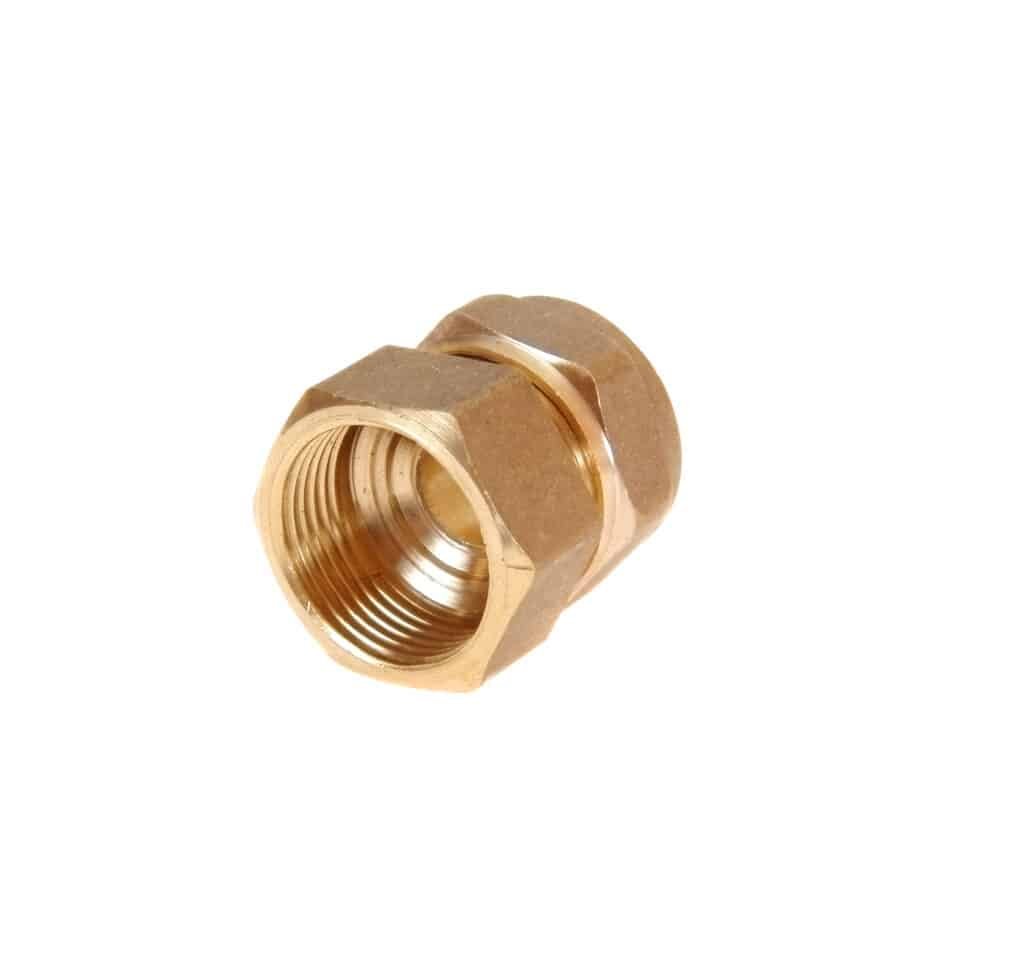
What Are Brass Reducing Bushings?
A reducing bushing is a short fitting with male threads on its outside diameter and female threads through its bore, letting a smaller pipe thread into a larger tapped port. It occupies almost no length, which is its main advantage over a reducing coupling — the reduction happens inside the existing port rather than adding a fitting to the run.
| Body Style | Drive Feature | Typical Use |
|---|---|---|
| Hex body | External hex flats | The general standard; wrench-tightened |
| Round body | Internal hex or slots in the face | Tight clearances; needs an internal driver |
| Flush / countersunk | Internal drive only | Sits flush with the port face |
| Face-slot (spanner) | Two slots for a pin spanner | Low-profile, service-friendly |
The round-body version deserves a note: without external flats, it is driven from the inside, so the internal drive must be intact and the correct tool available. In service positions where a fitting may need removal years later, a hex body is the safer specification.
KeyFix machines brass threaded components including bushings and adapters across its CNC production line and CNC parts portfolio, producing to customer drawings and thread standards.
Which Thread System Applies — NPT, BSPT, or BSPP?
This is the single most consequential decision in the whole product family, and the failure mode it causes is deceptive because the wrong parts partially assemble.
| System | Thread Angle | Form | Seals On | Region |
|---|---|---|---|---|
| NPT | 60° | Tapered | Thread flanks (sealant required) | North America |
| NPTF | 60° | Tapered, dryseal | Thread flanks (metal-to-metal) | Hydraulics, North America |
| BSPT (R) | 55° | Tapered | Thread flanks (sealant required) | UK, EU, Asia, Australia |
| BSPP (G) | 55° | Parallel | Gasket, O-ring, or bonded washer | UK, EU, Asia, Australia |
Two independent differences hide in that table. The thread angle differs — 60° for NPT against 55° for both BSP forms — so even where pitch happens to be similar, the flanks never mate correctly. And taper versus parallel changes the sealing mechanism entirely, not just the geometry.
⚠️ Common Pitfall: Threading an NPT male into a BSPT female (or the reverse) because it starts easily and tightens to a firm feel. At some sizes the pitches are close enough that several turns engage, so the joint feels assembled — but the mismatched 60°/55° flanks leave a continuous spiral gap that no amount of PTFE tape reliably closes. It typically passes a quick test and weeps under pressure or thermal cycling weeks later. Confirm the system on both halves before assembly, not just the size.
Telling them apart on the bench is straightforward once you know what to check: measure the thread pitch, check whether the thread is visibly tapered along its length, and verify the flank angle with a thread gauge. Size markings alone are not sufficient, since a “½ inch” designation exists in every system listed above.
How Does Each Thread Type Seal?
Getting this wrong causes leaks even when both halves belong to the same system.
| Thread Type | Sealing Mechanism | Correct Practice | Wrong Practice |
|---|---|---|---|
| NPT / BSPT (tapered) | Flank interference as the taper wedges | PTFE tape or thread sealant on the flanks | Relying on a flat gasket |
| NPTF (dryseal) | Crest-to-root metal deformation | May seal without sealant | Over-tightening to compensate |
| BSPP (parallel) | Gasket, bonded washer, or O-ring at the face | Bonded seal under the hex | PTFE tape — it cannot seal a parallel thread |
The BSPP row is the one that surprises people. A parallel thread has uniform clearance along its entire length — there is no wedging action to close a gap — so tape or paste in a parallel joint simply fills a spiral channel that pressure will eventually find. Parallel fittings need a sealing face: a bonded washer, O-ring in a groove, or a soft gasket compressed under the hex.
💡 Engineer’s Note: Count turns rather than chasing torque on tapered threads. A properly cut NPT joint reaches hand-tight, then takes roughly two to three turns with a wrench. Needing five or six turns to feel resistance means the threads are undersized or mismatched; stopping at one means something is binding. The turn count is a better diagnostic than any torque figure, because the taper makes torque highly variable.
What Is Dezincification and When Does It Matter?
Brass is copper alloyed with zinc, and in certain water chemistries the zinc leaches out of the alloy selectively, leaving behind a spongy, mechanically weak copper structure that looks like a pinkish discolouration and eventually cracks or leaks under pressure. This is dezincification, and it is a real field failure mode rather than a theoretical concern.
| Condition | Dezincification Risk | Recommendation |
|---|---|---|
| Low-chloride, neutral pH water | Low | Standard brass adequate |
| Soft or acidic water | Moderate–high | Specify DZR brass |
| High chloride / coastal supply | High | DZR brass required |
| Elevated temperature water | High | DZR brass required |
| Compressed air, oil, fuel | Low | Standard brass adequate |
The remedy is dezincification-resistant brass — designated CW602N in the European system, CZ132 in the older British system — which adds a small arsenic content that inhibits the zinc loss mechanism. It costs more and machines slightly less freely than standard brass, and in aggressive water systems that trade is worth making.
Why Does Lead Content Matter for Potable Water?
Here is where a highly useful property of brass becomes a compliance problem. Free-cutting brass C36000 contains roughly 3 % lead, and that lead is precisely what makes it the most machinable copper alloy available — it breaks chips cleanly and lets threads cut with excellent finish at high speed.
That same lead disqualifies it from drinking water service. Potable water regulations in the United States and many other markets limit wetted-surface lead content to a weighted average of 0.25 %, verified under NSF/ANSI 61 and NSF/ANSI 372.
| Alloy | Lead Content | Machinability | Potable Water |
|---|---|---|---|
| C36000 (free-cutting) | ~3 % | Excellent (100 % reference) | Not permitted |
| C46400 (naval brass) | Low | Good | Check certification |
| C69300 / C87850 (lead-free) | <0.25 % | Fair–good | Compliant |
| Bismuth brass (C89833 etc.) | <0.25 % | Good | Compliant |
| DZR brass CW602N | Varies by variant | Good | Check the specific grade |
📋 Spec Tip: Write the application on the drawing, not just the alloy — “potable water service, NSF/ANSI 61 compliant, lead-free per NSF 372” tells the manufacturer which alloy family is acceptable. A drawing that says only “brass” invites C36000, which is the correct choice for compressed air and the wrong one for a drinking water line.
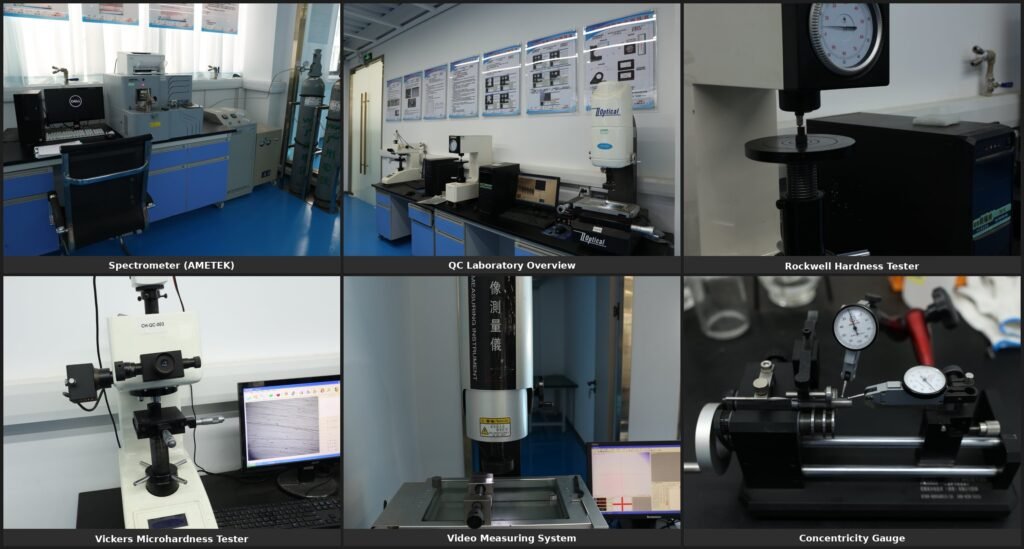
Incoming alloy is confirmed on every bar lot by SPECTRO optical emission spectrometry through KeyFix’s raw material control process — the verification that distinguishes a leaded free-cutting bar from a lead-free grade before machining begins.
How Do You Size and Rate Brass Reducing Bushings?
| Consideration | Guidance |
|---|---|
| Size step | Common reductions span one to three nominal sizes (e.g. 1″ × ½″) |
| Wall thickness | Governs pressure rating; the bore reduction sets the remaining wall |
| Pressure rating | Falls as the size step grows — the thin section is the limit |
| Flow restriction | The smaller bore sets the flow; a bushing cannot help flow |
| Stacking | Avoid — each joint is a leak path and a stress riser |
The stacking point deserves emphasis. Bridging a 1″ port down to ¼″ by threading a 1″ × ½″ bushing into the port and a ½″ × ¼″ bushing into that creates two sealed joints where one would do, doubles the leak paths, and puts a thin-walled fitting inside another thin-walled fitting. A single 1″ × ¼″ bushing is stronger, shorter, and cheaper to install.
Pressure ratings depend on size, wall thickness, alloy, and temperature, so they come from the manufacturer’s rating table for the specific part rather than from a general rule. What holds universally is the direction: a larger reduction leaves less wall and rates lower.
How Are Custom Brass Bushings Manufactured?
| Step | What Happens | KeyFix Capability |
|---|---|---|
| Bar verification | Alloy and lead content by OES | SPECTRO (Germany), 100 % of heats |
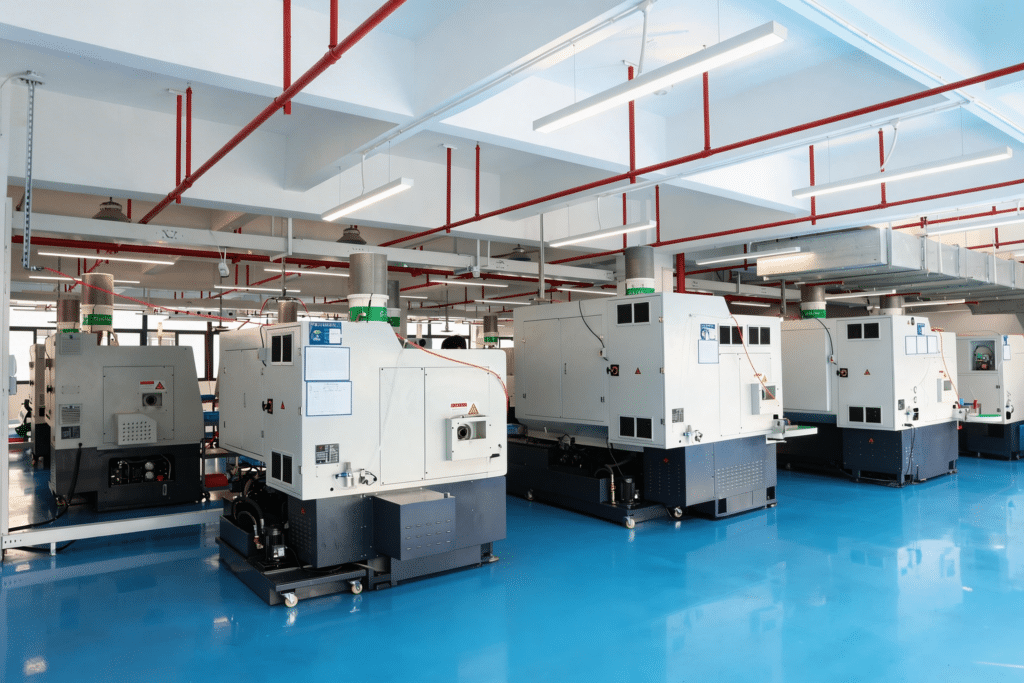
| CNC turning | Body, bore, hex or round profile | 32 CNC machines incl. two 5-axis, ±0.005 mm |
| External threading | Male thread cut or rolled to standard | Live tooling; 22 thread-rolling machines |
| Internal threading | Female thread tapped to standard | 10 nut tapping machines |
| Cold forming (volume) | Near-net hex blanks | 25 cold heading machines |
| Deburr and clean | Thread crests dressed, chips removed | Controlled process |
| Verification | Thread gauging, bore, hex, concentricity | 2D video measuring + Mitutoyo gauges, 100 % optical sorting |
Thread gauging is the operation that matters most here, and it is done with go/no-go ring and plug gauges matched to the specific system — an NPT plug gauge tells you nothing useful about a BSPT thread. Both male and female threads are gauged on production parts, with results documented under KeyFix’s inspection standards program; process detail sits on the technology overview and the cold forging page.
Need a quote on custom brass reducing bushings or threaded adapters? Send your drawing with the thread system specified to KeyFix — DFM review and quotation within 48 hours. Get a quote or email sales@keyfixpro.com.
What Should the Drawing Specify?
| Call-Out | What to Specify | Why It Matters |
|---|---|---|
| Thread system, both ends | NPT, NPTF, BSPT (R), or BSPP (G) | The primary failure point |
| Thread sizes | Male × female, e.g. 1″ × ½″ | Defines the reduction |
| Thread class | Per the applicable standard | Fit and seal quality |
| Alloy | C36000, DZR CW602N, or lead-free grade | Machinability vs compliance |
| Application | Potable water, air, fuel, hydraulic | Drives alloy and certification |
| Body style | Hex or round, drive feature | Installation and service access |
| Sealing method | Sealant, bonded washer, or O-ring groove | Must match thread type |
| Pressure and temperature | Working conditions | Wall thickness and rating |
How Do You Qualify a Manufacturer?
| Audit Point | Minimum Requirement | KeyFix Status |
|---|---|---|
| Quality system | ISO 9001 minimum | IATF 16949 + ISO 9001 + ISO 14001 |
| Thread capability | Both male and female, multiple systems | CNC threading + 10 nut tapping machines |
| Thread gauging | System-specific go/no-go gauges | 100 % gauging, Mitutoyo library |
| Material verification | OES per bar lot, lead content confirmed | SPECTRO OES, 100 % of heats |
| Alloy range | Standard, DZR, and lead-free grades | Sourced to drawing requirement |
| Dimensional control | Bore, hex, concentricity | 2D video measuring + Mitutoyo gauges |
| Outgoing quality | Stated defect rate | <25 PPM at AQL 0.4 |
Where an application requires potable water certification, that approval attaches to the finished part and its alloy, so state it in the enquiry at the outset. Brass bar follows ASTM B16 and thread standards follow ISO 7 and ISO 228 for BSP forms, under the quality system documented in KeyFix’s company background, with the wider range in the product portfolio and delivered work in the project case studies.
What Are the Logistics and Shipping Terms?
KeyFix manufactures in Huizhou, Guangdong, near South China’s export ports.
| Term | Detail |
|---|---|
| Manufacturing location | Huizhou, Guangdong Province |
| Standard shipping term | FCA Dongguan |
| Sea freight term | FOB Shenzhen Yantian Port |
| Prototype lead time | 7–14 business days (air-expressed) |
| Production lead time | 4–6 weeks after sample approval |
Frequently Asked Questions
Can I thread an NPT fitting into a BSP port?
No. NPT uses a 60° thread angle and BSP uses 55°, so the flanks never mate correctly even when the pitch is close enough to engage several turns. The joint feels tight and leaks under pressure or thermal cycling. Confirm the system on both halves before assembly.
Should I use PTFE tape on a BSPP parallel thread?
No. Parallel threads have uniform clearance and no wedging action, so tape cannot seal them reliably. Use a bonded seal washer, an O-ring in a groove, or a gasket compressed at the face. Tape belongs on tapered NPT and BSPT threads.
What is DZR brass and when do I need it?
Dezincification-resistant brass (CW602N / CZ132) resists selective zinc loss that turns ordinary brass porous in aggressive water. Specify it for soft, acidic, high-chloride, or hot water service; standard brass is adequate for compressed air, oil, and neutral water.
Can I use standard brass fittings for drinking water?
Not free-cutting C36000, which contains around 3 % lead. Potable water systems require wetted surfaces below 0.25 % lead under NSF/ANSI 61 and 372, so a lead-free brass or bismuth brass grade is required.
Is it acceptable to stack two reducing bushings?
It works but is poor practice. Each joint adds a leak path and the nested thin walls lower the assembly’s pressure capability. A single bushing making the full reduction is shorter, stronger, and easier to install.
What is the minimum order quantity for custom bushings?
CNC-machined brass bushings run from 100–500 pieces for validation, scaling into the thousands with price breaks. Contact sales@keyfixpro.com for quotations.
If your next project needs custom brass reducing bushings or threaded adapters — NPT, BSPT, or BSPP, in standard, DZR, or lead-free alloys — send your drawing to KeyFix for a free DFM review and a quotation within 48 hours. Explore the product portfolio or contact KeyFix at sales@keyfixpro.com.
Author: KeyFix Engineering Team Published: July 10, 2026 Last Updated: July 10, 2026