
Two-hole spanner nuts are defined by what they refuse to do: turn under a standard wrench. Instead of hex flats, they carry a pair of blind holes in the face, engaged by a two-pin spanner that most people do not own. That single design choice serves two very different purposes — keeping unauthorised hands off a public-facing assembly, and giving a technician fine, repeatable control over a preload adjustment. The engineering consequence is unusual: on this part, the tool interface is the functional feature, and hole diameter, depth, and pitch circle carry the tolerances that decide whether the nut can be tightened at all. This guide covers the drive geometry, torque capacity, tamper resistance, stainless material selection, CNC turning, and specification.
TL;DR — Key Takeaways
- The two blind holes are the drive feature — hole diameter, depth, and pitch circle diameter (PCD) are functional dimensions, not cosmetic details.
- Torque capacity is limited by the wall of material between the hole and the outside diameter, and by hole depth — not by the thread.
- Shallow holes are the leading failure: the spanner pin cams out, wallows the hole, and the nut becomes unremovable.
- Two-hole drives give moderate tamper resistance — pin spanners are purchasable, so they deter casual interference rather than a determined attacker.
- CNC turning suits this part because the face holes and thread come from one chucking, keeping the PCD concentric to the thread axis.
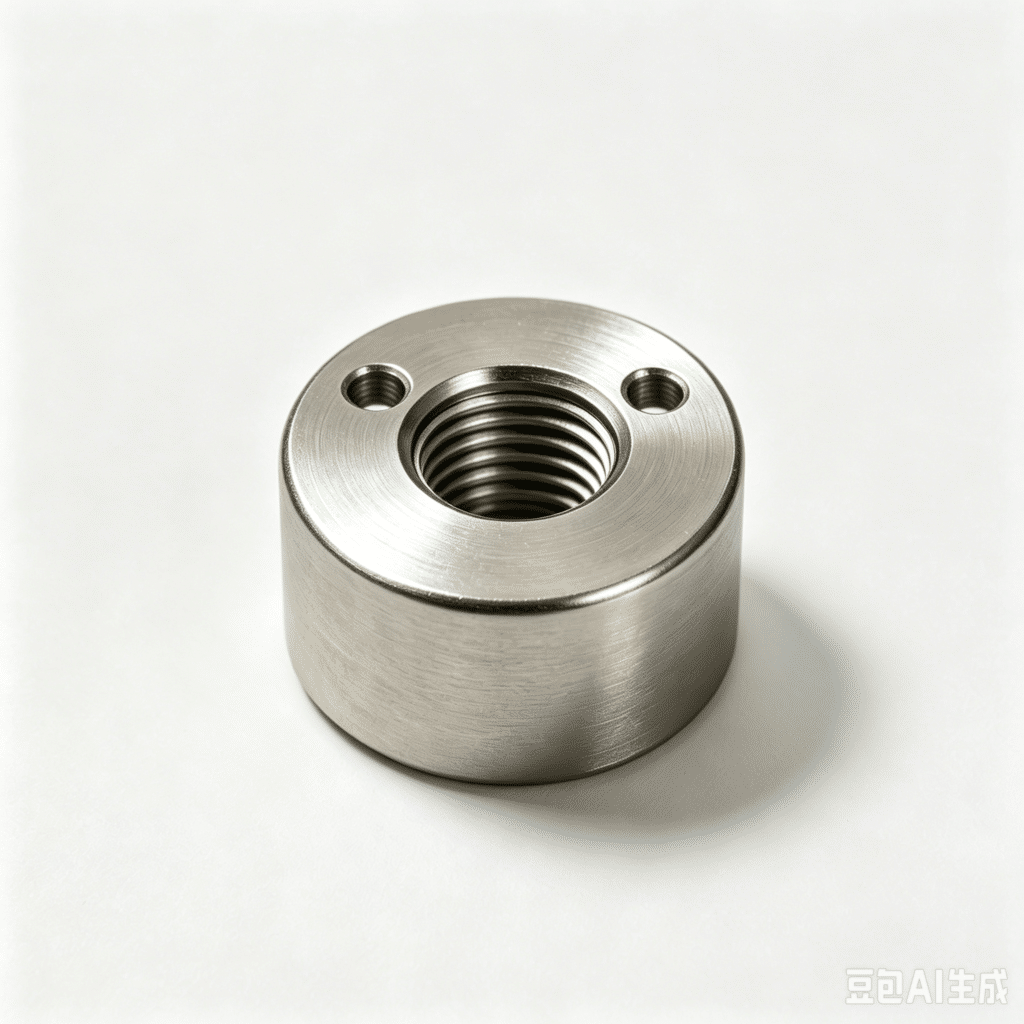
What Are Two-Hole Spanner Nuts?
A two-hole spanner nut is a threaded nut whose driving feature is a pair of blind holes drilled into its outer face on a common pitch circle, straddling the thread axis. A pin spanner — a two-pin face wrench, fixed or adjustable — drops into both holes and turns the nut as a couple. The body may be round, hexagonal, or knurled; what defines the part is the face drive.
| Drive Style | Tool Required | Access Needed | Tamper Resistance |
|---|---|---|---|
| Standard hex | Open-end or socket wrench | Side clearance | None |
| Two-hole (pin spanner) | Two-pin face spanner | Face access only | Moderate |
| Slotted / castellated | Hook spanner | Side or face | Low–moderate |
| Knurled | Hand grip | Face | None (finger-tight only) |
| Hex with two face holes | Either tool | Side or face | Low (hex still works) |
That last row is worth flagging, because it is a common specification error. A hex nut with two face holes is not tamper-resistant — the hex flats remain, so a standard wrench still turns it. The holes only add an alternative drive for tight side clearance. If security is the goal, the body must have no wrenchable flats.
Two situations drive demand for this design. Restricted access assemblies — public seating, park equipment, display fixtures, shared laboratory apparatus — use them so a passer-by with pliers cannot loosen anything. And adjustment positions — bearing preload collars, optical and instrument mounts, tensioners — use them because a pin spanner gives smooth, controlled rotation without the sudden slip of a wrench jumping a rounded flat.
KeyFix machines this family across its CNC production line, with related turned hardware in the CNC parts portfolio.
Why Is the Hole Geometry the Critical Dimension?
On an ordinary nut, the thread does the work and the flats are simply a grip. On a spanner nut, the holes carry the entire applied torque through two small pins, and the geometry decides how much torque the part survives.
| Parameter | What It Controls | Failure If Wrong |
|---|---|---|
| Hole diameter | Pin fit; contact area | Loose: pin rocks and wallows the hole. Tight: pin binds |
| Hole depth | Pin engagement length | Too shallow: pin cams out under load |
| Pitch circle diameter (PCD) | Lever arm of the couple | Small PCD needs far more pin force for the same torque |
| Wall to outside diameter | Material resisting blowout | Thin wall: hole breaks through the OD |
| Wall to thread bore | Material resisting inward collapse | Hole breaks into the thread |
| Hole perpendicularity | Even pin contact | Angled hole loads one pin edge |
The torque relationship is simple and worth internalising: applied torque equals pin force × PCD. A larger pitch circle multiplies the same hand force into more torque, so PCD should sit as far outboard as the wall thickness safely allows. Squeezing the holes inboard “to keep them away from the edge” quietly halves the nut’s usable torque.
⚠️ Common Pitfall: Specifying hole depth as an afterthought — or leaving it to the machinist — is the number one cause of ruined spanner nuts. A pin engaged only 1–2 mm deep levers itself out of the hole under load, deforming the hole mouth. Once the mouth is wallowed, the pin no longer seats, and the nut becomes effectively unremovable. As a working rule, engage the pin at least 1.5 × its own diameter, and state the depth on the drawing.
💡 Engineer’s Note: Specify the spanner alongside the nut. Pin spanners come in fixed and adjustable forms with pin diameters that vary between makers, and a nut drilled for a 4 mm pin is useless to a technician holding a 5 mm spanner. Naming the intended tool, or at least the pin diameter it must accept, closes the gap between a part that is correct on paper and one that can be serviced in the field.
How Much Tamper Resistance Do They Provide?
Honest positioning matters here, because these nuts are frequently oversold as a security product.
| Security Level | Drive Type | Deters |
|---|---|---|
| None | Hex, square | Nobody |
| Low | Knurled, slotted | Casual hand-loosening |
| Moderate | Two-hole spanner | Opportunists without the tool |
| Moderate–high | Proprietary / registered drive | Anyone without dealer tool access |
| High | Permanent (welded, one-way, shear-off) | Removal is destructive |
A two-hole nut stops someone reaching for a wrench or pliers, which covers most real-world interference in public and semi-public installations. It does not stop a determined attacker, because pin spanners are ordinary catalogue tools and an adjustable one fits a wide range of PCDs. Where a joint must truly resist attack, the design has to move up the table — a proprietary drive or a fastener intended never to come apart.
There is a second-order benefit worth mentioning: because the tool is uncommon, these nuts also resist unqualified adjustment. On a bearing preload or instrument alignment, that is often the more valuable property — the joint stays where it was set because nobody idly turns it.
Which Stainless Grades Suit Two-Hole Spanner Nuts?
| Grade | Machinability | Strength | Corrosion | Best Use |
|---|---|---|---|---|
| 303 | Excellent (sulphur-added) | Moderate | Good | The default for CNC-turned spanner nuts |
| 304 | Fair (gummy) | Moderate | Excellent | When 303’s sulphur content is unacceptable |
| 316 | Fair | Moderate | Outstanding (chloride) | Marine, coastal, chemical exposure |
| 17-4PH (H900) | Good | High (~1,170 MPa yield) | Very good | High-torque or load-bearing adjustment nuts |
| 416 | Very good | Hardenable | Moderate | Hardened, wear-resistant, non-critical corrosion |
303 is the practical default: it turns cleanly, holds a good thread finish, and cuts crisp hole mouths — which matters more here than on a plain nut, since a ragged hole edge is exactly where pin wallowing starts. Where the environment is marine or the nut is washed down, 316 is the correct upgrade despite its poorer machinability. For adjustment nuts that carry real load through the threads, 17-4PH in the H900 condition brings the strength that austenitic grades cannot reach.
One recurring stainless caution applies with extra force to adjustment positions: stainless-on-stainless threads gall under repeated cycling, and a nut designed to be adjusted is cycled by definition. An anti-seize compound on the thread, or pairing a stainless nut with a differently finished stud, keeps the adjustment functional over the assembly’s life.
Bar chemistry is verified on every incoming lot by SPECTRO optical emission spectrometry through KeyFix’s raw material control process.
Why Does CNC Turning Suit This Part?
Standard hex nuts are cold-headed and tapped at enormous volume. A two-hole spanner nut usually is not, and the reasons are structural rather than incidental.

| Factor | Cold Heading | CNC Turning |
|---|---|---|
| Face hole features | Needs secondary operation | Cut in the same setup |
| Typical volumes | 10,000+ | 50–5,000 |
| Custom PCD / hole size | New tooling per variant | Program change only |
| Round or knurled bodies | Awkward | Natural |
| Concentricity of PCD to thread | Depends on secondary setup | Single chucking |
| Lead time for a variant | Weeks (tooling) | Days |
The concentricity row is the one that matters technically. If the face holes are drilled in a second operation after the nut is tapped elsewhere, the pitch circle can sit slightly off the thread axis — and a pin spanner then loads one pin harder than the other, concentrating wear in one hole. Turning the body, cutting the thread, and drilling the face holes with the part held in one chucking keeps the PCD centred on the thread axis by machine geometry.
KeyFix turns these parts complete on its 32-machine CNC line at ±0.005 mm, with live tooling drilling the face holes without releasing the part; process detail sits on the technology overview. Where volumes justify it, near-net blanks come from the cold forging line and threads from the 10 dedicated nut tapping machines.
How Are Custom Spanner Nuts Produced and Verified?
| Step | What Happens | KeyFix Capability |
|---|---|---|
| Bar verification | Grade confirmed by OES | SPECTRO (Germany), 100 % of heats |
| CNC turning | OD, face, chamfers in one chucking | 32 CNC machines incl. two 5-axis, ±0.005 mm |
| Threading | Internal thread cut or tapped | Live tooling; 10 nut tapping machines |
| Face hole drilling | Both holes on PCD, same setup | Live-tool stations |
| Deburr | Hole mouths dressed, edges broken | Controlled — protects pin seating |
| Passivation | Chromium oxide layer restored | Per standard practice |
| Verification | Thread, PCD, hole diameter and depth | 2D video measuring + Mitutoyo gauges, 100 % optical sorting |
Hole-mouth deburring deserves its own line because it is functional, not cosmetic. A burr at the hole entry prevents the spanner pin from seating to full depth, so the pin engages shallowly and starts the cam-out failure described earlier. Dimensional conformance including PCD and hole depth is documented under KeyFix’s inspection standards program, with delivered work shown in the project case studies.
Need a quote on custom two-hole spanner nuts? Send your drawing with the pin diameter and PCD specified to KeyFix — DFM review and quotation within 48 hours. Get a quote or email sales@keyfixpro.com.
What Should the Drawing Specify?
| Call-Out | What to Specify | Why It Matters |
|---|---|---|
| Thread size + class | e.g., M20 × 1.5, 6H | Mating fit |
| Hole diameter + tolerance | Sized to the intended spanner pin | Pin fit; too loose wallows |
| Hole depth | Minimum ~1.5 × pin diameter | Prevents cam-out |
| PCD | With tolerance, referenced to thread axis | Torque arm and pin alignment |
| Hole count and position | Two, diametrically opposed | Balanced couple |
| Body form | Round, hex, or knurled | Determines tamper resistance |
| Material + condition | 303, 316, 17-4PH H900 | Machinability vs corrosion vs strength |
| Finish | Passivated, plain, or plated | Corrosion behaviour |
| Intended spanner | Tool reference or pin diameter | Field serviceability |
📋 Spec Tip: Reference the PCD and the hole positions to the thread axis as datum, not to the outside diameter. The thread is what the nut runs on, so an eccentric OD is harmless while an eccentric pitch circle loads one pin and ruins one hole.
How Do You Qualify a Manufacturer?
| Audit Point | Minimum Requirement | KeyFix Status |
|---|---|---|
| Quality system | ISO 9001 minimum | IATF 16949 + ISO 9001 + ISO 14001 |
| Single-chucking capability | Thread and face holes in one setup | 32 CNC machines with live tooling |
| Material verification | OES per bar lot | SPECTRO OES, 100 % of heats |
| Thread gauging | Go/no-go per class | 100 % gauging, Mitutoyo library |
| Feature measurement | PCD, hole diameter and depth checked | 2D video measuring + Mitutoyo gauges |
| Deburr control | Hole mouths dressed to spec | Documented |
| Outgoing quality | Stated defect rate | <25 PPM at AQL 0.4 |
Stainless bar follows ASTM A582 and thread classes follow ISO 965, under the quality system documented in KeyFix’s company background, with the wider range in the product portfolio and application work in the machinery hardware programs.
What Are the Logistics and Shipping Terms?
KeyFix manufactures in Huizhou, Guangdong, near South China’s export ports.
| Term | Detail |
|---|---|
| Manufacturing location | Huizhou, Guangdong Province |
| Standard shipping term | FCA Dongguan |
| Sea freight term | FOB Shenzhen Yantian Port |
| Prototype lead time | 7–14 business days (air-expressed) |
| Production lead time | 4–6 weeks after sample approval |
Frequently Asked Questions
What tool turns a two-hole spanner nut?
A two-pin face spanner, available in fixed and adjustable forms. The pin diameter must match the nut’s hole diameter and the spanner’s span must cover the pitch circle, so specify the intended tool or at least the pin diameter alongside the nut.
How deep should the spanner holes be?
Engage the pin at least 1.5 times its own diameter. Shallower holes let the pin lever out under torque, deforming the hole mouth until the nut can no longer be gripped at all.
Are two-hole spanner nuts tamper-proof?
They are tamper-resistant, not tamper-proof. Pin spanners are standard catalogue tools, so these nuts deter opportunists without the right wrench rather than a determined attacker. For real security, specify a proprietary drive or a permanent fastener.
Does a hex nut with two face holes provide security?
No. If the hex flats remain, a standard wrench still turns it — the holes only add an alternative drive for tight side access. Tamper resistance requires a body with no wrenchable flats.
Why CNC turning rather than cold heading?
Volumes are usually modest, PCD and hole size vary by customer, and turning cuts the thread and both face holes in one chucking — keeping the pitch circle concentric to the thread axis, which a secondary drilling operation cannot guarantee.
What is the minimum order quantity?
CNC-machined spanner nuts run from 50–100 pieces for prototypes and validation, scaling into the thousands with price breaks. Contact sales@keyfixpro.com for quotations.
If your assembly needs custom two-hole spanner nuts — round, hex, or knurled bodies in 303, 316, or 17-4PH — send your drawing with the pin diameter and PCD to KeyFix for a free DFM review and a quotation within 48 hours. Explore the CNC parts portfolio or contact KeyFix at sales@keyfixpro.com.
Author: KeyFix Engineering Team Published: July 10, 2026 Last Updated: July 10, 2026