
An L shaped bracket looks like the simplest part in any assembly — two flat legs and a 90° bend — and that simplicity hides the reason so many of them sag, open up, or tear their fasteners out of a wall. A right-angle bracket is a lever. Whatever load sits on the horizontal leg acts at a distance from the bend, and that distance multiplies the force into a bending moment the corner has to absorb and the mounting fasteners have to resist. Understanding that one relationship tells you where to add a gusset, how far apart to space the mounting holes, what gauge to order, and whether galvanized or stainless is the right call. This guide covers all of it.
TL;DR — Key Takeaways
- Load capacity is governed by the bending moment at the corner (M = F × d), not by material strength alone — doubling the leg length doubles the moment.
- The mounting fastener tension follows T ≈ (F × d) / s, where s is the vertical hole spacing. Spreading the holes further apart is the cheapest strength upgrade available.
- A corner gusset typically multiplies bracket stiffness several times over for one extra forming station — far cheaper than upgauging the whole part.
- Galvanized and stainless are different material systems, not two finishes. Galvanized carbon steel is coated; stainless resists corrosion inherently. Mixing stainless brackets with galvanized fasteners invites galvanic attack.
- A qualified supplier verifies coil chemistry by OES, scans formed angles in 3D, and documents outgoing quality below 25 PPM at AQL 0.4.
What Is an L Shaped Bracket?
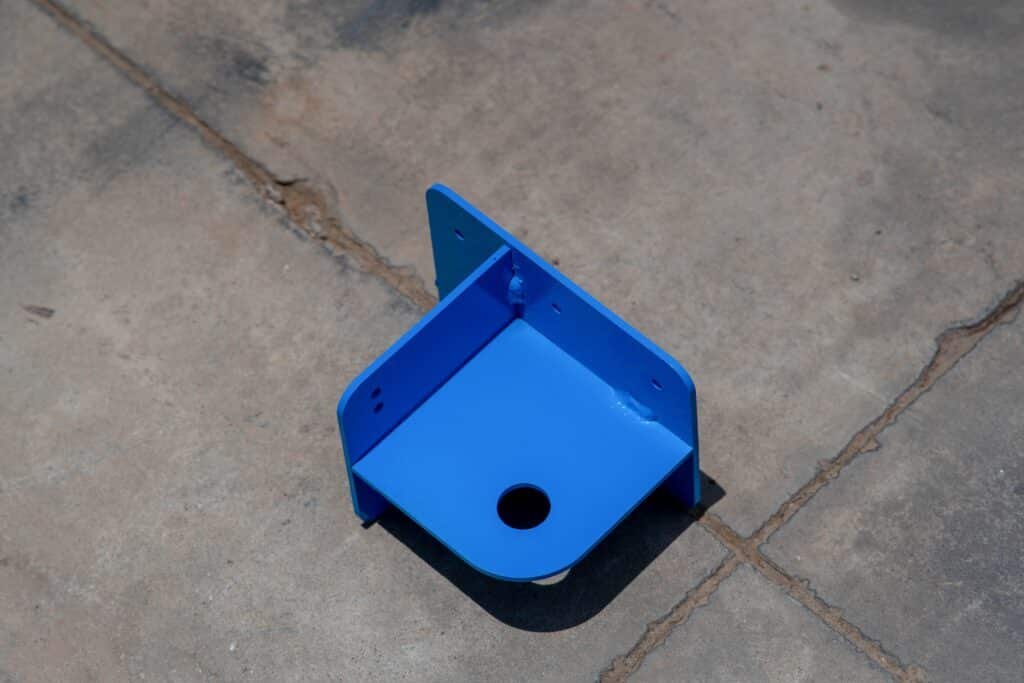
An L shaped bracket is a right-angle support formed from flat stock, joining two perpendicular surfaces or carrying a load out from a vertical face. The differences across the family are structural, not cosmetic.
| Type | Distinguishing Feature | Typical Duty |
|---|---|---|
| Plain angle bracket | Two legs, single bend | Light — panels, trim, covers |
| Gusseted bracket | Triangular rib across the corner | Heavy — shelving, machinery |
| Flat corner brace | Flat plate, no bend, joins in-plane | Light — furniture corners, frames |
| Slotted / adjustable | Elongated holes for position tuning | Medium — alignment-critical mounts |
| Heavy structural angle | Thick gauge, often hot-rolled | Structural — building, framing |
| Multi-hole mounting plate | Extended leg with hole pattern | Medium — equipment mounting |
The flat corner brace is often ordered by mistake. It joins two members in the same plane — a picture frame or cabinet face — and resists almost no out-of-plane load. If anything hangs off it, a bracket with a real bend is the part you need. KeyFix produces this full family through its stamping capability on 50–300 T presses, with representative work in the product portfolio.
Why Does the Bend Carry the Whole Load?
Put a load on the horizontal leg and the bracket wants to unfold. The force acts at a distance from the corner, so the corner sees a bending moment equal to force times distance:
M = F × d
Ten kilograms hung 50 mm out from the bend produces half the moment of the same ten kilograms hung 100 mm out. This is why load ratings are meaningless without a stated distance, and why the single most effective way to strengthen an installation is to move the load closer to the wall rather than to buy a thicker bracket.
| What Changes | Effect on Corner Moment | Practical Note |
|---|---|---|
| Double the load | Moment doubles | Linear — predictable |
| Double the distance from the bend | Moment doubles | Same penalty as doubling the load |
| Double the material thickness | Section strength rises roughly 4× | Thickness is the strongest lever on the part |
| Double the bracket width | Section strength rises roughly 2× | Cheaper than thickness if space allows |
| Add a corner gusset | Stiffness rises several times over | One forming station, minimal material |
💡 Engineer’s Note: Because section strength scales with the square of thickness, going from 2 mm to 3 mm stock more than doubles the bracket’s capacity while adding only 50 % material. Going from a 100 mm leg to a 50 mm leg halves the demand for free. Check the geometry before you upgrade the steel — the free fix is usually still on the table.
The failure mode follows from this. A properly designed L bracket rarely snaps; it opens. The bend angle grows past 90° as the outer fibre at the bend radius yields, the horizontal leg droops, and the assembly loses alignment long before anything breaks. That progressive opening is the behaviour to design against.
How Much Does a Gusset Add?
A gusset is a triangular web bridging the two legs across the corner. It converts the bend from a hinge into a braced triangle, and triangles do not fold.
| Stiffening Feature | How It Works | Cost to Add |
|---|---|---|
| Corner gusset (formed) | Triangulates the corner in the die | One form station |
| Embossed corner rib | Bead pressed across the bend | One form station |
| Welded gusset plate | Separate triangle welded in | Secondary operation |
| Flanged leg edges | Turns each leg into a channel | One or two form stations |
| Increased thickness | Raises section strength ~4× per doubling | Material cost on every part |
The economics are decisive. A formed gusset costs a one-time tooling investment and effectively nothing per piece; upgauging costs more material on every part forever. Stiffen with geometry first, and reach for thicker stock only when geometry runs out. Flanging the free edges is the next step — it turns each leg into a shallow channel and resists drooping that thickness alone only partly controls.
How Should the Fastener Pattern Be Laid Out?
This is the part most drawings get wrong, and it has a clean piece of statics behind it. When a wall-mounted bracket carries a load, the mounting fasteners do not share it equally. The bracket tries to rotate away from the wall, so the top fastener is pulled out in tension while the bottom of the bracket is pressed into the wall in compression.
The tension in that top fastener is approximately:
T ≈ (F × d) / s
where F is the load, d is its distance from the wall, and s is the vertical spacing between the top and bottom fastener rows.
| Design Change | Effect on Top-Fastener Tension |
|---|---|
| Move load 2× closer to wall | Tension halves |
| Double the vertical hole spacing (s) | Tension halves |
| Add a second bracket sharing the load | Tension roughly halves |
| Use a longer vertical leg (more spacing) | Tension falls proportionally |
| Add more holes at the same spacing | Little change — spacing rules, not count |
That fourth row is the one people miss: adding holes at the same spacing barely helps, because the top row still takes the tension. Spreading the existing holes further apart is what reduces it. A vertical leg 200 mm long with holes near each end vastly outperforms a 100 mm leg with four crowded holes.
⚠️ Common Pitfall: A single mounting hole, or two holes side by side on the same horizontal line, gives the bracket nothing to resist rotation with — it pivots on that line and the load pulls the top edge straight off the wall. Every load-bearing bracket needs two fastener rows separated vertically, and the further apart the better.
Formed angles and hole positions are verified on KeyFix production by Shining3D 3D scanning and 2D video measuring under the inspection standards program.
Galvanized or Stainless — Which Should You Specify?
The two are frequently written into the same specification line, which cannot be right: they are different material systems, not alternative finishes on the same metal. Galvanized brackets are carbon steel protected by a zinc coating; stainless brackets resist corrosion through their own chromium content and need no coating at all.
| Option | Corrosion Source | Salt Spray Guide | Relative Cost | Best Environment |
|---|---|---|---|---|
| Zinc plated (electro) | Zinc coating, thin | 96–240 hr | 1.0× | Dry indoor |
| Hot-dip galvanized | Thick zinc, seals cut edges | 500–1,500 hr | 1.5× | Outdoor, structural |
| Zinc-nickel / DACROMET | Alloy coating | 720–1,000+ hr | 1.8× | Automotive, harsh service |
| Stainless 304 (A2) | Inherent, permanent | Excellent | 2.5× | Humid, food-adjacent, visible |
| Stainless 316 (A4) | Inherent + molybdenum | Outstanding | 3.5× | Marine, coastal, chemical |
Two decisions follow. First, coating wears; stainless does not — a galvanized bracket scratched during installation begins corroding at the scratch, while stainless simply re-passivates. Second, and more often overlooked: do not mix systems in one joint. A stainless bracket bolted with zinc-plated fasteners in a damp environment creates a galvanic couple in which the zinc coating is consumed first, and the fastener fails long before the bracket shows anything.
📋 Spec Tip: Write the finish as a system, not a word: “hot-dip galvanized per ASTM A123, fasteners galvanized to match” or “304 stainless bracket, A2-70 stainless fasteners”. Naming the bracket alone leaves the fastener choice to whoever is holding the toolbox, which is where mixed-metal corrosion starts.
Coil and sheet chemistry is confirmed on receipt by SPECTRO optical emission spectrometry through KeyFix’s raw material control process. Zinc-nickel and DACROMET run on in-house lines validated beyond 1,000 hours neutral salt spray, with hot-dip galvanizing handled through qualified partners under the same traceability.
Which Gauges and Sizes Fit Which Duty?
| Thickness | Typical Leg Lengths | Duty Class | Common Use |
|---|---|---|---|
| 0.8–1.2 mm | 20–40 mm | Light | Trim, panels, covers |
| 1.5–2.0 mm | 40–75 mm | Medium | Shelving, enclosures, guards |
| 2.5–3.0 mm | 75–125 mm | Heavy | Machinery mounts, load shelves |
| 4.0–6.0 mm | 100–200 mm | Structural | Framing, equipment bases |
Two design rules bound the geometry. The inside bend radius should be at least 1× material thickness for ductile steel and more for stainless or hard tempers — tighter radii crack the outer fibre exactly where the moment peaks. And mounting holes should sit at least 3× thickness plus the bend radius away from the bend line, or forming will drag them oval. Programs across this range appear in KeyFix’s project case studies and machinery hardware programs.
How Are L Shaped Brackets Manufactured?
| Step | What Happens | KeyFix Capability |
|---|---|---|
| Coil verification | Grade and temper by OES | SPECTRO (Germany), 100% of heats |
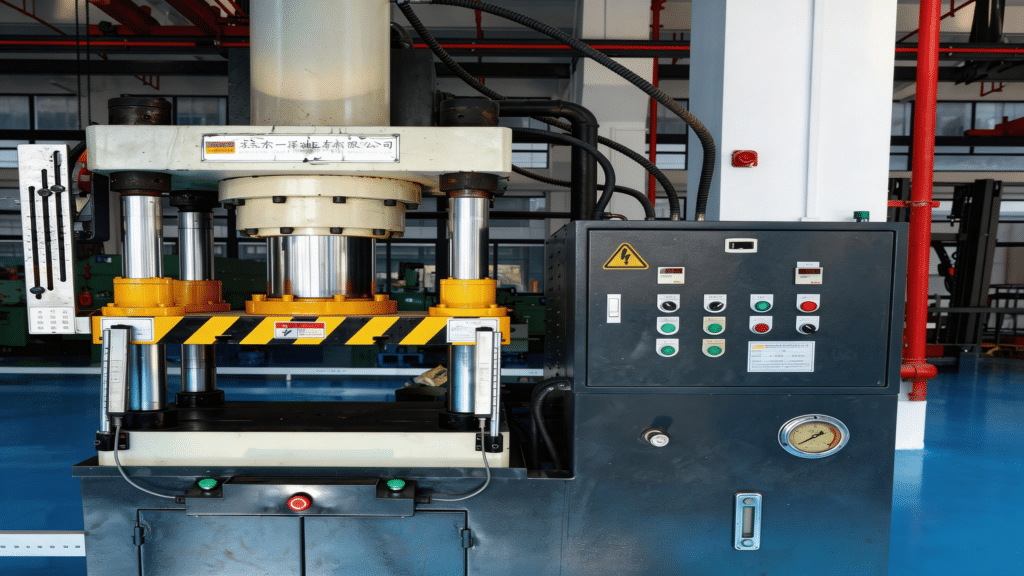
| Blanking and piercing | Profile and hole pattern in one die | 50–300 T presses, ±0.05 mm |
| Forming | 90° bend and gusset formed in-die | In-die forming, repeatable angle |
| Deburr | Burr controlled, edges safe to handle | Burr side tracked |
| Machining (specials) | Tight bores, milled faces where needed | 32-machine CNC line |
| Finishing | Zn-Ni / DACROMET in-house; hot-dip via partner | 1,000+ hr salt spray verified |
| Verification | Bend angle, hole position, flatness | 3D scanning + 2D video measuring, Mitutoyo gauges, 100% optical sorting |
Forming the bend in the die rather than on a press brake is what makes bracket angles repeatable across a production run: die geometry sets the overbend that compensates for springback, so every part relaxes to the same angle instead of tracking an operator’s technique. Where a bracket carries pressed-in or clinched hardware, those fasteners come from the same cold forging lines that supply the CNC parts portfolio — so hole size and hardware knurl are matched by one engineering owner. Equipment detail sits on the technology overview.
Need a quote on custom L shaped brackets? Send your drawing or a sketch with load and distance to KeyFix — DFM review and quotation within 48 hours. Get a quote or email sales@keyfixpro.com.
What Should the Drawing Specify?
| Call-Out | What to Specify | Why It Matters |
|---|---|---|
| Material + finish system | e.g., 2 mm CRS, hot-dip galv per ASTM A123 | Sets corrosion and fastener match |
| Thickness | Gauge with tolerance | Dominates load capacity |
| Leg lengths | Both legs, from the bend | Defines the moment arm |
| Bend angle + tolerance | 90° ±1° typical | Alignment of the mounted part |
| Inside bend radius | ≥ 1× t | Prevents cracking at the corner |
| Hole pattern | Diameter, position, vertical spacing | Spacing sets fastener tension |
| Hole-to-bend distance | ≥ 3× t + radius | Stops holes going oval in forming |
| Gusset | Present or not, dimensions | Major capacity difference |
| Rated load and distance | e.g., 40 kg at 75 mm | A rating without distance is meaningless |
How Do You Qualify a Bracket Supplier?
| Audit Point | Minimum Requirement | KeyFix Status |
|---|---|---|
| Quality system | ISO 9001 minimum | IATF 16949 + ISO 9001 + ISO 14001 |
| Forming method | In-die forming for volume angles | 50–300 T presses, in-die bends |
| Material verification | OES per coil | SPECTRO OES, 100% of heats |
| Angle measurement | 3D scanning or checking fixture | Shining3D + 2D video measuring |
| Finish validation | Salt spray records by system | Zn-Ni / DACROMET 1,000+ hr in-house |
| Hardware integration | Clinch hole and fastener controlled together | Both produced in-house |
| Outgoing quality | Documented defect rate | <25 PPM at AQL 0.4 |
Cold-rolled steel follows ASTM A1008 and general tolerances follow ISO 2768, under the quality system documented in KeyFix’s company background.
What Are the Logistics and Shipping Terms?
KeyFix manufactures in Huizhou, Guangdong, near South China’s export ports.
| Term | Detail |
|---|---|
| Manufacturing location | Huizhou, Guangdong Province |
| Standard shipping term | FCA Dongguan |
| Sea freight term | FOB Shenzhen Yantian Port |
| Prototype lead time | 7–14 business days (air-expressed) |
| Die tooling lead time | 3–6 weeks for progressive dies |
| Production lead time | 4–6 weeks after sample approval |
Frequently Asked Questions
How much weight can an L bracket hold?
There is no answer without a distance. Capacity is set by the bending moment (load × distance from the bend), so the same bracket that holds 40 kg at 50 mm may only hold 20 kg at 100 mm. Always state both numbers together on a drawing or a datasheet.
Should I choose galvanized or stainless?
They are different material systems. Choose hot-dip galvanized carbon steel for outdoor and structural duty at lower cost; choose 304 or 316 stainless where the finish must never wear through, the appearance matters, or the environment is marine or food-adjacent. Match the fasteners to whichever system you pick.
Does adding more mounting holes make a bracket stronger?
Usually not much. The top row of fasteners carries the pull-out tension, and that tension depends on the vertical spacing between rows, not the number of holes. Spreading two rows further apart helps far more than crowding four holes together.
When is a gusset worth it?
Whenever the load is meaningful and the leg is long. A formed gusset costs one die station and multiplies corner stiffness several times over, which is nearly always cheaper than upgauging the whole bracket to achieve the same capacity.
What is the minimum order quantity?
Tool-free prototypes run from 10–100 pieces. Progressive-die production typically starts at 1,000–5,000 pieces, with the die quoted separately and amortized over the program. Contact sales@keyfixpro.com for numbers on your geometry.
What shipping terms apply for international orders?
Standard shipping is FCA Dongguan, with sea freight as FOB Shenzhen Yantian Port from the Huizhou production base.
If your next program needs custom L shaped brackets — plain angles, gusseted heavy-duty, slotted adjustable, or brackets with clinch hardware installed — send your drawing to KeyFix for a free DFM review and a quotation within 48 hours. Explore the product portfolio or contact KeyFix at sales@keyfixpro.com.
Author: KeyFix Engineering Team Published: July 6, 2026 Last Updated: July 6, 2026