Titanium bolts for bicycles deliver 40–45 % weight reduction versus steel at comparable strength — the standard upgrade for MTB, gravel, and road builds where every gram matters. The most common sizes — M5, M6, and M8 — cover bottle cage mounts, stem clamps, disc brake caliper bolts, brake lever pivots, and crank fixings. Not every titanium grade or thread profile suits every position. This guide walks through metallurgy, dimensional specs, torque values, and corrosion behavior you need to specify titanium fasteners properly — whether you’re sourcing for a custom MTB build or a Tier 1 OEM program.
TL;DR — Key Takeaways
- Grade 5 titanium (Ti-6Al-4V) delivers tensile strength of 900–1,100 MPa at density 4.43 g/cm³ — roughly 45 % lighter than 8.8-grade steel.
- M5, M6, and M8 cover 80 %+ of bicycle bolt positions; torque varies from 3 Nm (M5 brake lever pivot) to 35 Nm (M8 crank bolt).
- Titanium-on-aluminum joints require anti-seize compound to prevent thread galling — a critical install step often skipped.
- Rolled threads deliver 8–10× higher fatigue life than cut threads under dynamic cycling loads.
- Anodized Type II titanium bolts come in 6+ standard colors without mechanical-property degradation.
Which Titanium Grade Is Right for Bicycle Bolts?
Three titanium grades cover virtually all bicycle fastener applications. The choice depends on load class and price point.
| Grade | Composition | Tensile (MPa) | Density (g/cm³) | Cost | Best Application |
|---|---|---|---|---|---|
| Grade 2 (CP-Ti) | Commercially pure titanium | 345 | 4.51 | 1.0× | Bottle cage bolts, fender mounts |
| Grade 5 (Ti-6Al-4V) | 90 % Ti + 6 % Al + 4 % V | 900–1,100 | 4.43 | 1.4× | Stem, seatpost, disc brake, crank — most common |
| Grade 9 (Ti-3Al-2.5V) | 94.5 % Ti + 3 % Al + 2.5 % V | 620–860 | 4.48 | 1.6× | Frame tubing, derailleur hardware |
Grade 5 (Ti-6Al-4V) is the workhorse of the bicycle bolt market. Tensile strength approaches 8.8 carbon steel, but density is 44 % lower — translating to weight savings on every bolt. For a complete MTB frame swap (typically 35–45 bolts), Grade 5 saves approximately 80–120 grams versus OEM steel.
Grade 2 is sometimes substituted on low-load positions for cost. At 345 MPa tensile, it’s strong enough for water bottle cages and accessory mounts, but it shouldn’t appear on stem clamps, brake calipers, or crank bolts.
⚠️ Common Pitfall: Some vendors sell “titanium bolts” that are actually Grade 1 or Grade 2 commercially pure titanium at Grade 5 prices. The visual difference is invisible — but a Grade 2 stem bolt installed at Grade 5 spec torque can yield within the first ride. Always require a mill certificate showing Ti-6Al-4V composition for safety-critical positions.
What Torque Specs Apply to Titanium Bolts on Bicycles?
Torque values for titanium bolts are typically identical to the steel-bolt OEM spec at the same property class — strength determines torque capacity, not material density.
| Position | Bolt Size | Material | Torque (Nm) | Notes |
|---|---|---|---|---|
| Brake lever clamp | M5 × 12–20 | Grade 5 Ti | 5–6 | Anti-seize on aluminum bar |
| Brake lever pivot | M5 × 10–14 | Grade 5 Ti | 3–4 | Loctite 222 (low-strength) |
| Bottle cage mount | M5 × 12–16 | Grade 2 or 5 Ti | 3–4 | Anti-seize against aluminum boss |
| Stem face plate (handlebar) | M5 × 16–25 | Grade 5 Ti | 5–6 | Star-pattern tightening |
| Stem steerer clamp | M5 × 18–30 | Grade 5 Ti | 5–7 | Carbon-safe paste on carbon steerer |
| Seatpost clamp | M5 × 25–45 | Grade 5 Ti | 5–7 | Per OEM frame spec |
| Saddle rail clamp | M6 × 18–35 | Grade 5 Ti | 8–10 | Alternating stages |
| Disc brake caliper mount | M6 × 18–30 | Grade 5 Ti | 8–10 | Loctite 243 — vibration-prone |
| Rotor bolt (6-bolt) | M5 × 10 | Grade 5 Ti (T25) | 5–6 | Star pattern; never reuse if stripped |
| Crank arm bolt (square taper) | M8 × 22 | Grade 5 Ti | 35–40 | High-load — Grade 5 only |
| Crank arm bolt (Hollowtech) | M8 / M14 | Grade 5 Ti | 15–22 | Per crank manufacturer spec |
| Pedal axle | M9 × 1.0 (or 9/16″) | Grade 5 Ti | 35 | Right-thread drive, left-thread non-drive |
For all titanium-on-aluminum joints, anti-seize is mandatory. Titanium and aluminum form a galvanic couple that — combined with metal-on-metal contact under preload — creates galling that can permanently weld threads. Copper-based or aluminum-based anti-seize prevents both galvanic corrosion and seizing.
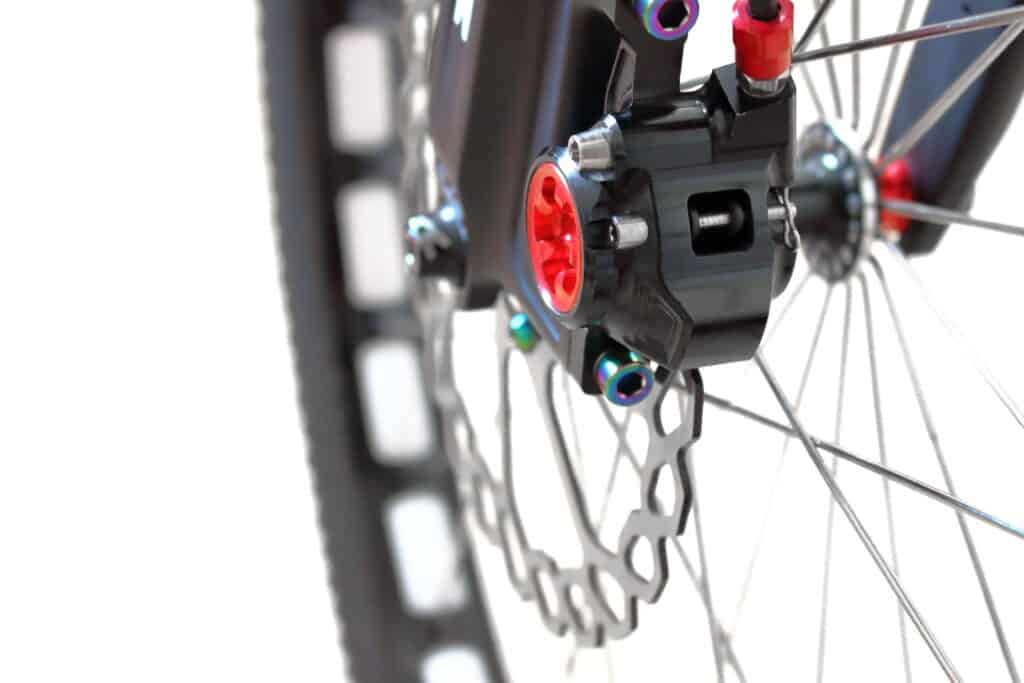
💡 Engineer’s Note: For brake lever assemblies, specify a dedicated M5 brake lever pivot bolt with a shoulder rather than a fully threaded screw. The shoulder controls pivot clearance precisely, ensuring lever feel doesn’t degrade as threadlocker ages.
How Are Titanium Bicycle Bolts Manufactured?
Two primary processes dominate titanium bolt production.
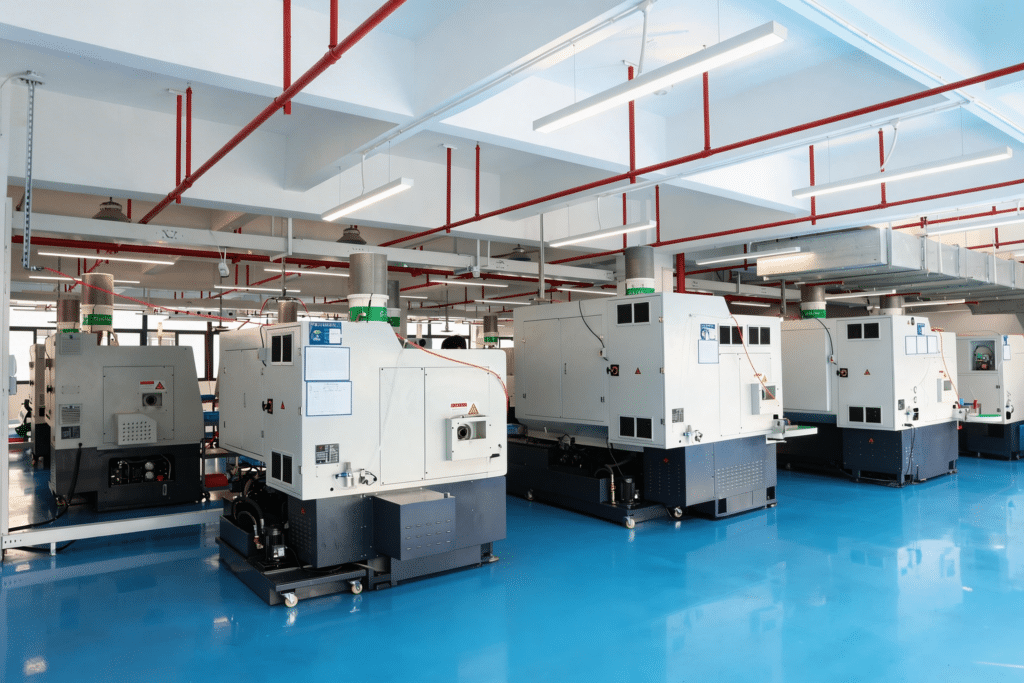
CNC machining (Swiss-type lathe) cuts the bolt from titanium bar — best for low-volume custom geometries and prototypes. Tolerance runs to ±0.005 mm.
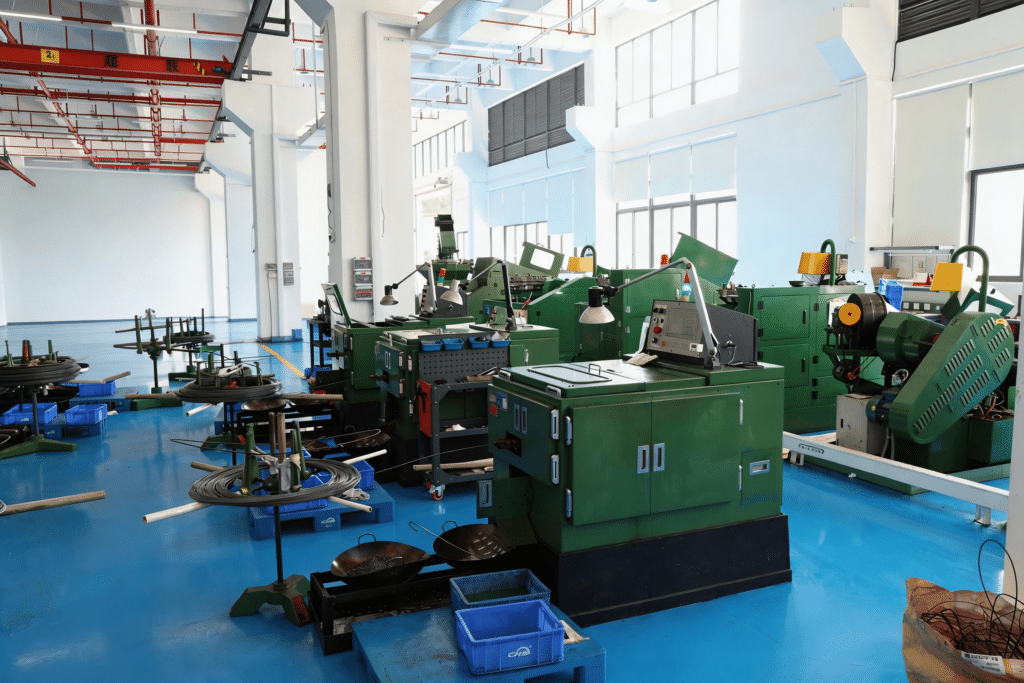
Cold heading + thread rolling produces titanium bolts at higher volume with continuous grain flow through the head-to-shank transition. Thread rolling creates compressive residual stress at the thread root, delivering 8–10× higher fatigue life than cut threads — the technically correct choice for dynamic cycling applications.
| Process | Best For | Volume | Tolerance | Fatigue |
|---|---|---|---|---|
| CNC Swiss machining | Prototypes, custom heads | 50 – 5,000 | ±0.005 mm | Baseline (cut threads) |
| Cold heading + thread rolling | Standard sizes, production | 5,000 – 500,000+ | ±0.02 mm | 8–10× cut threads |
| CNC head + rolled thread (hybrid) | Custom head with rolled thread | 1,000 – 50,000 | ±0.01 mm | 8–10× cut threads |
Keyfix operates YCM NFX 380A 5-axis CNC centers, CNC lathes, and cold-heading and thread-rolling lines — covering 50-piece prototypes to 500,000-piece annual OEM programs under one IATF 16949 quality system, with Ti-6Al-4V verified by SPECTRO (Germany) OES on incoming heats.
What Head Styles and Drive Recesses Work Best?
| Head Style | Drive Recess | Best Position |
|---|---|---|
| Hex socket — low profile | 3, 4, 5, 6 mm hex | Universal — most common bicycle head |
| Hex socket — standard ISO 4762 | 4, 5, 6, 8 mm hex | Higher-torque positions (M6, M8 cranks) |
| Button head | 3, 4, 5 mm hex | Low-clearance positions, aesthetic builds |
| Tapered (countersunk) | 4, 5 mm hex or T25 | Disc rotor mounts, flush mounting |
| External Torx | T20, T25, T30 | Disc rotors, modern brake calipers |
External Torx is increasingly specified for disc rotor bolts — deeper engagement resists cam-out under the 5–6 Nm install torque. T25 Torx outperforms 4 mm hex by 3–5× engagement life before recess wear.
Need help selecting the right titanium bolt set? Send your application list and quantity targets to Keyfix engineers — we’ll flag whether Grade 2, Grade 5, or a mixed-grade kit makes the most sense. Quote turnaround 48 hours. Email: sales@keyfixpro.com
What Surface Treatments Apply to Titanium Bicycle Bolts?
Titanium does not require corrosion-protection coatings — the native oxide layer resists sweat, salt, water, and acids. Surface treatment on titanium bicycle bolts is almost entirely aesthetic.
| Treatment | Function | Color Options | Cost |
|---|---|---|---|
| As-machined | None — bare titanium | Silver-grey | 1.0× |
| Bead-blasted | Matte texture | Light grey, satin | 1.1× |
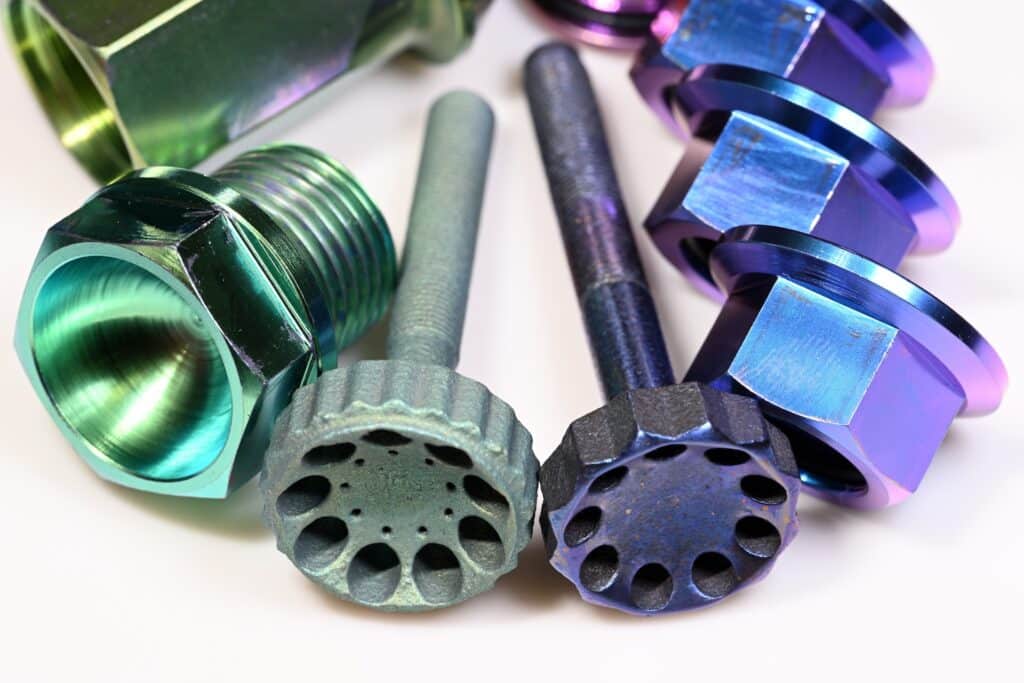
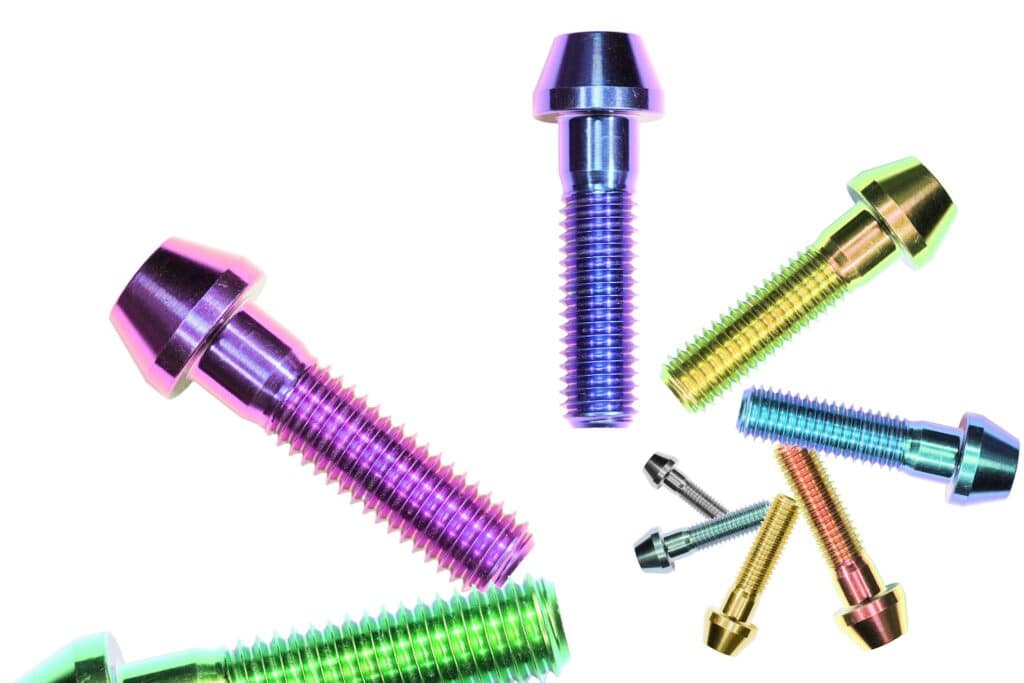
| Type II anodize | Decorative color | Gold, blue, purple, rainbow, green, pink, black | 1.2× |
| Type III hard anodize | Wear + color | Dark grey, black, blue | 1.5× |
| Polishing | Mirror finish | Mirror silver | 1.4× |
| PVD coating | Decorative + wear | Black, gunmetal, rainbow | 2.0× |
Type II anodizing is the dominant aesthetic treatment. Color comes from light-interference within a controlled oxide layer; thickness varies from 20 nm (gold) to 200 nm (green/pink), with no impact on bolt strength.
What Should You Specify on a Titanium Bolt Drawing?
| Drawing Call-Out | What to Specify | Why It Matters |
|---|---|---|
| Material grade | Ti-6Al-4V Grade 5 per ASTM B348 | Prevents Grade 2 substitution |
| Mill certificate | Required, traceable to heat number | Verifies alloy composition |
| Head style + recess | E.g., low-profile hex socket, 4 mm | Tool compatibility |
| Thread production method | Rolled threads required | 8–10× cut-thread fatigue life |
| Length | Total length under head, with tolerance | Grip-length engagement |
| Surface treatment | Mill finish, bead-blast, or Type II anodize color | Defines appearance |
| Torque rating | Per OEM spec (e.g., 5–6 Nm for M5 brake) | Installation parameters |
📋 Spec Tip: Always specify rolled threads on dynamic-load positions. Cut threads leave sharp root geometry that initiates fatigue cracks — relevant on crank bolts, disc brake mounts, and suspension pivots. The cost difference at production volumes is usually under $0.05 per bolt.
How Do You Qualify a Titanium Bolt Manufacturer?
| Audit Point | Minimum Requirement | Keyfix Status |
|---|---|---|
| Quality system | ISO 9001; IATF 16949 for OEM | IATF 16949 + ISO 9001 + ISO 14001 |
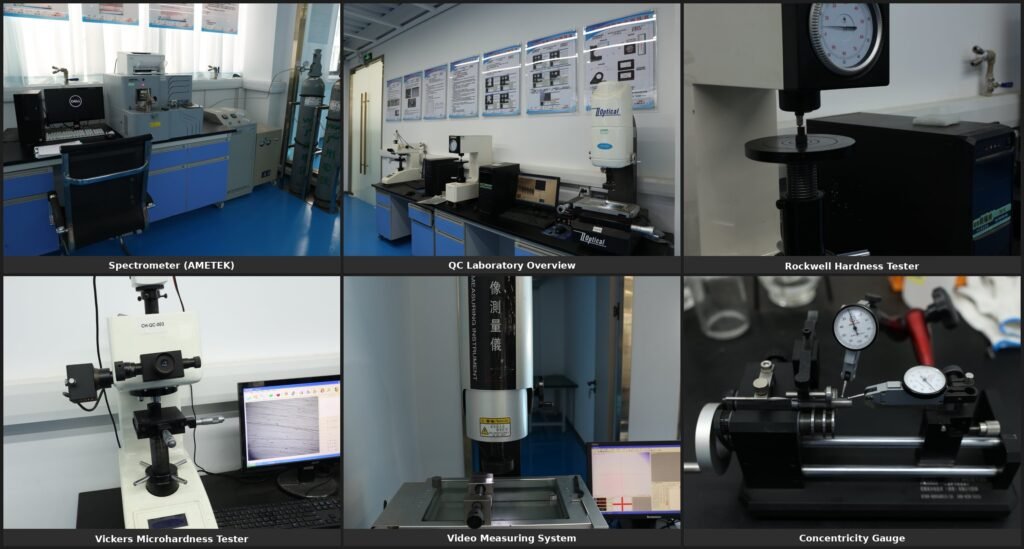
| Material verification | OES per incoming heat | SPECTRO (Germany) OES on 100 % of heats |
| Mill certificate | Traceable to heat number | Standard with every lot |
| Dimensional control | Calibrated precision metrology (CMM or video measuring) | 2D video measuring (0.001 mm resolution) + Shining3D 3D scanning |
| Thread production | Rolled threads available | In-house thread rolling |
| Anodize color consistency | Limit samples + voltage SPC | Voltage-controlled anodize line |
| PPAP capability | Level 3 for OEM | Level 3–5, digital traceability |
| Production capacity | 100K+ pieces per month | Multi-line cold heading + CNC |
Keyfix’s titanium bolt production follows the same process chain as all other fastener families — incoming material verification, cold heading or CNC turning, thread rolling, anodizing, dimensional inspection, and packaging — under one IATF 16949 system with full per-lot traceability.
Frequently Asked Questions
What’s the minimum order quantity (MOQ) for custom titanium bicycle bolts?
CNC-machined custom geometries have no MOQ. Cold-headed production runs typically begin at 5,000 pieces per variant, with cost reductions at 10K, 50K, and 100K+ tiers. Anodizing adds 3–5 business days to lead time.
What certifications does Keyfix hold for titanium bolt production?
Keyfix holds IATF 16949, ISO 9001, and ISO 14001. Titanium bolts ship with mill certificates traceable to heat number, dimensional inspection reports, and full PPAP Level 3 documentation for OEM programs.
Can Keyfix supply mixed titanium bolt kits (M5, M6, M8 combined)?
Yes. Mixed-size kits ship as single-SKU assemblies. Common configurations include the 35-piece full-frame set (bottle cage, stem, seatpost, brakes, derailleur) and the 15-piece brake/drivetrain set.
What lead time should I expect for a custom titanium bolt program?
48 hours for DFM and quotation, 2–3 weeks for prototype CNC samples, 4–6 weeks for production after PPAP approval. Cold-heading tooling adds 3–4 weeks of setup amortized over the first order.
Does titanium cause corrosion on aluminum or carbon frames?
Titanium-on-aluminum joints can produce mild galvanic corrosion if exposed to sweat or salt water. Apply anti-seize at installation. Titanium-on-carbon contact is safe but should use carbon-rated assembly paste.
Can Keyfix produce titanium bolts with custom anodized colors?
Yes. Standard Type II colors: gold, blue, purple, rainbow, green, pink, black. Custom voltages produce shades between standards. Color limit samples are agreed at PPAP and held for the life of the program.
If your next bicycle project — custom MTB build, brake lever upgrade, or Tier 1 OEM bolt program — needs M5, M6, or M8 titanium fasteners, send your bolt list and quantity targets to Keyfix’s application engineering team. You’ll get a free DFM review, the most cost-effective grade-process-finish combination, and a quotation within 48 hours. Contact sales@keyfixpro.com or visit www.keyfixpro.com.
Author: Keyfix Engineering Team Published: May 17, 2026 Last Updated: May 17, 202