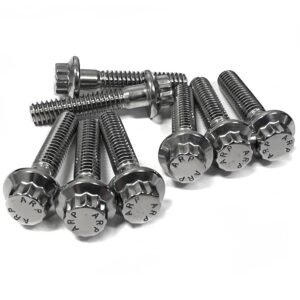
Titanium motorcycle screws in Grade 5 (Ti-6Al-4V) deliver roughly the strength of an 8.8 steel bolt at 43 % less weight, which is why they fill race paddocks and custom builds. But a motorcycle is a far harsher host than a bicycle: engine cases run hot, magnesium covers sit in direct galvanic contact, and titanium’s defining vice — it galls and seizes against itself and against aluminium — turns a routine service into a drilled-out fastener. This guide covers where titanium truly earns its place on a motorcycle, the anti-seize and torque discipline that keeps it removable, galvanic pairing with magnesium and aluminium, heat limits, anodised colour, and how to specify and source custom parts.
TL;DR — Key Takeaways
- Grade 5 Ti-6Al-4V reaches roughly 950–1,100 MPa tensile at a density of 4.43 g/cm³ versus steel’s 7.85 — about 43 % lighter for equal strength.
- Commercially pure Grade 2 (~345 MPa) is not a structural screw material; a “titanium bolt” without a grade callout is a warning sign.
- Titanium’s oxide layer makes it gall and cold-weld under load — anti-seize on every thread is mandatory, not optional.
- Anti-seize lowers thread friction, so a steel torque figure applied to a lubricated titanium screw over-tensions it; reduce torque or specify by preload.
- Titanium is strongly cathodic to magnesium — a Ti screw straight into a magnesium engine cover drives rapid galvanic attack on the cover.
What Makes Grade 5 the Right Titanium?
Titanium is a family, not a material, and only one member belongs in a loaded fastener.
| Grade | Designation | Tensile Strength | Use in Fasteners |
|---|---|---|---|
| Grade 2 | Commercially pure Ti | ~345 MPa | Non-structural trim, fairing screws only |
| Grade 5 | Ti-6Al-4V | ~950–1,100 MPa | The structural standard |
| Grade 5 ELI | Ti-6Al-4V ELI | ~860–970 MPa | Medical; unnecessary here |
| Grade 9 | Ti-3Al-2.5V | ~620 MPa | Tubing, some cold-formed parts |
Grade 5 sits between property class 8.8 and 10.9 steel in strength while weighing little more than half as much. The comparison that matters to a builder:
| Property | Grade 5 Titanium | Steel 8.8 | Steel 12.9 | Stainless A2-70 |
|---|---|---|---|---|
| Tensile strength | ~950–1,100 MPa | 800 MPa | 1,220 MPa | 700 MPa |
| Density | 4.43 g/cm³ | 7.85 | 7.85 | 7.9 |
| Weight vs steel | −43 % | baseline | baseline | +1 % |
| Corrosion | Outstanding | Poor (needs coating) | Poor | Excellent |
| Galling tendency | High | Low | Low | Moderate |
| Relative cost | 8–15× | 1× | 1.5× | 2.5× |
💡 Engineer’s Note: Weigh the real saving before buying a full kit. Replacing 80–120 fasteners across a mid-size motorcycle typically saves 0.5–1.5 kg — meaningful on a track bike, marginal on a tourer. Spend the budget where mass matters most: unsprung and rotating positions such as caliper, disc, and sprocket hardware, where a gram counts for more than it does on a fairing.
Where Do Titanium Screws Belong on a Motorcycle?
Not everywhere. Heat, load type, and galvanic environment split the bike into zones.
| Location | Suitability | Reason |
|---|---|---|
| Brake caliper mounting | Excellent | Unsprung mass; moderate temperature |
| Disc rotor bolts | Excellent | Rotating mass; high value per gram |
| Sprocket bolts | Excellent | Rotating; high strength needed |
| Axle pinch bolts | Good | Unsprung; clamp-critical, torque carefully |
| Engine case covers | Good — with caution | Magnesium covers create galvanic risk |
| Fairing and bodywork | Good (Grade 2 acceptable) | Low load; cosmetic anodising |
| Exhaust flange / header | Marginal | Sustained heat plus severe galling |
| Suspension internals | Case by case | Fatigue-critical; validate before substituting |
| Safety-critical OEM joints | Do not substitute | Homologated torque and material spec |
The rule behind the table: titanium rewards you where mass moves — unsprung, rotating, or reciprocating — and offers little where a part simply sits still. Exhaust hardware is the classic mistake; sustained heat and titanium’s galling behaviour combine to weld the fastener into the flange.
Why Do Titanium Screws Gall and Seize?
This is the defining failure mode, and it is chemistry rather than carelessness. Titanium carries a tenacious oxide film. Under thread contact pressure that film ruptures, and the freshly exposed metal — highly reactive, with poor thermal conductivity to carry away friction heat — cold-welds to the mating surface. The screw and the tapped hole become one part.
| Contact Pair | Galling Risk | Mitigation |
|---|---|---|
| Titanium into titanium | Severe | Anti-seize mandatory; avoid where possible |
| Titanium into aluminium | High | Anti-seize; consider a steel insert |
| Titanium into steel | Moderate | Anti-seize; usually manageable |
| Titanium into magnesium | High + galvanic | Anti-seize plus isolation |
| Titanium with rolled thread | Reduced | Smoother flank; fewer initiation points |
Three controls keep titanium removable. Anti-seize compound on every thread and under every head — a copper- or nickel-based paste, applied thinly, is the standard practice. Rolled rather than cut threads, whose burnished flanks give galling fewer places to start while adding fatigue strength. And slow, steady tightening: fast driving generates the local heat that starts a weld, so titanium is a hand-torque fastener, not an impact-driver one.
⚠️ Common Pitfall: Applying the steel torque figure to an anti-seized titanium screw over-tightens it badly. Torque splits between friction and preload; anti-seize cuts thread friction sharply, so a larger share becomes tension — the same wrench setting can push a titanium fastener toward yield. Use the fastener maker’s lubricated-condition torque, typically well below the dry steel value, or specify by angle or preload instead.
How Does Titanium Behave Galvanically?
Titanium is highly cathodic — noble, corrosion-immune, and therefore an aggressive partner for the less noble metals a motorcycle is built from. In a galvanic couple, the anodic metal corrodes; titanium is almost never the one that suffers.
| Mating Material | Galvanic Severity | Practical Consequence |
|---|---|---|
| Magnesium (engine covers) | Severe | Cover corrodes around the screw, rapidly in salt |
| Aluminium (cases, brackets) | Moderate–high | Pitting and white bloom at the boss |
| Carbon steel | Moderate | Rust at the interface |
| Stainless steel | Low | Generally compatible |
| Titanium | None | Ideal pairing |
Magnesium is the one to plan for. Many sport machines use magnesium engine covers and clutch covers precisely to save weight, and a bare titanium screw threaded into one creates a strong couple — the cover pits and blooms around every fastener within a season of winter riding. Mitigation is straightforward if planned: an anodised titanium screw, an anti-seize barrier, and where possible a steel or stainless insert in the magnesium so the two metals never meet directly.
What Does Anodising Do Beyond Colour?
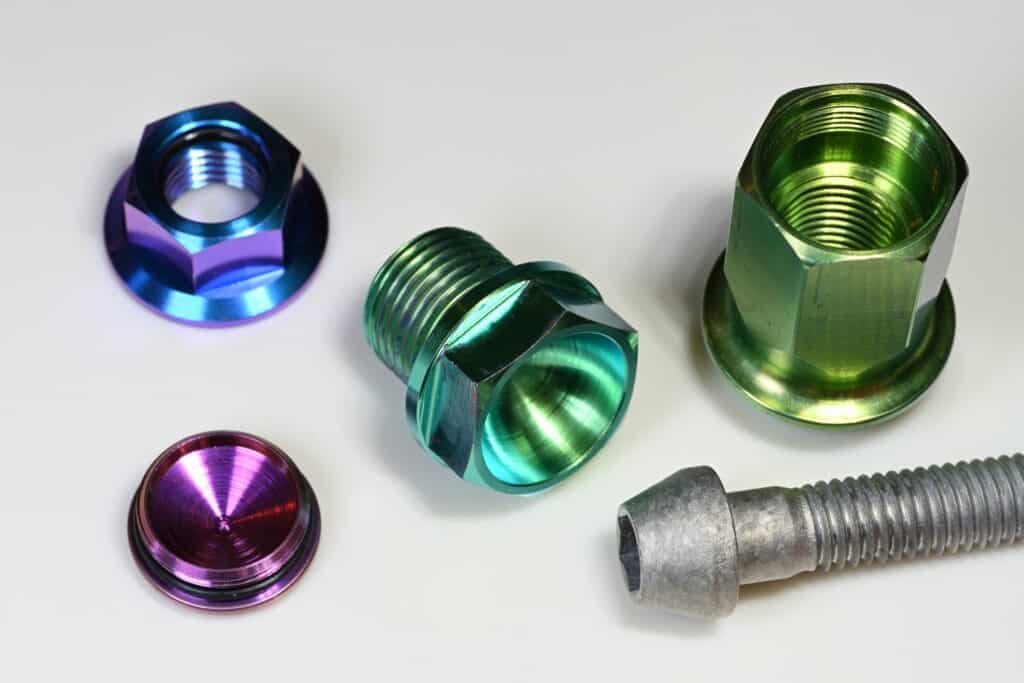
Titanium anodising grows a thicker oxide layer whose interference effect produces colour without dye. The film also modestly improves the surface’s resistance to galling initiation and adds a barrier in galvanic couples — so the colour motorcyclists buy for aesthetics does real work.
| Approximate Voltage Band | Resulting Colour |
|---|---|
| 10–20 V | Bronze / gold |
| 20–30 V | Purple / dark blue |
| 30–45 V | Light blue, silver |
| 45–70 V | Yellow, gold-green |
| 70–100 V | Pink, magenta, green |
Colour follows film thickness, so consistency across a batch depends on bath control and voltage repeatability. Specify colour by an approved sample, never by name alone — “blue” spans several volts and several visibly different results. KeyFix documents finish process parameters through its raw material and surface treatment control.
How Are Custom Titanium Motorcycle Screws Made?
Titanium work-hardens, holds heat at the cutting edge, and refuses to be cold-headed like carbon steel, so the process route differs from a standard bolt.
| Step | What Happens | KeyFix Capability |
|---|---|---|
| Bar verification | Grade 5 confirmed by OES | SPECTRO (Germany), 100 % of heats |
| CNC turning | Head, shank, and features machined | 32 CNC machines incl. two 5-axis, ±0.005 mm |
| Drive forming | Torx, hex socket, or custom head | Live tooling in the same chucking |
| Thread rolling | Rolled flank for fatigue and anti-galling | 22 thread-rolling machines |
| Deburr and finish | Edge break, bead blast or polish | Controlled process |
| Anodising | Colour and oxide barrier | Documented voltage per batch |
| Verification | Diameters, thread, head geometry | 2D video measuring + Shining3D scanning, Mitutoyo gauges, 100 % optical sorting |
Rolling the thread rather than cutting it matters twice over on titanium: the burnished flank resists galling initiation, and the uninterrupted grain flow raises fatigue strength — valuable on a machine whose engine vibrates every fastener continuously. KeyFix machines Grade 5 across its CNC production line and CNC parts portfolio, applying the same cold forging and thread-rolling discipline used on its steel fastener programs; process detail sits on the technology overview, and related two-wheeler work is described in its motorcycle fastener guide.
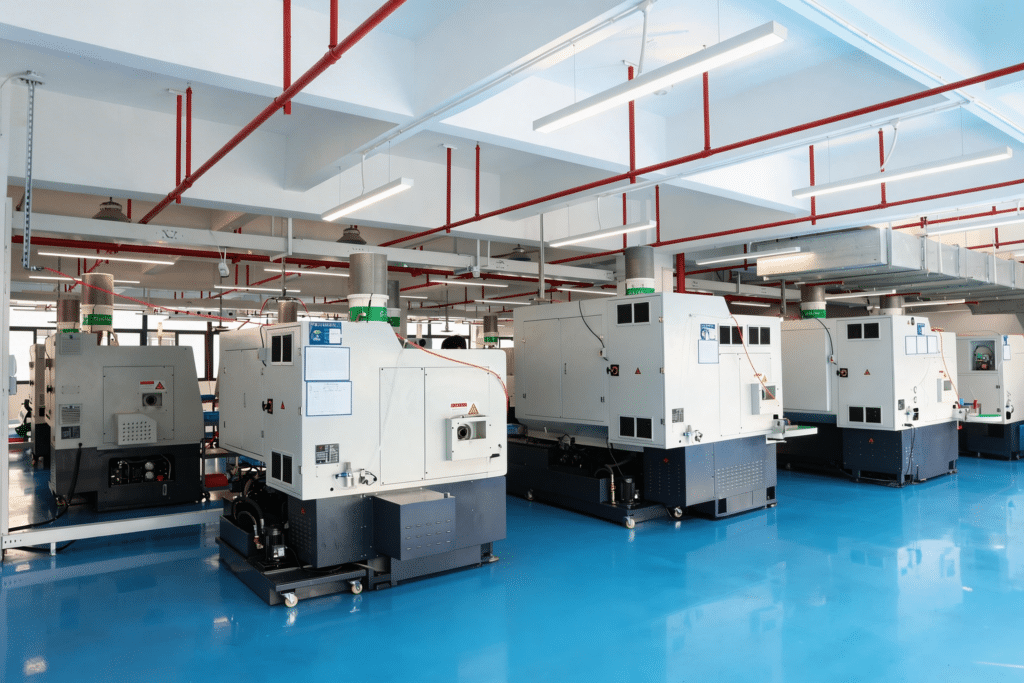
Dimensional and thread conformance is documented under the inspection standards program, with delivered examples in the project case studies.
Need a quote on custom Grade 5 titanium screws? Send your drawing or a sample fastener to KeyFix — DFM review and quotation within 48 hours. Get a quote or email sales@keyfixpro.com.
What Should the Drawing Specify?
| Call-Out | What to Specify | Why It Matters |
|---|---|---|
| Grade and standard | Ti-6Al-4V Grade 5 per ASTM B348 / F136 | Blocks Grade 2 substitution |
| Thread + class | e.g., M8 × 1.25, 6g, rolled | Fatigue and galling behaviour |
| Head style + drive | Flange, button, countersunk; Torx or hex | Access and bearing area |
| Under-head length | With tolerance | Grip and engagement |
| Surface finish | Bead blast, polish, anodised colour | Appearance and galling |
| Anodise colour | By approved sample | Voltage bands overlap visually |
| Anti-seize requirement | Note on the assembly print | Removability in service |
| Torque specification | Lubricated-condition value | Prevents over-tension |
📋 Spec Tip: Put the torque figure and the words “anti-seize applied” on the same line of the assembly drawing. Separating them is how a lubricated titanium fastener ends up tightened to a dry-steel number and yields on the first service.
How Do You Qualify a Titanium Fastener Manufacturer?
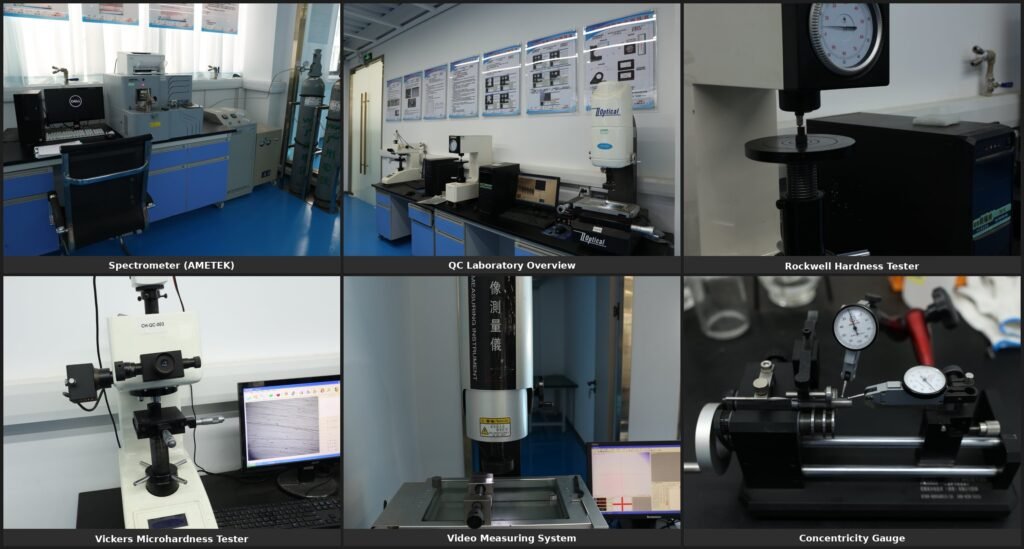
| Audit Point | Minimum Requirement | KeyFix Status |
|---|---|---|
| Quality system | ISO 9001 minimum | IATF 16949 + ISO 9001 + ISO 14001 |
| Titanium machining | Proven Grade 5 experience | 32 CNC machines, Ti in standard material library |
| Material verification | OES per bar lot, mill certs | SPECTRO OES, 100 % of heats |
| Thread production | Rolled, not cut, on production parts | 22 thread-rolling machines |
| Dimensional control | Documented optical measurement | 2D video measuring + 3D scanning, Mitutoyo gauges |
| Finish control | Anodise parameters recorded per batch | Documented |
| Outgoing quality | Stated defect rate | <25 PPM at AQL 0.4 |
Grade 5 bar follows ASTM B348 and thread classes follow ISO 965, under the quality system documented in KeyFix’s company background and applied across its machinery hardware programs.
What Are the Logistics and Shipping Terms?
KEYFIX manufactures in its own plant in Guangdong Province, near South China’s export ports.
| Term | Detail |
|---|---|
| Manufacturing location | Guangdong Province |
| Standard shipping term | FCA at our Guangdong plant |
| Sea freight term | FOB Shenzhen Yantian Port |
| Prototype lead time | 7–14 business days (air-expressed) |
| Production lead time | 4–6 weeks after sample approval |
Frequently Asked Questions
Are titanium motorcycle screws as strong as steel bolts?
Grade 5 Ti-6Al-4V reaches roughly 950–1,100 MPa tensile — above property class 8.8 steel and below 12.9 — at 43 % less weight. Grade 2 commercially pure titanium, at about 345 MPa, is not a structural substitute.
Why do titanium screws seize, and how do I prevent it?
Titanium’s oxide film ruptures under thread pressure and the exposed metal cold-welds to the mating surface. Apply anti-seize to every thread and head face, use rolled threads, and tighten slowly by hand rather than with an impact driver.
Can I use titanium screws in a magnesium engine cover?
Only with protection. Titanium is strongly cathodic to magnesium, so the cover corrodes around the fastener. Use anodised screws with anti-seize as a barrier, and where the design allows, a steel or stainless insert in the magnesium.
Do titanium screws use the same torque as steel?
No. Anti-seize reduces thread friction, so the same torque produces more preload and can over-tension the fastener. Use the manufacturer’s lubricated-condition torque figure, or specify by angle or preload.
Should I replace safety-critical fasteners with titanium?
Not on homologated joints. Brake, steering, and suspension attachment hardware is specified with a material and torque as a system; substitute only where the manufacturer or a competent engineer has validated it.
What is the minimum order quantity for custom titanium screws?
CNC-machined titanium parts have no MOQ — from prototypes and validation lots to several thousand pieces, with price breaks. Contact sales@keyfixpro.com for quotations.
If your next build or program needs custom Grade 5 titanium motorcycle screws — caliper, sprocket, engine cover, or bodywork hardware in anodised colour — send your drawing to KeyFix for a free DFM review and a quotation within 48 hours. Explore the product portfolio or contact KeyFix at sales@keyfixpro.com.
Author: KeyFix Engineering Team Published: July 7, 2026 Last Updated: July 7, 2026