
Brass hex nuts get ordered under a confusing name almost as often as they get ordered correctly. Buyers ask for “copper nuts,” but structural hex nuts are almost never made from pure copper — copper alone is too soft, wears out its own threads quickly, and galls against a steel bolt within a handful of cycles. What ships under that name is brass: a copper-zinc alloy engineered for exactly the machinability, conductivity, and corrosion resistance that pure copper cannot deliver in a fastener. This guide clears up that material confusion, covers standard versus thin (jam) nuts and locking mechanisms, brass grades and where each earns its place, electrical and non-sparking applications, galvanic behaviour against steel, and how to specify and source custom parts including M12 and other common sizes.
TL;DR — Key Takeaways
- “Copper nut” almost always means brass — pure copper is too soft for a durable thread; brass (CuZn alloy) is the real structural product.
- Thin (jam) nuts — DIN 439 — lock by wedging against the bolt thread flank when torqued against a full nut, roughly half the height of a standard DIN 934 hex nut.
- Nylon-insert lock nuts (DIN 985 style) resist loosening by prevailing torque from a compressed nylon collar — a different mechanism from a jam nut’s wedge action.
- Free-cutting brass C36000 is the workhorse grade for standard hex nuts; where higher strength is needed, silicon bronze or aluminium bronze steps in.
- Brass is prized for non-sparking, non-magnetic, and electrically conductive service — properties no steel nut, plated or not, can match.
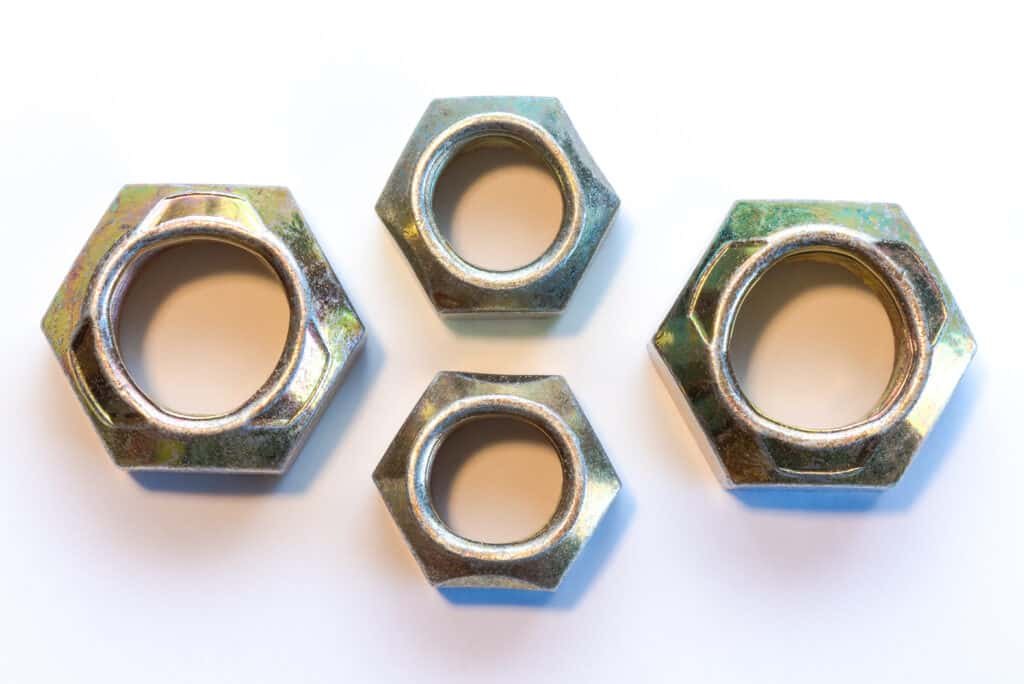
Why “Copper Nut” Is Not a Real Specification
This is the confusion worth resolving before anything else, because it changes what gets manufactured. Copper is soft — roughly a third the hardness of brass — and a nut cut from pure copper strips its own internal thread under normal tightening torque, then galls badly against a steel bolt because copper and steel have a strong tendency to seize under sliding pressure. Nobody manufactures structural hex nuts from unalloyed copper for this reason.
| Term Used by Buyers | What Ships | Why |
|---|---|---|
| “Copper nut” | Brass hex nut (CuZn alloy) | Pure copper is too soft; brass adds zinc for hardness and machinability |
| “Bronze nut” | Often really brass, or true tin/silicon bronze | Bronze (Cu-Sn or Cu-Si) is a distinct, stronger alloy family |
| “Brass hex nut” | Brass hex nut | The correct term — no substitution needed |
Brass is copper alloyed with zinc, typically in the 30–40 % range for the grades used in fasteners. The zinc addition raises hardness and machinability dramatically while keeping most of copper’s conductivity, corrosion resistance, and non-magnetic behaviour. Specify “brass, C36000” or the equivalent grade on the drawing, not “copper,” and the part that arrives will hold a thread properly.
KeyFix machines brass hex nuts and related turned components across its CNC parts portfolio, with nut-specific tapping handled on dedicated equipment described below.
What Are Standard, Thin, and Locking Hex Nuts?
Hex nuts split into families by height and locking mechanism, and mixing them up on a drawing is the second most common ordering error in this product line.
| Type | Standard | Height (M12 reference) | Function |
|---|---|---|---|
| Standard hex nut | DIN 934 / ISO 4032 | ~10.8 mm | General clamping |
| Thin (jam) hex nut | DIN 439 / ISO 4035 | ~5.0 mm | Locking, low-profile applications |
| Nylon-insert lock nut | DIN 985 style | ~15.8 mm (with insert) | Prevailing-torque locking |
| Wing nut | — | — | Hand-tightened, tool-free |
| Cap (acorn) nut | DIN 1587 | Varies | Covers the bolt end, cosmetic |
| Coupling nut | — | Extended | Joins two threaded rods |
Thin nuts and nylon-insert nuts both “lock,” but by completely different physics, and confusing them leads to specifying the wrong part for the job.
💡 Engineer’s Note: A thin nut alone does not lock anything — it locks only when run up against a full-height nut and torqued against it, wedging its threads against the opposite flank of the bolt’s thread. Order thin nuts as a jam-nut pair with a standard nut, never as a standalone locking solution.
How Does a Thin Nut Lock?
The mechanism is worth understanding because it explains both why it works and why it fails when misused.
| Locking Mechanism | How It Works | Reusable? | Vibration Resistance |
|---|---|---|---|
| Jam nut (thin + standard pair) | Two nuts torqued against each other wedge onto opposite thread flanks | Yes | Good |
| Nylon insert (prevailing torque) | Compressed nylon collar grips the thread continuously | Limited (nylon wears) | Very good |
| Distorted thread (all-metal) | Deformed thread section grips by friction | Yes, several cycles | Good, high temperature |
| Serrated flange | Teeth bite the bearing surface | Yes | Moderate — needs bare metal contact |
In a jam-nut pair, the bottom (thin) nut is tightened first and takes up the thread clearance. The top nut is then tightened against it, and because both nuts pull in opposite directions along the same thread, each nut’s flanks load against the opposite side of the bolt thread from the other. That opposing preload is what resists loosening — remove either nut and the effect disappears entirely.
⚠️ Common Pitfall: Installing a thin nut on its own where a locking function was intended, because it is the same diameter and “looks like a lock nut.” A single thin nut has no locking mechanism at all — it is simply a low-profile standard nut. The locking effect exists only in the two-nut jam configuration or when the thin nut is torqued hard against a shoulder that plays the same role as the second nut.
Which Brass Grades Suit Hex Nuts?
| Grade | Composition | Machinability | Strength | Best Use |
|---|---|---|---|---|
| C36000 (free-cutting brass) | ~61 % Cu, 3 % Pb, balance Zn | Excellent (reference 100 %) | Moderate | Standard hex nuts, high-volume |
| C26000 (cartridge brass) | ~70 % Cu, 30 % Zn | Good | Moderate | Decorative, deep-formed parts |
| C46400 (naval brass) | ~60 % Cu, 39 % Zn, 0.75 % Sn | Good | Moderate–high | Marine, higher corrosion resistance |
| Silicon bronze (C65500) | Cu-Si alloy | Fair | High | Load-bearing where brass is too soft |
| Aluminium bronze (C95400) | Cu-Al-Fe alloy | Fair | Highest | Heavy-duty corrosion + strength |
C36000 dominates hex nut production because its lead content makes it the easiest copper alloy to machine and tap cleanly — a genuine engineering advantage, not a cost shortcut, since clean thread roots directly affect fatigue life and assembly feel. Where a joint needs real load-bearing strength beyond what any brass offers, silicon bronze or aluminium bronze step in, trading some machinability for meaningfully higher yield strength.
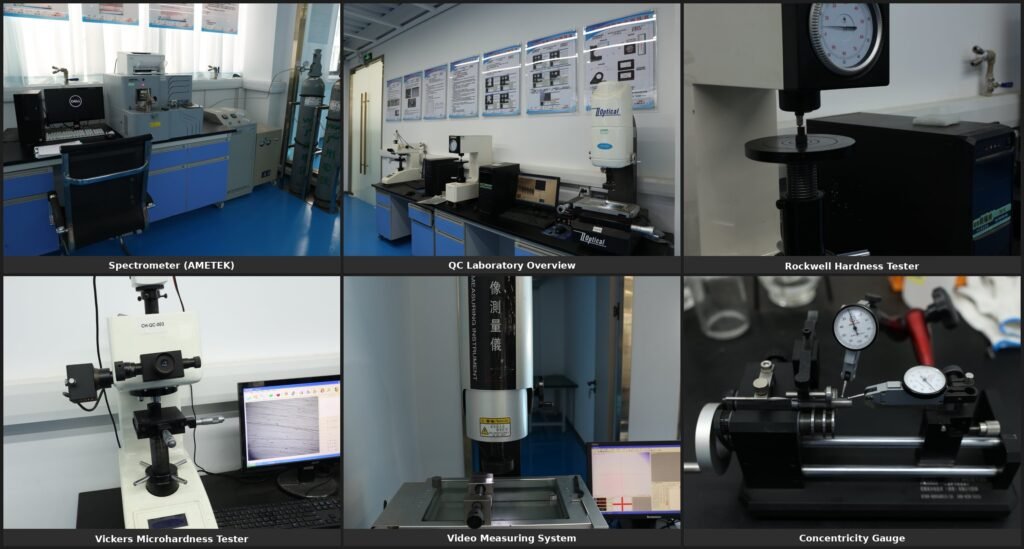
Incoming brass bar chemistry is confirmed on every lot by SPECTRO optical emission spectrometry through KeyFix’s raw material control process — the check that separates a genuine C36000 bar from an off-spec alloy before it reaches a tapping head.
Why Choose Brass Over Steel for a Hex Nut?
Brass earns its premium in three application areas that plated steel cannot match, regardless of coating quality.
| Property | Brass | Plated Steel | Stainless Steel |
|---|---|---|---|
| Electrical conductivity | High — genuine conductor | Poor (coating dependent) | Poor |
| Non-sparking | Yes | No | No |
| Non-magnetic | Yes | No (carbon steel) | Depends on grade |
| Corrosion resistance | Good, inherent | Coating-dependent | Excellent |
| Cost | Moderate–high | Low | Moderate |
| Strength | Moderate | High | High |
Non-sparking service is the application that has no substitute: in fuel handling, mining, grain processing, and other environments where a single spark risks ignition, brass hardware is specified precisely because impact against another metal surface will not throw a spark the way steel can. Electrical grounding and busbar hardware relies on the same property from the opposite angle — genuine conductivity through the fastener itself, not just a conductive path around it. And non-magnetic assemblies — instrumentation, MRI-adjacent equipment, some marine compass work — rule out carbon steel entirely regardless of finish.
📋 Spec Tip: If the application is non-sparking or electrical, say so explicitly on the drawing (“brass required — non-sparking application”) rather than just specifying the material. It flags the requirement for anyone downstream who might otherwise substitute a plated steel nut of the same size and appearance.
How Does Brass Behave Against a Steel Bolt Galvanically?
Brass and steel form a moderate galvanic couple — not as severe as titanium against magnesium, but worth checking in wet or outdoor service.
| Pairing | Galvanic Severity | Practical Note |
|---|---|---|
| Brass nut on stainless bolt | Low | Generally compatible |
| Brass nut on plated carbon steel bolt | Moderate | Coating protects the bolt initially |
| Brass nut on bare carbon steel bolt | Moderate–high | Bolt corrodes preferentially over time |
| Brass nut on aluminium structure | Moderate | Aluminium is the anode; consider isolation |
In most indoor and moderate environments, a brass nut on a zinc-plated bolt performs well for years, because the zinc coating itself is sacrificial and buffers the couple. In continuously wet or marine service, the safer pairing is brass on stainless, or a naval brass / bronze fastener set matched on both sides.
How Are Custom Brass Hex Nuts Manufactured?

| Step | What Happens | KeyFix Capability |
|---|---|---|
| Bar verification | Alloy confirmed by OES | SPECTRO (Germany), 100 % of heats |
| Cold heading | Hex body formed at volume | 25 cold heading machines |
| Nut tapping | Internal thread cut or formed | 10 nut tapping machines |
| CNC turning (specials) | Non-standard profiles, coupling nuts | 32 CNC machines, ±0.005 mm |
| Nylon insert installation | Prevailing-torque collar fitted | Controlled assembly process |
| Finishing | Passivation, plating, or plain | In-house lines where applicable |
| Verification | Across-flats, thread, height | 2D video measuring + Mitutoyo gauges, 100 % optical sorting |
Cold heading suits brass hex nuts particularly well: the alloy forms cleanly under the die, and the flats and chamfers come out consistent at volume without the tool wear that harder alloys demand. For coupling nuts, oversized specials, or unusual profiles, work moves to the CNC production line; process detail sits on the technology overview and the cold forging page, with dimensional conformance documented under the inspection standards program.
Need a quote on custom brass hex nuts, M12 or any size? Send your drawing or a sample to KeyFix — DFM review and quotation within 48 hours. Get a quote or email sales@keyfixpro.com.
[IMAGE SUGGESTION: Cold heading die producing brass hex nut blanks, with a finished tray of tapped M12 brass nuts and a thread gauge beside it. Alt text: “Cold heading production of custom brass hex nuts including M12 size”]
What Should the Drawing Specify?
| Call-Out | What to Specify | Why It Matters |
|---|---|---|
| Material grade | C36000, not “copper” or “brass” alone | Prevents alloy substitution |
| Standard + type | DIN 934 standard, DIN 439 thin, or DIN 985 lock | Anchors height and function |
| Thread size + class | e.g., M12 × 1.75, 6H | Bolt fit |
| Locking function | State jam-pair or nylon-insert explicitly | Prevents single-thin-nut misuse |
| Non-sparking / non-magnetic requirement | State if application-critical | Blocks silent steel substitution |
| Finish | Passivated, plain, or plated | Corrosion and appearance |
| Across-flats + height | With tolerance | Fit and stacking clearance |
How Do You Qualify a Brass Nut Manufacturer?
| Audit Point | Minimum Requirement | KeyFix Status |
|---|---|---|
| Quality system | ISO 9001 minimum | IATF 16949 + ISO 9001 + ISO 14001 |
| Cold heading capacity | Volume production of hex bodies | 25 cold heading machines |
| Tapping capacity | Dedicated nut tapping | 10 nut tapping machines |
| Material verification | OES per bar lot | SPECTRO OES, 100 % of heats |
| Dimensional control | Across-flats, thread, height gauged | 2D video measuring + Mitutoyo gauges |
| Special profiles | CNC available for non-standard parts | 32 CNC machines |
| Outgoing quality | Stated defect rate | <25 PPM at AQL 0.4 |
Brass bar follows ASTM B16 and thread classes follow ISO 965, under the quality system documented in KeyFix’s company background, with the wider product range in the product portfolio and delivered programs in the project case studies.
Frequently Asked Questions
Is a “copper nut” the same thing as a brass hex nut?
In practice, yes — what ships under the name “copper nut” is almost always brass, since pure copper is too soft to hold a durable thread. Specify “brass, C36000” on the drawing to avoid ambiguity and ensure the correct alloy is quoted.
Does a thin (jam) nut lock on its own?
No. A thin nut only locks when torqued against a second, full-height nut, wedging both sets of threads against opposite flanks of the bolt. Used alone, it is simply a low-profile standard nut with no locking function.
What is the difference between a jam nut and a nylon-insert lock nut?
A jam nut locks mechanically by opposing preload between two nuts on the same thread. A nylon-insert lock nut locks by prevailing torque from a compressed nylon collar gripping the thread continuously. They resist loosening by different physics and are not interchangeable solutions.
Why use brass instead of stainless steel for electrical or non-sparking hardware?
Brass is a genuine electrical conductor and will not spark on impact, properties stainless and plated steel cannot replicate regardless of finish. For non-sparking or grounding applications, brass is the correct material choice, not a coating decision.
What is the minimum order quantity for custom brass hex nuts?
Cold-headed production typically starts at 10,000 pieces per size; sample and validation lots of 500–1,000 pieces are available, with machined specials from 100 pieces. Contact sales@keyfixpro.com for quotations.
What shipping terms apply for international orders?
Standard shipping is FCA Dongguan, with sea freight as FOB Shenzhen Yantian Port from the Huizhou production base.
If your next program needs custom brass hex nuts — standard, thin jam, nylon-insert lock, or coupling types in M12 or any size — send your drawing to KeyFix for a free DFM review and a quotation within 48 hours. Explore the product portfolio or contact KeyFix at sales@keyfixpro.com.
Author: KeyFix Engineering Team Published: July 9, 2026 Last Updated: July 9, 2026