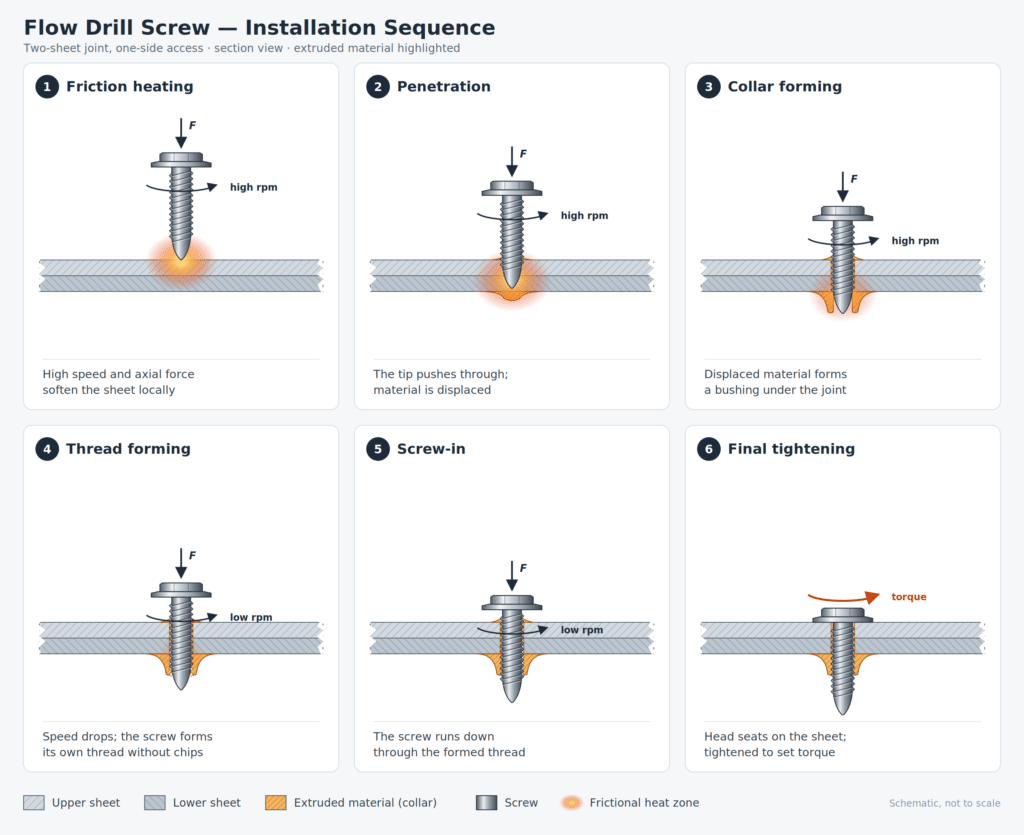
Flow drill screws join sheet metal from one side only, with no pre-drilled hole in the bottom sheet, no nut, and no chips. The screw spins at high speed under axial force, friction softens the metal, the point pushes through, and the displaced material flows into a collar that the screw then threads itself into. That sequence matters most in aluminum car bodies and mixed aluminum-steel structures, where spot welding cannot join the two metals and self-pierce rivets need tool access from both sides. This guide covers the six-stage installation process, where friction-drilling screws beat the alternatives, clearance-hole and stack-up rules, materials and coatings, joint performance, manufacturing, and how to specify and source custom parts.
TL;DR — Key Takeaways
- These screws need access from one side only and usually no pre-hole in the bottom sheet. That suits closed profiles, castings, and extrusions.
- Friction heating extrudes a collar of displaced metal, so thread engagement reaches several times the sheet thickness. That fixes the thin-sheet thread problem.
- They join aluminum to steel, a pairing resistance spot welding cannot make.
- High-strength or thick top sheets need a clearance hole. Without one, the top sheet lifts and a gap opens in the joint.
- A case-hardened screw should be coated with zinc flake rather than electroplated zinc, to avoid hydrogen embrittlement and control galvanic attack on aluminum.

What Are Flow Drill Screws?
They are self-piercing, thread-forming fasteners for sheet assemblies. They make their own hole, form their own mating thread, and clamp the joint in one automated operation. The best-known branded versions are sold under trade names such as EJOT FDS® and Semblex OptiFlow®. The generic engineering principle, friction drilling followed by thread forming, is what this guide covers.
Every feature along the screw has a job:
| Screw Zone | Function | Engineering Note |
|---|---|---|
| Point | Generates friction heat and pierces the sheet | Geometry and hardness carry the whole process |
| Forming zone | Extrudes the softened metal into a collar | Sets the height of the thread-engagement collar |
| Thread-forming section | Rolls a thread into the collar, no chips | Often a lobular (trilobular) profile to cut forming torque |
| Load thread | Carries the clamp load in service | Standard metric pitch, commonly M4–M6 |
| Flange head with underhead groove | Clamps the stack and captures extruded material | The groove keeps displaced metal from lifting the head |
| Drive | Transmits torque at high speed | Hexalobular (Torx-type) drive resists cam-out |
The underhead groove is easy to overlook and matters a lot. Friction drilling pushes some material up as well as down. A flat underside would sit on that ring of displaced metal and never clamp flat, while a groove gives it somewhere to go.
KeyFix produces custom thread-forming and special-point fasteners across its CNC parts portfolio and wider product portfolio, made to customer drawings and installation specifications.
How Does the Six-Stage Installation Work?
Installation runs as one continuous cycle on an automated spindle, typically a few seconds per joint. Each stage is controlled by a different parameter.
| Stage | What Happens | Controlling Parameter |
|---|---|---|
| 1. Heating | Spinning point rubs the sheet; friction heats a small zone | High speed (several thousand rpm) plus axial force |
| 2. Penetration | Softened metal yields; the point pushes through | Axial force, point geometry |
| 3. Collar forming | Displaced metal flows down into a tubular collar | Forming-zone geometry, speed |
| 4. Thread forming | Thread section rolls a thread into the collar | Speed drops; torque rises |
| 5. Screw-in | Screw threads through to the head | Low speed, controlled feed |
| 6. Tightening | Head seats; joint clamped to torque or angle | Final tightening torque |
The collar is the reason the technology exists. A thread tapped straight into 1.5 mm aluminum engages only a couple of thread pitches and strips easily. The extruded collar gives flow drill screws several sheet-thicknesses of thread engagement, formed from the sheet itself, with no weld nut, clinch nut, or rivet nut to add, stock, or feed.
💡 Engineer’s Note: Treat the installation curve as your quality record. Modern flow-drill spindles log torque and depth against time for every joint, and each stage has a recognisable signature. A penetration that took too long, a thread-forming torque outside its window, or a final depth short of target flags a bad joint at the station, before it becomes a warranty claim. Specify curve monitoring and data retention in the process requirements, not just a final torque value.
Why Are Flow Drill Screws Used in Aluminum Car Bodies?
Mixed-material body structures ran into a problem conventional joining could not solve. Here is how the options compare:
| Joining Method | Access Needed | Pre-Hole | Aluminum to Steel | Removable | Chips / Spatter |
|---|---|---|---|---|---|
| Resistance spot welding | Two sides | No | No — metallurgically incompatible | No | Spatter |
| Self-pierce rivet (SPR) | Two sides (die underneath) | No | Yes | No (drill out) | None |
| Clinching | Two sides | No | Limited | No | None |
| Blind rivet | One side | Yes, through all sheets | Yes | Drill out | Drilling chips |
| Flow-drill screwing | One side | Usually not in bottom sheet | Yes | Yes — unscrew | None |
The two columns that decide most applications are access and removability. Closed extrusions, hollow castings, and box sections give no room for an SPR die underneath, which leaves one-sided methods. Of those, the blind rivet needs a pre-drilled hole through the whole stack, which adds an operation and a tolerance-stacking problem. Flow drill screws avoid both, and they can be removed for service, which permanent joints cannot.
The trade-off is cycle cost: the screw is more expensive than a rivet, and the installation equipment is specialised. The method earns its place where one-sided access, mixed materials, or serviceability are real requirements, not as a general replacement for spot welds.
When Does the Top Sheet Need a Clearance Hole?
Whether the top sheet needs a clearance hole is the most important design decision for a flow-drill joint. The screw can pierce the top sheet, but only up to a limit set by that sheet’s strength and thickness.
| Top Sheet Condition | Clearance Hole? | Reason |
|---|---|---|
| Thin aluminum, moderate total stack | Often not required | Friction drilling handles both sheets |
| Thick aluminum top sheet | Usually required | Heat and force needed become excessive |
| High-strength or press-hardened steel | Required | The point cannot efficiently pierce it |
| Stack with adhesive between sheets | Evaluate case by case | Adhesive affects heat and the gap between sheets |
| Bottom sheet or casting | No pre-hole — the key benefit | Collar forms in the receiving part |
Where a clearance hole is used, it is typically punched or drilled in the top part during its own forming operation. Then only the receiving sheet or casting is friction-drilled. Positional tolerance on that clearance hole then enters the stack-up, so allow enough diameter for the screw to find its location without binding.
⚠️ Common Pitfall: Piercing both sheets without a clearance hole and without a hold-down (downholder) on the installation tool. Material displaced upward from the bottom sheet can push the top sheet away, leaving a gap between the sheets that the screw then clamps across instead of closing. The joint passes a torque check but carries load poorly and leaks if sealed. For stiff or thick top sheets, specify a clearance hole. In all cases, specify a downholder that clamps the stack during stages 1 to 3.
What Stack-Ups and Design Rules Apply?
Design rules for flow-drill joints come from the tool’s footprint and the heat-affected zone around each screw.
| Design Parameter | Guideline | Why |
|---|---|---|
| Access | Tool and downholder clearance on one side | The spindle nose needs working space |
| Edge distance | Several screw diameters from a free edge | Collar formation deforms nearby material |
| Joint pitch | Enough spacing that adjacent collars do not interact | Heat and displaced material overlap |
| Flange width | Sized for edge distance plus tool nose | Narrow flanges cannot host the joint |
| Receiving-sheet thickness | Within the screw’s validated range | Too thin gives a short collar; too thick overloads the process |
| Adhesive / sealant | Compatible with friction heat | Hybrid joining is common in body structures |
| Coating on the sheets | Accounted for in validation | Zinc coatings change friction behaviour |
Exact values depend on screw size, sheet grades, and the installation system, so they are set in a joint-validation programme with coupon tests rather than read off a generic chart. The design point that transfers across projects is to reserve flange width early. Flow-drill joints need more flange than a spot weld, and adding width after the body structure is frozen is expensive.
📋 Spec Tip: Define each joint on the drawing as a stack-up callout: top sheet grade and thickness, clearance hole yes/no and its diameter, receiving-part grade and thickness, adhesive yes/no, and the target installation depth. A screw part number alone is not enough, because the same screw performs differently in every stack.
Which Materials, Heat Treatment, and Coatings Apply?
The point of a flow drill screw has to pierce metal, survive friction heat, and form a thread. The core has to carry clamp load without cracking. Those requirements pull in different directions, and case hardening resolves them.
| Requirement | Solution | Why |
|---|---|---|
| Hard point and thread surface | Case hardening | Wear-resistant surface for piercing and forming |
| Tough core | Low-carbon case-hardening steel | Resists brittle fracture under clamp load |
| Survives friction heat | Correct case depth and tempering | Point must not soften during stage 1 |
| No hydrogen embrittlement | Zinc-flake coating, not electroplating | Hardened steel is highly sensitive to hydrogen |
| Galvanic compatibility with aluminum | Zinc-flake or zinc-nickel barrier | Bare steel on aluminum drives attack on the aluminum |
The coating choice follows from the heat treatment. A case-hardened surface is among the most hydrogen-sensitive conditions steel can be in, and conventional acid-based electroplating introduces hydrogen that can cause delayed fracture days after installation. Zinc-flake coatings are applied without electrolysis, so no hydrogen enters the steel. They also provide the corrosion barrier needed between a steel screw and an aluminum sheet.
⚠️ Common Pitfall: Accepting electroplated zinc on hardened friction-drilling screws to save coating cost. A hydrogen-relief bake reduces the risk but does not remove it on a highly hardened surface, and a screw that fractures under clamp load in a body structure is a safety problem. Specify zinc flake with a documented salt-spray performance, typically validated to 720–1,000+ hours per ASTM B117, or a verified low-hydrogen alternative.
KeyFix supplies zinc-flake (DACROMET-type) and zinc-nickel coatings specified to the neutral salt spray hours the drawing requires. Incoming wire chemistry is confirmed by SPECTRO optical emission spectrometry through its raw material control process.
What Joint Performance Should You Expect?
Joint strength comes from three sources: the screw’s own tensile and shear capacity, the thread engagement in the extruded collar, and the clamp load across the stack.
| Property | What Governs It | How It Is Verified |
|---|---|---|
| Shear strength | Screw diameter, sheet grades, clamp | Lap-shear coupon testing |
| Cross-tension (pull-out) | Collar height and thread engagement | Cross-tension coupon testing |
| Clamp load retention | Tightening torque, sheet relaxation | Preload measurement over time |
| Fatigue | Joint stiffness, clamp retention | Cyclic coupon testing |
| Corrosion durability | Coating, galvanic isolation, sealing | Cyclic corrosion testing |
| Strip-to-drive margin | Gap between forming torque and strip torque | Installation torque analysis |
The strip-to-drive margin needs attention. The thread is formed in softened, then cooled, aluminum, so there is a finite torque window between fully seating the screw and stripping the formed thread. A wide margin makes the process tolerant of sheet and coating variation. A narrow one causes stripped joints whenever material properties drift. Screw geometry, thread form, and installation parameters are tuned together to open that window.
Serviceability works in the method’s favour. A flow-drilled joint can be unscrewed, and repair strategies typically use a replacement screw of the next size up in the existing formed hole, restoring the joint without drilling out a rivet.
How Are Custom Flow Drill Screws Manufactured?
These are cold-formed fasteners with an unusually demanding point, so the manufacturing chain matches a precision screw plus extra control on geometry and hardness.
| Step | What Happens | KeyFix Capability |
|---|---|---|
| Wire verification | Grade confirmed by OES | SPECTRO (Germany), 100 % of heats |
| Cold heading | Flange head, underhead groove, drive recess | 25 multi-station cold headers |
| Point forming | Friction-drilling point shaped | Dedicated forming tooling |
| Thread rolling | Lobular forming thread and load thread | 22 thread-rolling machines |
| Case hardening | Hard surface, tough core | Controlled-atmosphere heat treatment |
| Coating | Zinc flake or zinc-nickel | To specification; salt spray per ASTM B117 |
| Verification | Point geometry, thread, hardness, coating | 2D video measuring + Mitutoyo gauges, 100 % optical sorting |
Point geometry is the most critical dimension on the part. Small variations in point angle or form change the heating and penetration stages directly, so the point is measured on production samples, not assumed from the tooling. Cold forming the head and recess gives continuous grain flow and a drive that holds up at installation speed. Process detail is on the cold forging and technology pages, dimensional conformance is documented under the inspection standards programme, and prototype or low-volume variants can be produced on the CNC production line for joint trials before tooling is committed.
Need a quote on custom flow drill screws? Send your drawing, stack-up definition, and installation system details to KeyFix. You’ll get a DFM review and quotation within 48 hours. Get a quote or email sales@keyfixpro.com.
Where Are Friction-Drilling Screws Used Beyond Car Bodies?
The same one-sided, chip-free joint is useful wherever thin-walled aluminum structures have to be joined without access from behind.
| Application | Why the Method Fits | Typical Joint |
|---|---|---|
| Car body-in-white | Mixed aluminum-steel, closed sections | Sheet to extrusion or casting |
| EV battery trays | Hollow aluminum extrusions, no rear access, sealing needed | Cover and bracket to extrusion |
| Seat and cockpit structures | Tubular and formed sections | Bracket to tube |
| Truck cabs and trailers | Aluminum panels on frames | Panel to profile |
| Rail vehicle interiors | Extruded aluminum systems | Fittings to profile |
| Enclosures and racks | Profile-based frames | Bracket to profile |
Battery trays show the method’s strengths most clearly. The tray is typically built from hollow aluminum extrusions that cannot be reached from inside. It must stay sealed against water and dust, and it may need to be opened for service. A friction-drilled joint makes no chips that could lodge inside a battery enclosure, forms its thread in the profile wall with no insert, and can be unscrewed. A rivet cannot meet the last requirement, and a welded joint cannot meet any of them.
The limit is volume economics. Where two-sided access exists and the joint never needs to come apart, self-pierce riveting is usually cheaper per joint. The screw earns its premium in closed sections, serviceable assemblies, and mixed-material stacks.
What Should the Drawing and RFQ Specify?
| Call-Out | What to Specify | Why It Matters |
|---|---|---|
| Screw geometry | Point form, thread form, head and groove | Controls every installation stage |
| Drive | Hexalobular size | Must match the installation spindle |
| Material + heat treatment | Case-hardening steel, surface and core hardness | Piercing ability vs toughness |
| Coating | Zinc flake, thickness, salt-spray hours | Embrittlement and galvanic control |
| Friction coefficient | Target range for the coating | Governs tightening behaviour |
| Stack-up definition | Sheets, grades, thicknesses, clearance hole | The screw only works in a validated stack |
| Installation system | Spindle make/model, parameters | Screw and process are validated together |
| Quality records | Installation curves, coupon test data | Traceability for body structures |
How Do You Qualify a Flow Drill Screw Supplier?
| Audit Point | Minimum Requirement | KeyFix Status |
|---|---|---|
| Quality system | IATF 16949 for automotive | IATF 16949 + ISO 9001 + ISO 14001 |
| Cold forming | Multi-station heading of flange-head screws | 25 cold headers |
| Thread rolling | Forming-thread capability | 22 thread-rolling machines |
| Heat treatment control | Case depth and hardness records per lot | Documented |
| Coating | Zinc flake with salt-spray records | In-house, 1,000+ hr validated |
| Material verification | OES per wire lot | SPECTRO OES, 100 % of heats |
| Dimensional control | Point geometry measured, not assumed | 2D video measuring + Mitutoyo gauges |
| Outgoing quality | Documented defect rate | <25 PPM at AQL 0.4 |
Thread and tolerance references follow ISO standards, under the quality system documented in KeyFix’s company background. Related automotive fastener programmes are described in the automotive CNC screw guide, with delivered work in the project case studies and machinery hardware programmes.
What Are the Logistics and Shipping Terms?
KEYFIX manufactures in its own plant in Guangdong Province, near South China’s export ports.
| Term | Detail |
|---|---|
| Manufacturing location | Guangdong Province |
| Standard shipping term | FCA at our Guangdong plant |
| Sea freight term | FOB Shenzhen Yantian Port |
| Prototype lead time | 7–14 business days (air-expressed) |
| Production lead time | 4–6 weeks after PPAP approval |
Frequently Asked Questions
What is a flow drill screw?
It is a self-piercing, thread-forming screw that joins sheet metal from one side. Friction heat softens the sheet, the point pierces it, the displaced metal forms a collar, and the screw rolls its own thread into that collar before tightening. It needs no nut and produces no chips.
Do flow drill screws need a pre-drilled hole?
Usually not in the bottom or receiving sheet, and that is the main benefit. A clearance hole in the top sheet is typically required when the top sheet is thick or made of high-strength steel, and it also stops the top sheet lifting away from the bottom sheet.
Can this method join aluminum to steel?
Yes. That is one of the main reasons they are used in mixed-material car bodies. Resistance spot welding cannot join aluminum to steel, while a flow-drilled joint connects the two mechanically. A zinc-flake coating controls galvanic corrosion between the steel screw and the aluminum sheet.
Can a flow-drilled joint be repaired?
Yes. The screw can be unscrewed. The usual repair is a replacement screw one size larger in the existing formed hole, which restores the joint without drilling anything out.
Why is zinc-flake coating used?
They are case hardened, which makes them highly sensitive to hydrogen embrittlement. Zinc flake is applied without electroplating, so it introduces no hydrogen, and it also provides the corrosion barrier needed against aluminum.
What is the minimum order quantity?
Production of cold-headed friction-drilling screws typically starts at 10,000–50,000 pieces per specification. Prototype quantities for joint validation can be arranged separately. Contact sales@keyfixpro.com for quotations.
What certifications and shipping terms apply?
KeyFix holds IATF 16949, ISO 9001, and ISO 14001. Standard shipping is FCA at our Guangdong plant, with sea freight as FOB Shenzhen Yantian Port from our Guangdong production base.
If your next body-in-white, battery-tray, or mixed-material structure needs flow drill screws built to your stack-up and installation system, send your drawing to KeyFix for a free DFM review and a quotation within 48 hours. Explore the product portfolio or contact KeyFix at sales@keyfixpro.com.
Author: KeyFix Engineering Team Published: September 28, 2026 Last Updated: September 28, 2026