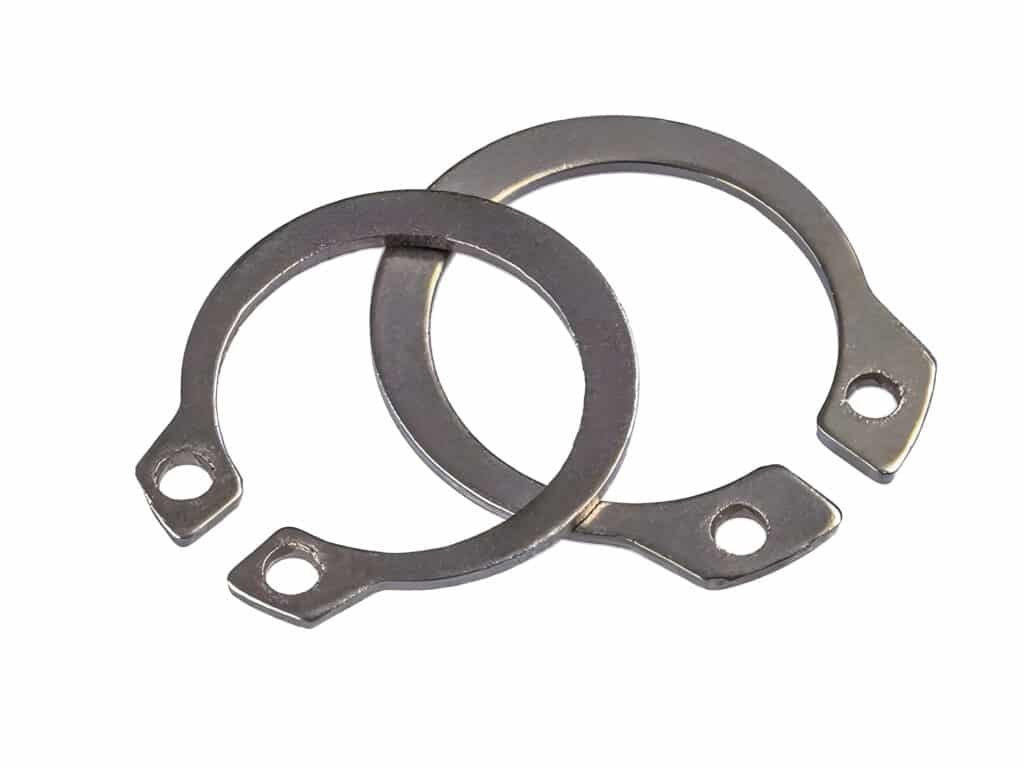
A stainless steel circlip is a spring-tempered ring that snaps into a machined groove and holds a shaft or bore assembly together axially — no threads, no tools left behind, no added length. External circlips clamp onto shafts; internal circlips push outward inside bores. The two look like mirror images and behave like opposites, right down to the pliers that install them. And beneath the simple appearance sits a metallurgical compromise most catalogues never mention: the corrosion resistance you want from stainless and the spring hardness a circlip needs pull in different directions. This guide covers ring types, the internal-versus-external logic, the stainless grade decision, groove design, thrust capacity, and supplier qualification.
TL;DR — Key Takeaways
- DIN 471 covers external rings for shafts, DIN 472 internal rings for bores, and DIN 6799 E-clips for quick radial assembly.
- Standard circlips are carbon spring steel hardened to roughly HRC 44–50. Plain 304 cannot reach spring temper — real stainless circlips use 301 cold-worked, 1.4122 martensitic, or 17-7PH.
- Thrust capacity is limited by whichever yields first: the ring in shear, or the groove wall in bearing — and in soft shafts the groove almost always loses.
- Groove corners must be sharp, not radiused; a radiused corner lets the ring dish outward and pop free under load.
- A qualified supplier verifies strip chemistry by OES, controls hardness on every lot, and documents outgoing quality below 25 PPM at AQL 0.4.
What Is a Stainless Steel Circlip?
A circlip — also called a retaining ring or snap ring — is an incomplete ring of spring material that deforms elastically during installation and springs back into a groove. Once seated, it presents a shoulder that resists axial movement. Because the ring lives entirely within the groove diameter, it adds no length to an assembly, which is why circlips dominate gearboxes, bearing housings, hydraulic cylinders, and pivot joints where space is measured in tenths of a millimetre.
| Type | Standard | Where It Sits | Typical Use |
|---|---|---|---|
| External retaining ring | DIN 471 | Groove on a shaft | Bearings, gears, pulleys on shafts |
| Internal retaining ring | DIN 472 | Groove inside a bore | Bearing seats, cylinder housings |
| E-clip | DIN 6799 | Shaft groove, radial fit | Fast assembly, light axial loads |
| Spiral wound ring | Custom / ANSI | Shaft or bore | 360° contact, no lug ears |
| Circlip with lug holes | DIN 471/472 | Shaft or bore | Plier-installed, serviceable |
| Constant-section ring | Custom | Shaft or bore | Uniform section, tight spaces |
The lug-eared DIN types are the workhorses because pliers make installation and removal repeatable. Spiral and constant-section rings trade tool convenience for a continuous bearing shoulder and a cleaner look. KeyFix produces the full family through its stamping capability, with representative work across the product portfolio.
How Do Internal and External Circlips Differ?
They are not variants of one part — they work in opposite directions, and confusing them is the most common ordering error in the category.
| Property | External (DIN 471) | Internal (DIN 472) |
|---|---|---|
| Mounts on | Shaft outside diameter | Bore inside diameter |
| Free-state size | Slightly smaller than groove | Slightly larger than groove |
| Installation motion | Expanded to slip over shaft | Compressed to enter bore |
| Retaining force direction | Squeezes inward | Pushes outward |
| Plier type | External (opens the ring) | Internal (closes the ring) |
| Lug ears point | Outward from the ring | Inward toward centre |
💡 Engineer’s Note: Order the pliers with the rings, and mark the tool. External pliers open as you squeeze; internal pliers close as you squeeze. Using the wrong pair on a stainless ring overstrains it past its elastic limit, and a circlip that has been over-opened once will never develop full seating force again — even if it looks fine.
Why Is Stainless Circlip Material a Compromise?
Here is the fact behind the keyword. A circlip must be a spring: it has to deflect substantially during installation and return to its original diameter with force. Carbon spring steel (C67S / 1.1231-class) hardened and tempered to roughly HRC 44–50 does this superbly, which is why standard circlips are made from it and simply plated for corrosion.
Plain austenitic 304 cannot be hardened by heat treatment at all. A ring stamped from ordinary 304 sheet is soft, takes a permanent set the first time it is opened, and will not hold thrust. So a genuine stainless steel circlip is made from one of three quite different materials, each buying corrosion resistance at a different price.
| Material | How It Gets Its Spring | Approx. Hardness | Corrosion | Relative Thrust Capacity |
|---|---|---|---|---|
| Carbon spring steel (C67S) | Quench + temper | HRC 44–50 | Poor — needs phosphate or zinc | Baseline (highest) |
| 301 / 1.4310 | Cold rolling to spring temper | HRC ~35–45 | Good (austenitic) | Moderate |
| 1.4122 / 420-type | Hardenable martensitic | HRC ~40–47 | Moderate (needs passivation) | High |
| 17-7PH / 1.4568 | Precipitation hardening (CH900) | HRC ~44–48 | Very good | Near carbon-steel |
| 304 / 316 (annealed) | Cannot reach spring temper | Soft | Excellent | Unsuitable for circlips |
The selection logic falls out cleanly. For mild humidity and light loads, 301 spring temper is the economical stainless answer. For higher thrust in a corrosive setting, 1.4122 martensitic gives back most of the lost hardness, though it needs passivation and is less corrosion-resistant than the austenitic grades. Where both maximum load and real corrosion resistance are required — food processing, marine, medical — 17-7PH is the grade that refuses to compromise, at a matching price.
⚠️ Common Pitfall: Specifying “304 stainless circlip” is the single most damaging error in this product family. Suppliers will either quietly substitute 301 spring temper (usually fine, but undocumented) or ship truly annealed 304 rings that take a permanent set on first installation and let the assembly walk apart. Name the grade and condition explicitly — “1.4310 spring temper” or “17-7PH CH900” — never just “stainless”.
Strip chemistry is confirmed on every incoming coil by SPECTRO optical emission spectrometry through KeyFix’s raw material control process, with hardness verified per lot.
What Governs Circlip Thrust Capacity?
Two components can fail, and the weaker one sets the joint rating.
| Failure Mode | What Happens | Governed By |
|---|---|---|
| Ring shear | Ring section shears at the groove edge | Ring thickness, material hardness |
| Groove deformation | Groove wall yields and the ring plows outward | Shaft/housing material strength, groove depth |
| Ring dishing | Ring cones under load and climbs out of the groove | Groove corner sharpness, ring stiffness |
| Ring rotation / creep | Ring walks in the groove under vibration | Groove fit, ring free-state accuracy |
In practice, groove deformation dominates. A hardened steel ring sitting in an aluminium or mild-steel groove will not shear; the groove wall crushes and the ring migrates. This is why circlip load ratings always come as a pair — a ring capacity and a groove capacity — and why the honest design number is the lower of the two.
Ring dishing is the failure that surprises people. Under axial thrust, an open ring tends to cone away from the load, and once it cones far enough the outer edge climbs the groove wall and releases. Sharp groove corners and adequate groove depth are what stop it.
How Do You Design the Circlip Groove?
The groove is the part you machine, and it decides whether the ring performs.
| Groove Feature | Specification | Why |
|---|---|---|
| Diameter | Per DIN 471 / 472 table for the ring size | Sets ring seating and free-state fit |
| Width | Ring thickness + small clearance per standard | Too wide lets the ring tilt and hammer |
| Depth | Per standard for the size | Shallow grooves invite dishing and pull-out |
| Corner at load-bearing wall | Sharp — no radius, no chamfer | A radius is a ramp the ring climbs |
| Surface finish | Ra ≤ 1.6 μm in the groove | Reduces ring creep and fretting |
| Concentricity | Groove concentric to shaft/bore axis | Uneven seating loads one side |
📋 Spec Tip: Write “groove corners sharp, no break” on the print and confirm it at first article. Deburring operations routinely blend a small radius into every edge on a part — including the one groove corner that must stay sharp — and the resulting rings pop out under load with no other cause visible.
Groove and ring dimensions are verified together on KeyFix production by 2D video measuring and calibrated Mitutoyo gauges, documented under the inspection standards program. Shafts and housings carrying those grooves are machined on the 32-machine CNC line to ±0.005 mm.
Which Standards and Sizes Apply?
| Standard | Scope | Typical Range |
|---|---|---|
| DIN 471 | External retaining rings for shafts | Ø3–300 mm |
| DIN 472 | Internal retaining rings for bores | Ø8–300 mm |
| DIN 6799 | E-clips (radial assembly) | Ø1.2–24 mm shaft |
| DIN 983 | External rings with lug bevel | Ø4–100 mm |
| ISO 464 | Bearing ring grooves and snap rings | Per bearing series |
Sizes below Ø10 mm and above Ø100 mm are where suppliers separate: small rings demand tight blanking control on thin strip, and large rings need press capacity plus flatness control across a wide diameter. Delivered programs across this span appear in KeyFix’s project case studies and machinery hardware programs.
How Are Stainless Steel Circlips Manufactured?
| Step | What Happens | KeyFix Capability |
|---|---|---|
| Strip verification | Grade and temper confirmed by OES | SPECTRO (Germany), 100% of heats |
| Blanking | Ring profile and lug ears stamped | 50–300 T presses, ±0.05 mm |
| Deburr / edge finish | Burr controlled; load edge kept square | Burr side tracked |
| Heat treatment | Hardening for martensitic and PH grades | Controlled-atmosphere furnaces |
| Passivation | Chromium oxide layer restored | Per standard practice |
| Setting / calibration | Free-state diameter trued to spec | Controlled tooling |
| Verification | Free diameter, thickness, hardness, flatness | Mitutoyo gauges + 2D video measuring, 100% optical sorting |
Stamping is the correct process because the ring profile, lug ears, and holes form in one stroke with repeatable geometry — and free-state diameter, the dimension that decides seating force, is controlled by die accuracy rather than operator skill. For non-standard sections, oversized rings, or machined variants, work moves to CNC machining or draws on the cold forging line for related components; equipment detail sits on the technology overview, with the broader precision range visible in the CNC parts portfolio.
Need a quote on stainless circlips or custom retaining rings? Send your drawing or groove dimensions to KeyFix — DFM review and quotation within 48 hours. Get a quote or email sales@keyfixpro.com.
What Should the Drawing Specify?
| Call-Out | What to Specify | Why It Matters |
|---|---|---|
| Standard + type | DIN 471 external / DIN 472 internal | Prevents the mirror-image error |
| Nominal size | Shaft or bore diameter | Anchors the whole size table |
| Material and condition | e.g., 1.4310 spring temper, 17-7PH CH900 | The core of stainless circlip quality |
| Hardness | HRC range | Proves spring temper was achieved |
| Thickness | Section thickness with tolerance | Drives thrust capacity |
| Free-state diameter | Per standard, with tolerance | Sets seating force |
| Finish | Passivated, plain, or plated (carbon) | Corrosion behavior |
| Groove reference | State mating groove dims on assembly print | Ring and groove must be designed as a pair |
How Do You Qualify a Circlip Manufacturer?
| Audit Point | Minimum Requirement | KeyFix Status |
|---|---|---|
| Quality system | ISO 9001 minimum | IATF 16949 + ISO 9001 + ISO 14001 |
| Stamping capacity | Precision blanking, controlled burr | 50–300 T presses, ±0.05 mm |
| Material verification | OES per coil, temper confirmed | SPECTRO OES, 100% of heats |
| Hardness testing | Per lot, recorded | Documented per lot |
| Free-diameter control | Gauged, not sampled loosely | Mitutoyo + 2D video measuring |
| Heat treat / passivation | Controlled under IATF 16949 | Controlled, documented |
| Outgoing quality | Documented defect rate | <25 PPM at AQL 0.4 |
Stainless strip follows ASTM A666 and general tolerances follow ISO 2768, under the quality system documented in KeyFix’s company background.
What Are the Logistics and Shipping Terms?
KEYFIX manufactures in its own plant in Guangdong Province, near South China’s export ports.
| Term | Detail |
|---|---|
| Manufacturing location | Guangdong Province |
| Standard shipping term | FCA at our Guangdong plant |
| Sea freight term | FOB Shenzhen Yantian Port |
| Prototype lead time | 7–14 business days (air-expressed) |
| Production lead time | 4–6 weeks after sample approval |
Frequently Asked Questions
Can a circlip be made from 304 stainless steel?
Not usefully. 304 cannot be hardened to spring temper, so a 304 ring takes a permanent set on first installation and loses its seating force. Specify 301 spring temper, 1.4122 martensitic, or 17-7PH depending on how much load and corrosion resistance the application needs.
What is the difference between internal and external circlips?
External rings (DIN 471) fit grooves on shafts and are expanded to install; internal rings (DIN 472) fit grooves in bores and are compressed to install. They require different pliers and are not interchangeable in any way.
Why did my circlip pop out under load?
Three usual causes: a radiused groove corner the ring could climb, a groove machined too shallow, or a ring that was over-opened during a previous installation and lost its spring. Check the groove corner first — deburring operations often round it by accident.
Can circlips be reused?
Carbon and martensitic rings should be treated as single-use in load-bearing positions. Every installation cycle takes the ring near its elastic limit, and a ring that has been opened twice may not return to its free-state diameter.
What is the minimum order quantity?
Stamped circlips typically start at 5,000–10,000 pieces per size once tooling exists, with sample lots from 500 pieces; machined specials have no MOQ. Contact sales@keyfixpro.com for quotations.
What shipping terms apply for international orders?
Standard shipping is FCA at our Guangdong plant, with sea freight as FOB Shenzhen Yantian Port from our Guangdong production base.
If your next assembly needs stainless steel circlips — internal, external, E-clips, or a custom retaining ring matched to your groove — send your drawing to KeyFix for a free DFM review and a quotation within 48 hours. Explore the product portfolio or contact KeyFix at sales@keyfixpro.com.
Author: KeyFix Engineering Team Published: July 6, 2026 Last Updated: July 6, 2026