Custom brass parts cover an unusually wide range of hardware — turned components, screws, nuts, threaded inserts, bushings, fittings, and electrical terminals — unified by one copper-zinc alloy family that machines faster than almost any other metal, resists corrosion without plating, conducts electricity and heat, and stays non-magnetic. This guide is the hub for sourcing brass: which alloy to specify, how brass parts are manufactured, the product families KEYFIX produces, and how to write a drawing and qualify a supplier.
TL;DR — Key Takeaways
- Free-cutting brass C36000 is the machinability reference at 100 % and the default for most turned brass parts; other brasses trade machinability for ductility, strength, or corrosion resistance.
- Brass is chosen for conductivity, corrosion resistance, non-magnetic behaviour and appearance — not strength. Where high clamp load matters, steel wins.
- High-zinc brass can suffer dezincification and stress corrosion cracking; DZR and low-lead grades solve this for potable-water and EU-market parts.
- Brass is produced by CNC turning, cold heading, thread rolling and stamping — the right process depends on geometry and volume.
- KEYFIX machines and forms the full brass range under one IATF 16949 system, with SPECTRO OES alloy verification on every lot.

Why Choose Brass for Custom Parts?
Brass earns its place through a combination of properties no single competing metal matches at the same cost. It is not the strongest material, but for the large class of parts that must conduct, resist corrosion, look good, or simply be machined quickly in volume, brass is often the correct engineering choice rather than a compromise.
| Property | What it means in practice |
|---|---|
| Machinability | Free-cutting brass cuts faster and cleaner than steel, aluminium or stainless — lower cycle time, better finish straight off the tool |
| Corrosion resistance | Resists water, atmospheric and many chemical environments without plating; naval and DZR grades extend this to seawater and potable water |
| Electrical & thermal conductivity | 26–30 % IACS — enough for terminals, contacts and earthing hardware; higher-copper alloys conduct more |
| Non-magnetic | No magnetic signature — valued in electronics, instrumentation and sensor assemblies |
| Appearance | Takes a fine polish and plates well — the material of choice for visible and decorative hardware |
| Non-sparking | Safe for tools and fittings used in explosive atmospheres |
💡 Engineer’s Note: Specify brass when the part must conduct, resist corrosion, stay non-magnetic, or be produced economically in volume. Specify steel when the joint needs high clamp load or tensile strength — brass threads strip at far lower torque than steel. Many assemblies use both: a brass contact or fitting with a steel bolt carrying the load.
Which Brass Alloy Should You Specify?
“Brass” is a family, not a single material. The alloy — set mainly by the copper-to-zinc ratio and small additions of lead, tin or arsenic — decides machinability, strength, formability and corrosion behaviour. Naming it precisely on the drawing is the single most important call-out, because it drives cycle time, cost and finish. Alloy chemistry is verified on every incoming lot through KEYFIX’s raw material control using SPECTRO optical emission spectrometry.
| Alloy | Designation | Key traits | Typical brass parts |
|---|---|---|---|
| Free-cutting brass | C36000 (CuZn36Pb3) | Machinability 100 % (reference); ~3 % lead | Turned parts, screws, fittings, terminals |
| Cartridge brass | C26000 (CuZn30) | High ductility; excellent cold formability | Deep-drawn and formed contacts, caps |
| Naval brass | C46400 (CuZn40Sn) | Tin addition for seawater corrosion resistance | Marine hardware, valve stems |
| DZR brass | CW602N (CuZn36Pb2As) | Resists dezincification | Plumbing & potable-water fittings |
| Low-lead / lead-free brass | C69300, C27450, etc. | RoHS / drinking-water compliant | EU-market and potable-water parts |
⚠️ Common Pitfall: Specifying a high-zinc brass for a part exposed to water or ammonia without considering corrosion. High-zinc brass can suffer dezincification (zinc leaches out, leaving porous copper) and stress corrosion cracking near ammonia. For potable water or wet service, specify a DZR grade or a low-zinc alloy, and add a stress-relief anneal where residual machining stress is high.
How Are Brass Parts Manufactured?
Four processes cover almost all brass hardware, and the right one depends on geometry, tolerance and volume. KEYFIX runs all four in-house — see the forming side on the cold forged parts page, the machining side on the CNC production page, and the full capability on the technology overview.
| Process | Best for | Typical volume | Tolerance |
|---|---|---|---|
| CNC turning | Rotational parts, complex bores, prototypes to volume | 1 – 1,000,000+ | ±0.005 mm |
| Cold heading | Screws, studs, terminals at high volume | 10,000+ | ±0.05 mm (as-headed) |
| Thread rolling | Strong, smooth volume threads | Volume production | Class 6g / 6H |
| Stamping | Flat contacts, washers, terminals from strip | 50,000+ | ±0.10 mm |

Brass Product Families KEYFIX Makes
Brass hardware falls into a handful of product families. Each has its own design rules, alloy preferences and sourcing traps — follow the linked guide for the detail on any one.
| Product family | Typical alloy | In-depth guide |
|---|---|---|
| Brass turned parts & components | C36000 | Brass CNC turned parts guide |
| Brass socket cap & machine screws | C36000, C37700 | Brass hex socket cap screws |
| Brass screws for automotive | C36000 | Brass screws in automotive |
| Brass hex nuts | C36000, C37700 | Brass hex nuts guide |
| Brass knurled nuts (M4–M8) | C36000 | Brass knurled nuts guide |
| Brass threaded inserts for plastic | C36000 | Brass threaded inserts guide |
| Brass reducing bushings & fittings | C36000, DZR | Brass reducing bushings guide |
| Brass terminals & battery connectors | C36000, C26000 | Brass battery connectors guide |
What Surface Treatments Are Used on Brass?
Brass performs well bare, but plating and finishing extend its life, control contact resistance, or change appearance. The right finish depends on whether the surface conducts, seals, shows, or simply has to resist a harsher environment.
| Finish | Why use it |
|---|---|
| Nickel plating | Wear and corrosion resistance; harder surface; matte or bright |
| Tin plating | Solderable, stable low contact resistance for terminals |
| Bright chrome | Decorative, durable gloss for visible hardware |
| Polishing | Brings up the natural brass lustre for decorative parts |
| Passivation / lacquer | Slows tarnish on bare brass |
What Tolerances and Quality Can You Expect?
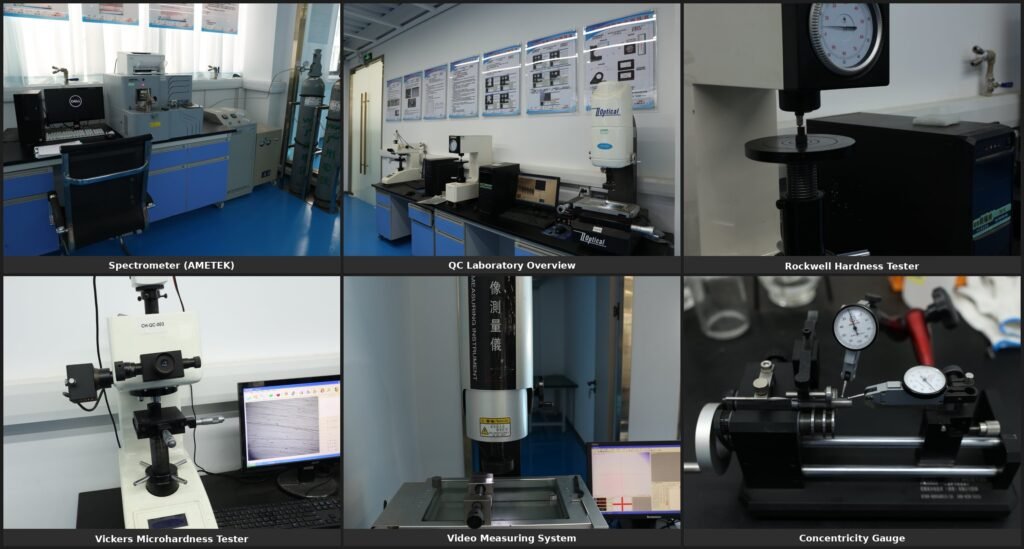
Brass turned parts hold ±0.005 mm on critical diameters and take a fine as-turned finish directly off the tool. Beyond dimensions, the quality that matters for brass is alloy verification and cleanliness. Every incoming lot is checked by SPECTRO OES, and parts are verified with 2D video measuring, 3D scanning and Mitutoyo gauges under the programme documented in KEYFIX’s inspection standards, all within an IATF 16949, ISO 9001 and ISO 14001 quality system.
What Should a Brass Part Drawing Specify?
| Call-out | What to specify | Why it matters |
|---|---|---|
| Alloy, precisely | C36000, C26000, DZR, etc. | Drives machinability, cost, corrosion behaviour |
| Lead status | Leaded or lead-free / RoHS | Market compliance and process window |
| Diameters + fit classes | Per feature, individually | Prevents blanket over-tolerancing |
| Thread + method | Size, class, rolled or cut | Strength and thread feel |
| Finish | Nickel, tin, polished or bare | Conductivity, corrosion, appearance |
| Corrosion requirement | DZR / stress-relief where wet or near ammonia | Prevents dezincification and cracking |
How Do You Qualify a Brass Parts Manufacturer?
| Audit point | Minimum requirement | KEYFIX status |
|---|---|---|
| Quality system | ISO 9001 minimum | IATF 16949 + ISO 9001 + ISO 14001 |
| Alloy verification | OES per bar lot | SPECTRO OES, 100 % of heats |
| Process range | Turning + forming + threading | 32 CNC, 25 cold headers, 22 thread rollers |
| Dimensional control | Documented per-feature measurement | 2D video measuring + 3D scanning |
| Finishing | Plating to spec with thickness report | Nickel, tin and decorative lines |
| Outgoing quality | Stated defect rate | <25 PPM at AQL 0.4 |
Brass alloy bar follows ASTM B16 and B124, with fits per ISO 286, and alloy data cross-referenced to the Copper Development Association UNS designations. The quality system behind this work is documented in KEYFIX’s company background.
Need custom brass parts? Send your drawing — turned part, screw, nut, insert, fitting or terminal — to KEYFIX for a free DFM review and a quotation within 48 hours. Get a quote or email sales@keyfixpro.com.
Frequently Asked Questions
What is the most common brass alloy for machined parts?
Free-cutting brass C36000 (CuZn36Pb3) is the default. Its ~3 % lead content makes it the machinability reference at 100 %, giving fast cycle times and a clean finish straight off the tool. Other brasses are specified when ductility, strength or specific corrosion resistance is needed.
Is brass stronger than steel?
No. Brass has lower tensile and thread strength than steel, so brass threads strip at lower torque. Brass is chosen for conductivity, corrosion resistance, non-magnetic behaviour and machinability, not clamp load. High-load joints use steel, often alongside brass contacts or fittings.
Can brass parts be lead-free and RoHS compliant?
Yes. Low-lead and lead-free brass grades (such as C69300 and C27450) meet RoHS and drinking-water regulations. They machine with slightly longer cycle times than leaded C36000, so treat a switch to lead-free as a process change and re-quote it.
Does brass corrode?
Brass resists most atmospheric and water corrosion, but high-zinc brass can dezincify in water and crack under stress near ammonia. For potable water or wet service, specify a dezincification-resistant (DZR) grade; for high residual stress, add a stress-relief anneal.
Can brass be plated?
Yes. Brass plates readily with nickel (wear and corrosion), tin (solderability and stable contact resistance), or bright chrome (decorative). It also polishes to a high lustre and can be passivated or lacquered to slow tarnish on bare surfaces.
Is brass magnetic?
No. Brass is non-magnetic, which makes it the material of choice for electronics, sensors, instrumentation and any assembly where a magnetic signature must be avoided.
What is the minimum order quantity and lead time for custom brass parts?
CNC-turned brass parts have no MOQ, from single prototypes to volume. Cold-headed brass screws and terminals typically start around 10,000 pieces per variant. Samples usually take 7–14 business days and production 4–6 weeks after approval. Contact sales@keyfixpro.com for a quotation.
Whatever brass part your next programme needs — a turned component, a screw, a nut, a threaded insert, a fitting or an electrical terminal — send your drawing or sample to KEYFIX for a free DFM review and a quotation within 48 hours. Contact KEYFIX at sales@keyfixpro.com.
Author: KEYFIX Engineering Team Published: October 21, 2026 Last Updated: October 21, 2026